 Back
Periodic Properties of the Elements: Structure, Trends, and Applications
Study Guide - Smart Notes
 Tailored notes based on your materials, expanded with key definitions, examples, and context.
Periodic Properties of the Elements
Development of the Periodic Table
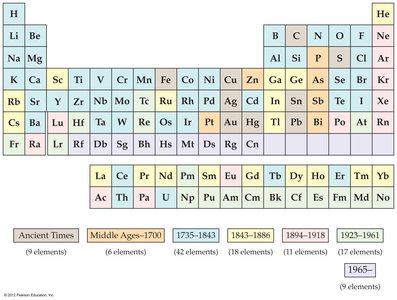
The periodic table is a fundamental tool in chemistry, organizing elements according to their atomic number and properties. Early discoveries, such as gold (Au), were made thousands of years ago, but most elements are found in nature as compounds rather than in their elemental form. Dmitri Mendeleev and Lothar Meyer independently proposed that elements should be grouped based on periodic similarities in their chemical and physical properties when arranged by increasing atomic weight.
Key Point: The periodic table arranges elements to highlight recurring trends in properties.
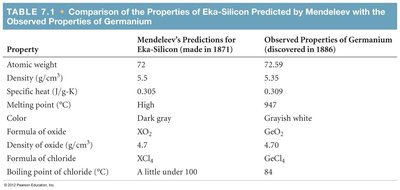
Key Point: Mendeleev predicted the existence and properties of undiscovered elements, such as germanium (eka-silicon).
Example: Mendeleev's predictions for germanium closely matched its observed properties after discovery.
Periodic Trends
Periodic trends are observable patterns in element properties as you move across periods (rows) or down groups (columns) in the periodic table. These include atomic and ionic sizes, ionization energy, and electron affinity.
Key Point: Trends are rationalized by electronic structure and effective nuclear charge.
Key Point: Properties such as atomic radius, ionization energy, and electron affinity change predictably across the table.
Effective Nuclear Charge (Zeff)
Definition and Calculation
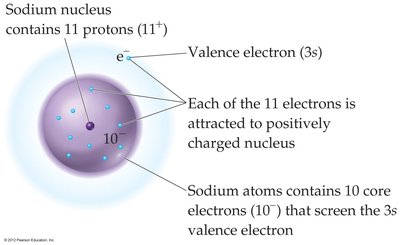
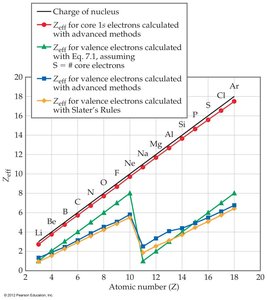
In multi-electron atoms, electrons are attracted to the nucleus but also repelled by other electrons. The effective nuclear charge (Zeff) is the net positive charge experienced by an electron, accounting for both attraction to the nucleus and repulsion from other electrons.
Key Point: Zeff is always less than the actual nuclear charge (Z) due to electron shielding.
Formula: where Z is the atomic number and S is the screening constant (number of inner electrons).
Key Point: Zeff increases from left to right across a period.
Atomic and Ionic Sizes
Atomic Radius
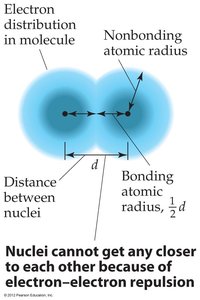
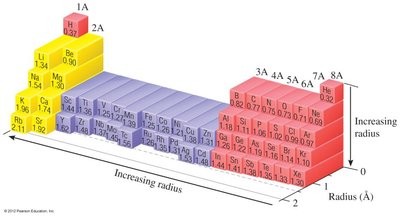
The size of an atom is defined by its atomic radius, which can be measured as the nonbonding (van der Waals) radius or the bonding atomic radius (half the distance between covalently bonded nuclei).
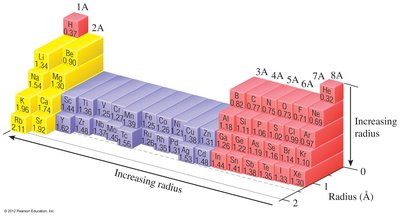
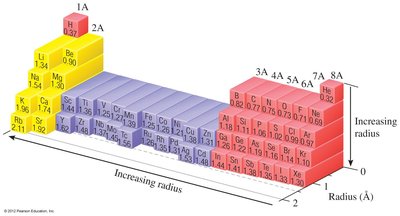
Key Point: Atomic radius decreases from left to right across a period due to increasing Zeff.
Key Point: Atomic radius increases from top to bottom within a group due to increasing principal quantum number (n).
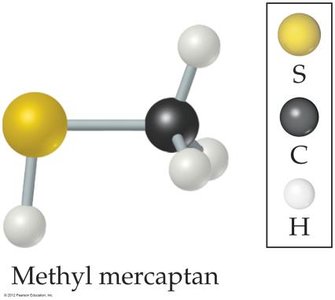
Example: Bond lengths in molecules can be estimated by adding the bonding atomic radii of the constituent atoms.
Periodic Trends in Atomic Size
Atomic size is influenced by both the effective nuclear charge and the principal quantum number. The trends are:
Across a period: Atomic radius decreases.
Down a group: Atomic radius increases.
Transition elements: Do not show a regular decrease across a period.
Ionic Radius
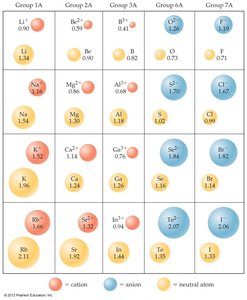
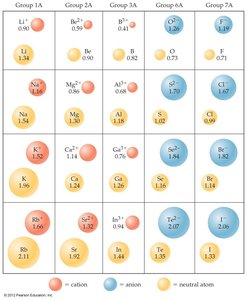
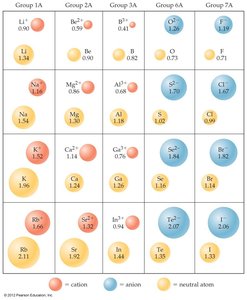
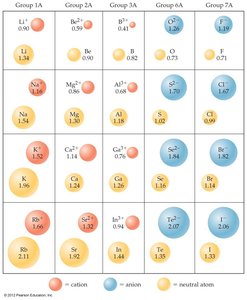
Ionic radii are determined from interatomic distances in ionic compounds. The size of an ion depends on its nuclear charge, number of electrons, and the orbitals occupied by valence electrons.
Key Point: Cations are smaller than their parent atoms due to loss of electrons and reduced electron repulsion.
Key Point: Anions are larger than their parent atoms due to added electrons and increased repulsion.
Key Point: Ionic size increases down a group due to increasing n.
Isoelectronic series: Ions with the same number of electrons; size decreases with increasing nuclear charge.
Ionization Energy
Definition and Trends
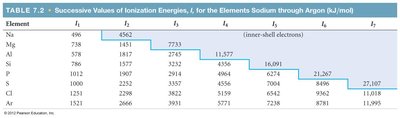
Ionization energy is the energy required to remove an electron from a gaseous atom or ion. The first ionization energy (I1) refers to the removal of the first electron, the second (I2) to the second electron, and so on.
Key Point: Ionization energy increases across a period and decreases down a group.
Key Point: Large jumps in ionization energy occur when removing inner (core) electrons.
Key Point: Discontinuities in trends occur between Groups IIA/IIIA and VA/VI A due to electron configuration and repulsion effects.
Electron Affinity
Definition and Trends
Electron affinity is the energy change when an electron is added to a gaseous atom. A more negative value indicates a greater tendency to accept an electron.
Key Point: Electron affinity generally becomes more exothermic across a period.
Key Point: Discontinuities occur between Groups IA/IIA and IVA/VA due to orbital filling and electron repulsion.
Properties of Metals, Nonmetals, and Metalloids
Metals
Metals are lustrous, malleable, ductile, and good conductors of heat and electricity. They tend to form cations and are oxidized in reactions. Metal oxides are typically basic and react with acids to form salts and water.
Key Point: Metals have low ionization energies and form ionic compounds with nonmetals.
Example: Scandium oxide reacts with nitric acid to form scandium nitrate and water.
Nonmetals
Nonmetals can exist as solids, liquids, or gases. They are dull, brittle, and poor conductors. Nonmetals tend to gain electrons in reactions, forming anions and molecular compounds. Nonmetal oxides are typically acidic.
Key Point: Substances containing only nonmetals are molecular compounds.
Example: Selenium dioxide reacts with water to form selenous acid.
Metalloids
Metalloids have properties intermediate between metals and nonmetals. For example, silicon is shiny but brittle and a semiconductor. Metalloids are used in electronics, and their conductivity can be controlled by adding impurities.
Group Trends
Alkali Metals (Group IA)
Alkali metals are soft, metallic solids with low densities and melting points. They are highly reactive, especially with water, and are found only in compounds in nature. Alkali metals form hydrides, sulfides, peroxides, and superoxides, and produce characteristic colors in flames.
Key Point: Alkali metals have low ionization energies and react vigorously with water.
Example: Sodium produces a yellow emission at 589 nm.
Alkaline Earth Metals (Group IIA)
Alkaline earth metals are harder and have higher densities and melting points than alkali metals. Their ionization energies are low but higher than those of alkali metals. Reactivity increases down the group.
Hydrogen
Hydrogen is a nonmetal with a unique electron configuration (1s1). It forms molecular compounds by sharing electrons and reacts exothermically with nonmetals.
Group 6A: The Oxygen Group
Oxygen, sulfur, and selenium are nonmetals; tellurium is a metalloid, and polonium is a metal. Oxygen is a strong oxidizer, and ozone (O3) absorbs UV light, protecting the atmosphere.
Group VIIA: Halogens
Halogens are prototypical nonmetals with large, negative electron affinities. They oxidize other elements easily and react directly with metals to form halides.
Group VIIIA: Noble Gases
Noble gases have very high ionization energies and positive electron affinities, making them chemically inert. They exist as monatomic gases.
Practice and Applications
Sample Calculations and Exercises
Estimating bond lengths: Add atomic radii of constituent atoms.
Arranging elements by atomic radius: Use periodic trends to predict relative sizes.
Arranging ions in isoelectronic series: Size decreases with increasing nuclear charge.
Writing electron configurations for ions: Remove or add electrons to/from the highest n orbitals.
Writing balanced equations: Use knowledge of element reactivity and compound formation.
Property | Mendeleev's Prediction (Eka-Silicon) | Observed Germanium |
|---|---|---|
Atomic weight | 72 | 72.59 |
Density (g/cm3) | 5.5 | 5.35 |
Specific heat (J/g·K) | 0.305 | 0.309 |
Melting point (°C) | High | 947 |
Color | Dark gray | Grayish white |
Formula of oxide | XO2 | GeO2 |
Density of oxide (g/cm3) | 4.7 | 4.70 |
Formula of chloride | XCl4 | GeCl4 |
Boiling point of chloride (°C) | A little under 100 | 84 |
*Additional info: The notes include sample exercises and practice questions to reinforce understanding of periodic trends and properties. The tables and diagrams visually support the explanations of atomic structure, periodic trends, and element properties.*
