 Back
Periodic Properties of the Elements – Study Notes
Study Guide - Smart Notes
 Tailored notes based on your materials, expanded with key definitions, examples, and context.
Periodic Properties of the Elements
Development of the Periodic Table
The periodic table organizes elements based on recurring chemical and physical properties. Dmitri Mendeleev and Lothar Meyer independently recognized that elements could be grouped by these properties, but Mendeleev is most credited due to his use of chemical properties and his prediction of undiscovered elements.
Mendeleev’s Table: Arranged by increasing atomic mass and grouped elements with similar properties.
Predictions: Mendeleev predicted the existence and properties of elements such as germanium before their discovery.
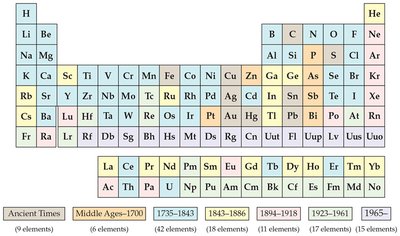
Example: Mendeleev predicted the properties of "eka-silicon" (germanium) with remarkable accuracy.
Atomic Number and Modern Table
While Mendeleev used atomic mass, the modern periodic table is organized by atomic number (number of protons), as established by Henry Moseley. This resolved inconsistencies in Mendeleev’s arrangement and allowed for the identification of missing elements.
Periodicity
Periodicity refers to the repeating patterns of chemical and physical properties among elements as atomic number increases. Key periodic properties include:
Atomic and ionic sizes
Ionization energy
Electron affinity
Group trends in chemical properties
Effective Nuclear Charge (Zeff)
Definition and Calculation
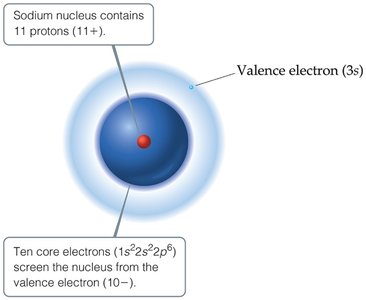
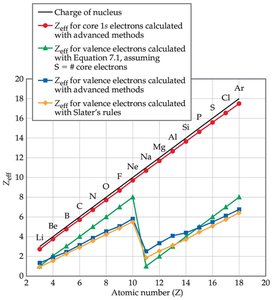
The effective nuclear charge (Zeff) is the net positive charge experienced by valence electrons. It is less than the actual nuclear charge due to shielding by inner electrons.
Formula: where is the atomic number and is the screening constant (number of core electrons).
Trend: Zeff increases left to right across a period due to increasing nuclear charge with similar shielding.
Sizes of Atoms and Ions
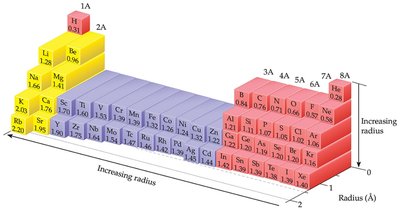
Atomic Radius
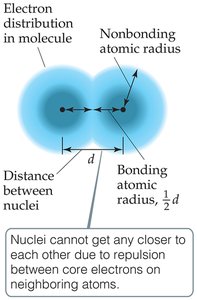
The atomic radius is the distance from the nucleus to the outermost electron shell. Two common definitions are:
Nonbonding (van der Waals) radius: Half the distance between nuclei of non-bonded atoms.
Bonding (covalent) radius: Half the distance between nuclei of bonded atoms.
Trends:
Decreases across a period (left to right) due to increasing Zeff.
Increases down a group due to additional electron shells.
Ionic Radius
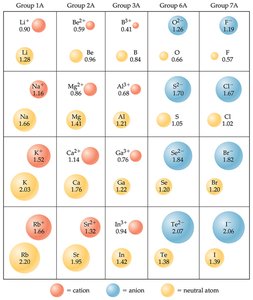
The ionic radius is the distance from the nucleus to the outermost electron in an ion.
Cations (positive ions) are smaller than their parent atoms due to loss of electrons and reduced electron-electron repulsion.
Anions (negative ions) are larger than their parent atoms due to gain of electrons and increased repulsion.
Isoelectronic Series
An isoelectronic series consists of ions with the same number of electrons. Within a series, ionic size decreases as nuclear charge increases.
Ionization Energy (IE)
Definition and Trends
Ionization energy is the energy required to remove an electron from a gaseous atom or ion.
First ionization energy (IE1): Energy to remove the first electron.
Successive ionization energies: Each subsequent electron requires more energy to remove.
Trends:
Increases across a period (left to right).
Decreases down a group.

Exceptions: Sublevel filling and electron pairing can cause deviations from the general trend.

Electron Affinity (EA)
Definition and Trends
Electron affinity is the energy change when an electron is added to a gaseous atom. Most values are negative (exothermic), indicating energy is released.
Trend: Generally becomes more negative across a period (left to right), with exceptions for filled and half-filled subshells.

Electronegativity
Electronegativity is a measure of an atom’s ability to attract electrons in a chemical bond. Pauling’s scale is commonly used.
Trend: Increases across a period and decreases down a group.
Metals, Nonmetals, and Metalloids
Metals
Shiny, good conductors, malleable, ductile, low ionization energies, tend to form cations.
Nonmetals
Dull, brittle, poor conductors, high electron affinities, tend to form anions.
Metalloids
Exhibit properties intermediate between metals and nonmetals; some are semiconductors.
Group Trends
Groups (columns) in the periodic table show similarities in properties due to similar valence electron configurations. Notable groups include:
Alkali metals (Group 1A): Soft, highly reactive, low ionization energies.
Alkaline earth metals (Group 2A): Harder, higher melting points, form +2 cations.
Halogens (Group 7A): Highly reactive nonmetals, form -1 anions.
Noble gases (Group 8A): Inert, very high ionization energies, full valence shells.
Summary Table: Comparison of Metals and Nonmetals
Property | Metals | Nonmetals |
|---|---|---|
Luster | Shiny | Dull |
Malleability | Malleable, ductile | Brittle |
Conductivity | Good | Poor |
Oxide Character | Basic, ionic | Acidic, molecular |
Ion Formation | Cations | Anions |
Born-Haber Cycle (Overview)
The Born-Haber cycle is a thermochemical cycle used to analyze the steps in the formation of an ionic compound from its elements. It combines ionization energies, electron affinities, and lattice energies to calculate the enthalpy of formation.
Key Periodic Trends Summary
Atomic radius: Increases down a group, decreases across a period.
Ionic radius: Cations smaller, anions larger than parent atoms; decreases with increasing nuclear charge in isoelectronic series.
Ionization energy: Increases across a period, decreases down a group.
Electron affinity: Generally more negative across a period, less negative down a group.
Electronegativity: Increases across a period, decreases down a group.
Effective nuclear charge: Increases across a period, slightly increases down a group.
