 Back
Periodic Table Trends and Chemical Periodicity
Study Guide - Smart Notes
 Tailored notes based on your materials, expanded with key definitions, examples, and context.
Periodic Table Trends
Mendeleev and Chemical Periodicity
The concept of chemical periodicity was first introduced by Dmitri Mendeleev, a Russian chemist, who arranged elements based on their properties. He observed that when elements are organized by increasing atomic mass, certain chemical properties repeat at regular intervals, a phenomenon known as periodicity. Mendeleev grouped elements with similar properties together, leaving gaps for undiscovered elements and predicting their properties. By 1886, many of these predicted elements had been discovered, confirming the utility of the periodic table.
Mosley and the Periodic Law
In 1911, Henry Mosley, an English scientist, found that arranging elements by atomic number rather than atomic mass provided a better fit for their properties. The Periodic Law states: "The physical and chemical properties of the elements are periodic functions of their atomic numbers." This law forms the basis for the modern periodic table.
The Modern Periodic Table
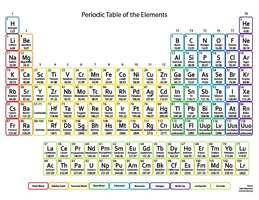
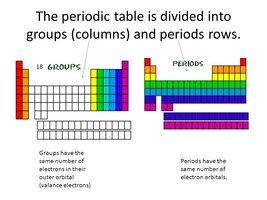
The modern periodic table arranges elements in order of increasing atomic number, grouping elements with similar properties into columns called groups and rows called periods. There are 18 groups and 7 periods. Groups contain elements with the same number of valence electrons, while periods contain elements with the same number of electron orbitals.
Periods and Blocks of the Periodic Table
Periods and Blocks
Elements are arranged in periods (rows) and groups (columns) in the periodic table. The length of each period is determined by the number of electrons that can occupy the sublevels within that period. The periodic table is divided into four blocks: s, p, d, and f, named after the type of atomic orbital being filled.
Groups 1 and 2: Alkali and Alkaline Earth Metals
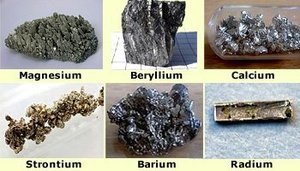
Group 1 elements are known as alkali metals and are highly reactive, soft metals with a single valence electron. Group 2 elements are called alkaline earth metals, which are harder and less reactive than alkali metals but still too reactive to be found in pure form in nature. Hydrogen, despite its electron configuration of 1s1, is unique and does not share the properties of alkali metals. Helium, with a filled 1s orbital, is part of Group 18 due to its stable electron configuration.
Groups 3-12: Transition Metals
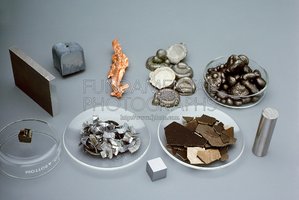
The d-block elements, or transition metals, first appear when the d sublevel begins to fill. These elements exhibit typical metallic properties and are often used in industrial applications due to their variable oxidation states and ability to form colored compounds.
Groups 13-18: p-Block Elements
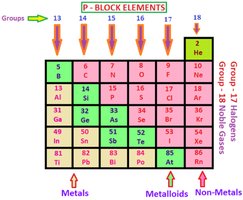
The p-block elements include Groups 13-18 (except Helium). This block contains metals, metalloids, and nonmetals, with properties varying greatly across the block. Group 17 elements are known as halogens, which are highly reactive nonmetals that form salts with metals. The p-block also contains metalloids, which have properties intermediate between metals and nonmetals. The p-block metals are generally less reactive than s-block metals but more reactive than d-block metals.
The f Block: Lanthanides and Actinides
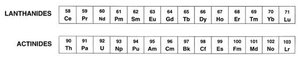
The f-block elements are wedged between Groups 3 and 4 in the sixth and seventh periods. The first row, lanthanides, are shiny metals similar in reactivity to Group 2 elements. The second row, actinides, are all radioactive and include elements such as uranium and plutonium.
Periodic Trends
Atomic Radii
The atomic radius is defined as half the distance between the nuclei of two bonded atoms. Atomic radii decrease across a period due to increased nuclear charge pulling electrons closer, and increase down a group due to the addition of electron shells. Inner electrons shield the outer electrons from the nucleus, reducing the effect of nuclear charge.
Group Trend
Atomic radius increases down a group.
Period Trend
Atomic radius decreases across a period.
Ionization Energy
Ionization energy is the energy required to remove one electron from a neutral atom. It increases across a period due to greater nuclear charge and decreases down a group due to increased distance from the nucleus and shielding effect.
Group Trend
Ionization energy decreases down a group.
Period Trend
Ionization energy increases across a period.
Electron Affinity
Electron affinity is the energy change that occurs when an electron is added to a neutral atom. It generally becomes more negative across a period and less negative down a group.
Ionic Radii
A positive ion is called a cation, formed by the loss of electrons, resulting in a smaller radius. A negative ion is called an anion, formed by the gain of electrons, resulting in a larger radius.
Electronegativity
Electronegativity is a measure of the ability of an atom in a chemical compound to attract electrons from another atom. Electronegativity increases across a period and decreases or remains the same down a group.
Example:
Of gallium (Ga), bromine (Br), and calcium (Ca), bromine has the highest electronegativity due to its position near the top right of the periodic table.
Summary Table: Periodic Trends
Trend | Across Period | Down Group |
|---|---|---|
Atomic Radius | Decreases | Increases |
Ionization Energy | Increases | Decreases |
Electron Affinity | Becomes more negative | Becomes less negative |
Electronegativity | Increases | Decreases/remains same |
Key Terms and Definitions
Periodicity: The repeating pattern of chemical properties in the periodic table.
Group: Vertical column in the periodic table; elements in a group have similar properties.
Period: Horizontal row in the periodic table; elements in a period have the same number of electron shells.
Valence Electrons: Electrons in the outermost energy level of an atom.
Cation: A positively charged ion formed by loss of electrons.
Anion: A negatively charged ion formed by gain of electrons.
Ionization Energy: Energy required to remove an electron from an atom.
Electron Affinity: Energy change when an electron is added to an atom.
Electronegativity: Ability of an atom to attract electrons in a compound.
Important Equations
Atomic radius definition:
Ionization energy:
Electron affinity:
Examples and Applications
Potassium (K) electron configuration: (1 valence electron)
Cobalt (Co) electron configuration: (2 valence electrons)
Group 1 element in third period: Sodium (Na), electron configuration
Additional info: Academic context and examples were added to clarify periodic trends and block/group properties.
