Back
BackPeriodic Table Trends, Nitrogen Oxides, and Halogen Oxyacids
Study Guide - Smart Notes
 Tailored notes based on your materials, expanded with key definitions, examples, and context.
Periodic Table Trends
Groups and Periods of Selected Elements
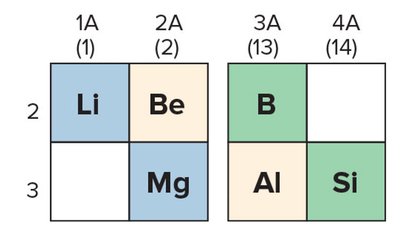
The periodic table organizes elements by increasing atomic number and groups them based on similar chemical properties. The image below highlights elements from Groups 1A, 2A, 3A, and 4A in Periods 2 and 3.
Group 1A (Alkali Metals): Lithium (Li)
Group 2A (Alkaline Earth Metals): Beryllium (Be), Magnesium (Mg)
Group 3A: Boron (B), Aluminum (Al)
Group 4A: Silicon (Si)
These elements demonstrate periodic trends in properties such as atomic radius, ionization energy, and chemical reactivity. For example, elements in the same group have similar valence electron configurations, leading to comparable chemical behavior.
Nitrogen Oxides
Oxidation States and Properties of Nitrogen Oxides
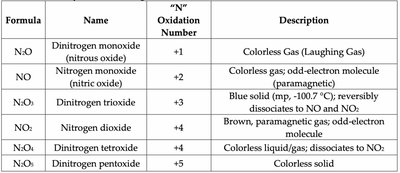
Nitrogen forms several oxides, each with distinct chemical and physical properties. The table below summarizes the formulas, names, oxidation numbers, and descriptions of common nitrogen oxides.
Formula | Name | N Oxidation Number | Description |
|---|---|---|---|
N2O | Dinitrogen monoxide (nitrous oxide) | +1 | Colorless gas (Laughing Gas) |
NO | Nitrogen monoxide (nitric oxide) | +2 | Colorless gas; odd-electron molecule (paramagnetic) |
N2O3 | Dinitrogen trioxide | +3 | Blue solid (mp. -100.7 °C); reversibly dissociates to NO and NO2 |
NO2 | Nitrogen dioxide | +4 | Brown, paramagnetic gas; odd-electron molecule |
N2O4 | Dinitrogen tetroxide | +4 | Colorless liquid/gas; dissociates to NO2 |
N2O5 | Dinitrogen pentoxide | +5 | Colorless solid |
Oxidation Number: Indicates the charge nitrogen would have if all bonds were ionic.
Physical Properties: Range from colorless gases to colored solids, with varying magnetic properties.
Applications: Nitrous oxide is used as an anesthetic; nitrogen dioxide is a significant air pollutant.
Halogen Oxyacids and Oxoanions
Classification and Structure of Halogen Oxyacids
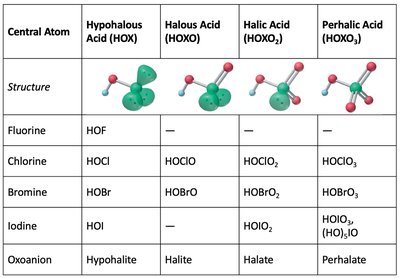
Halogen oxyacids are acids containing a halogen atom bonded to oxygen and hydrogen. Their structure and naming depend on the number of oxygen atoms attached to the halogen. The table below classifies these acids and their corresponding oxoanions.
Central Atom | Hypohalous Acid (HOX) | Halous Acid (HOXO) | Halic Acid (HOXO2) | Perhalic Acid (HOXO3) |
|---|---|---|---|---|
Fluorine | HOF | — | — | — |
Chlorine | HOCl | HOClO | HOClO2 | HOClO3 |
Bromine | HOBr | HOBrO | HOBrO2 | HOBrO3 |
Iodine | HOI | — | HOIO2 | HOIO3, (HO)5IO |
Oxoanion | Hypohalite | Halite | Halate | Perhalate |
Hypohalous Acids: Contain one oxygen atom (e.g., HOCl).
Halous Acids: Contain two oxygen atoms (e.g., HOClO).
Halic Acids: Contain three oxygen atoms (e.g., HOClO2).
Perhalic Acids: Contain four oxygen atoms (e.g., HOClO3).
Oxoanions: Derived from the acids by removing a proton (H+), named as hypohalite, halite, halate, and perhalate.