 Back
BackPeriodic Trends and Bond Energies in Halogen Chemistry
Study Guide - Smart Notes
 Tailored notes based on your materials, expanded with key definitions, examples, and context.
Q1. What are the group number and valence electron configuration of a main-group element that can be characterized by the following Lewis electron-dot symbol?
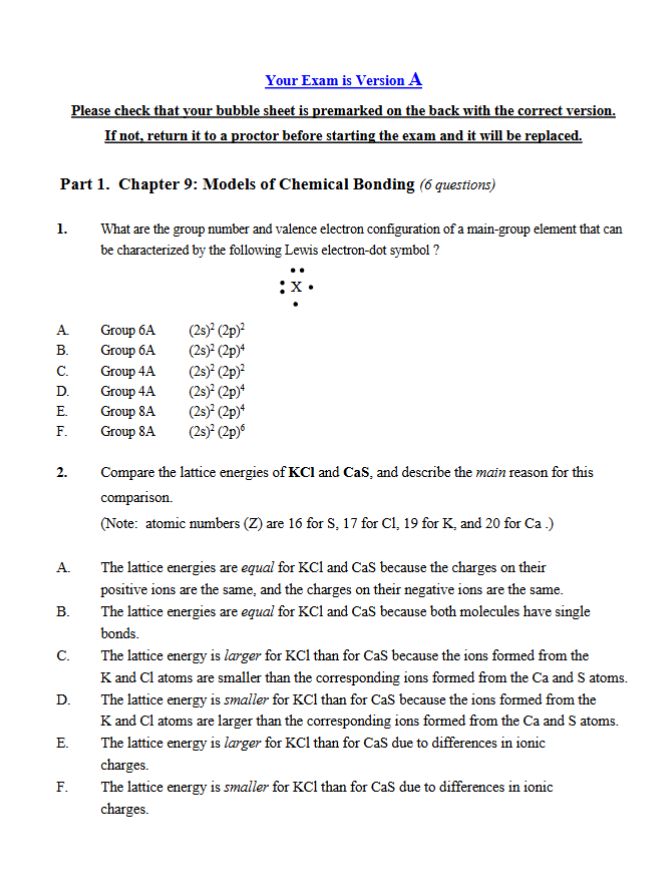
Background
Topic: Lewis Structures and Electron Configurations
This question tests your understanding of how to interpret Lewis electron-dot symbols and relate them to the group number and valence electron configuration of main-group elements.
Key Terms and Concepts:
Lewis electron-dot symbol: A representation of the valence electrons around an atom using dots.
Valence electrons: Electrons in the outermost shell (highest energy level) of an atom, important for chemical bonding.
Group number: For main-group elements, the group number corresponds to the number of valence electrons.
Valence electron configuration: The arrangement of electrons in the outermost s and p orbitals (e.g., (2s)2(2p)4).
Step-by-Step Guidance
Count the number of dots around the element symbol in the Lewis structure. Each dot represents one valence electron.
Recall that the group number for main-group elements (Groups 1A–8A) is equal to the number of valence electrons.
Match the number of valence electrons to the possible electron configurations given in the answer choices.
Remember that the p-block elements fill the 2p, 3p, etc., orbitals after the s-orbital is filled (e.g., (2s)2(2p)4 for Group 6A).
Try solving on your own before revealing the answer!
Q2. Compare the lattice energies of KCl and CaS, and describe the main reason for this comparison.
Background
Topic: Lattice Energy and Ionic Compounds
This question is about comparing the lattice energies of two ionic compounds and understanding the factors that influence lattice energy, such as ionic charge and ionic radius.
Key Terms and Concepts:
Lattice energy: The energy required to separate one mole of an ionic solid into its gaseous ions.
Coulomb's Law: Lattice energy is proportional to the product of the charges of the ions and inversely proportional to the distance between them.
and are the charges on the ions.
is the distance between the centers of the ions (ionic radius).
Step-by-Step Guidance
Identify the charges on the ions in KCl ( and ) and CaS ( and ).
Recall that higher ionic charges lead to greater lattice energy, while larger ionic radii lead to lower lattice energy.
Compare the charges and sizes of the ions in both compounds.
Use Coulomb's Law to reason which compound should have the larger lattice energy based on these factors.
Try solving on your own before revealing the answer!
Q3. Arrange Br-Br, Cl-Cl, and I-I in order of increasing bond strength (weakest < strongest) and increasing bond length (shortest < longest).
Background
Topic: Periodic Trends in Bond Strength and Bond Length (Group 7A Halogens)
This question tests your understanding of how atomic size and periodic trends affect the bond strength and bond length of diatomic halogen molecules (X2), specifically Br2, Cl2, and I2.
Key Terms and Concepts:
Bond Strength: The energy required to break a bond between two atoms. Stronger bonds require more energy to break.
Bond Length: The distance between the nuclei of two bonded atoms. Larger atoms form longer bonds.
Periodic Trend: As you move down Group 7A (halogens), atomic size increases, bond length increases, and bond strength generally decreases.
Step-by-Step Guidance
Recall that as you move down the group (Cl → Br → I), the atoms get larger. This means the bond length increases in the order: Cl-Cl < Br-Br < I-I.
Bond strength generally decreases as the atoms get larger because the overlap between atomic orbitals becomes less effective. So, the bond strength order is: I-I < Br-Br < Cl-Cl.
Match these trends to the answer choices provided in the question to find the correct order for both bond strength and bond length.
Try solving on your own before revealing the answer!
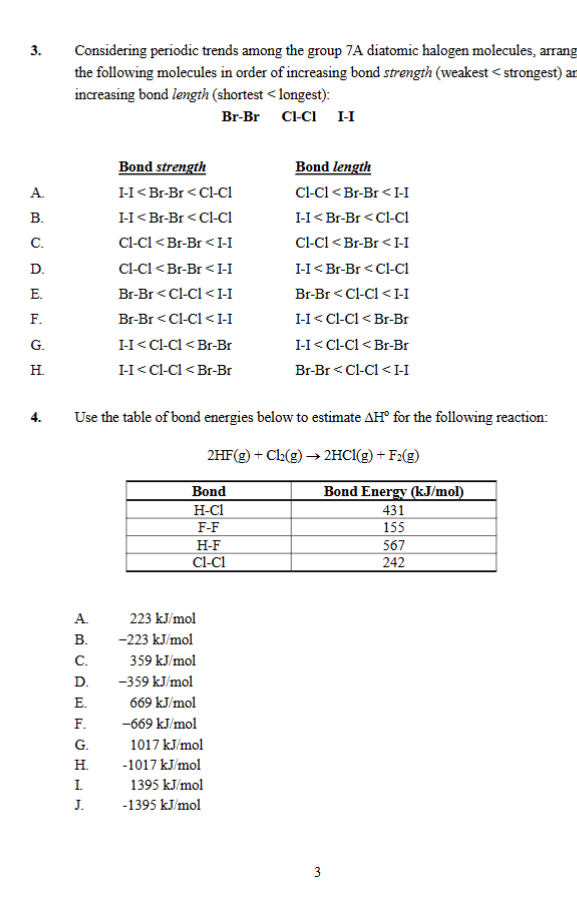
Q4. Use the table of bond energies below to estimate ΔH° for the following reaction: 2HF(g) + Cl2(g) → 2HCl(g) + F2(g)
Background
Topic: Bond Energy Calculations and Enthalpy Change (ΔH)
This question tests your ability to use bond energies to estimate the enthalpy change for a chemical reaction. You will need to consider which bonds are broken and which are formed.
Key Terms and Formulas:
Bond Energy: The energy required to break one mole of a specific bond in a molecule.
ΔH° (Enthalpy Change): The heat absorbed or released during a chemical reaction at standard conditions.
Key Formula:
Step-by-Step Guidance
Identify all the bonds broken in the reactants: 2 H-F bonds (from 2HF) and 1 Cl-Cl bond (from Cl2).
Identify all the bonds formed in the products: 2 H-Cl bonds (from 2HCl) and 1 F-F bond (from F2).
Write the sum of the bond energies for all bonds broken and all bonds formed using the values from the table:
Bonds broken:
Bonds formed:
Set up the equation for ΔH° using the bond energies from the table:
H-Cl: 431 kJ/mol
F-F: 155 kJ/mol
H-F: 567 kJ/mol
Cl-Cl: 242 kJ/mol
Try solving on your own before revealing the answer!
Final Answer for Q3:
Bond strength: I-I < Br-Br < Cl-Cl Bond length: Cl-Cl < Br-Br < I-I
This matches answer choice A in the worksheet. As you go down the group, bond length increases and bond strength decreases due to increasing atomic size and weaker orbital overlap.
Final Answer for Q4:
kJ/mol
The enthalpy change for the reaction is 359 kJ/mol, which matches answer choice C.
