 Back
Periodic Trends: Atomic and Ionic Properties in the Periodic Table
Study Guide - Smart Notes
 Tailored notes based on your materials, expanded with key definitions, examples, and context.
Periodic Trends in the Periodic Table
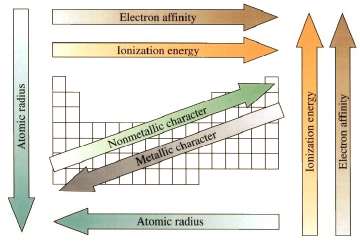
Overview of Periodic Trends
The periodic table organizes elements according to their atomic number and reveals recurring trends in their physical and chemical properties. Understanding these trends is essential for predicting element behavior and chemical reactivity.
Atomic radius decreases across a period (left to right) and increases down a group (top to bottom).
Ionization energy increases across a period and decreases down a group.
Electron affinity becomes more negative across a period and less negative down a group.
Metallic character increases down a group and decreases across a period.
Nonmetallic character increases across a period and decreases down a group.
Atomic Radius
Definition and Measurement
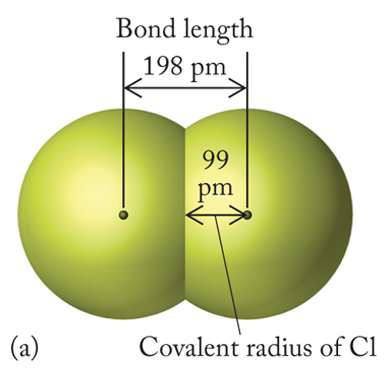
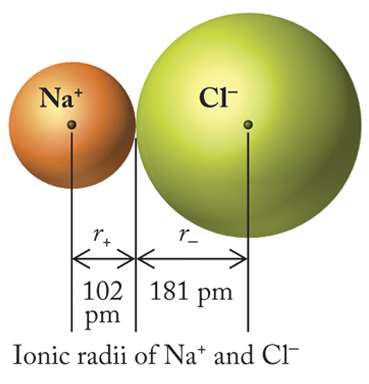
The atomic radius is a measure of the size of an atom, typically defined as half the distance between the nuclei of two identical atoms bonded together. For diatomic molecules, this is called the covalent radius. For metals, the metallic radius is used, and for ions, the ionic radius is half the distance between ions in a crystal lattice.
Covalent radius: Half the bond length in a diatomic molecule.
Metallic radius: Half the distance between nuclei in a metal lattice.
Ionic radius: Half the distance between ions in an ionic crystal.
Periodic Trend in Atomic Radius
Atomic radii increase down a group due to the addition of electron shells, which extend further from the nucleus. Across a period, atomic radii decrease as the effective nuclear charge increases, pulling electrons closer to the nucleus.
Down a group: Atomic radius increases (more electron shells).
Across a period: Atomic radius decreases (greater nuclear charge, stronger attraction).

Effective Nuclear Charge and Electron Shielding
Concept of Effective Nuclear Charge (Zeff)
The effective nuclear charge (Zeff) is the net positive charge experienced by an electron in a multi-electron atom. It is calculated as:
Z: Actual nuclear charge (number of protons).
S: Shielding constant (effect of other electrons).
The formula is:
Inner electrons shield outer electrons from the full nuclear charge, reducing the attraction felt by valence electrons.
Slater's Rules for Shielding
Slater's rules provide a method to estimate the shielding constant (S) for a given electron. Electrons in lower shells shield more effectively than those in the same shell.
Electrons in the same (n) shell: 0.35 each
Electrons in (n-1) shell: 0.85 each
Electrons in (n-2) or lower shells: 1.00 each
Example for Sodium (Na):
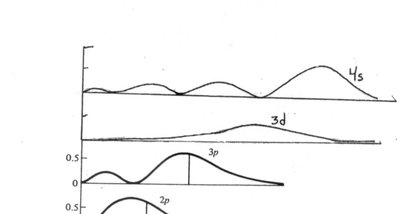
Radial Distribution of Orbitals
Radial Probability Distribution
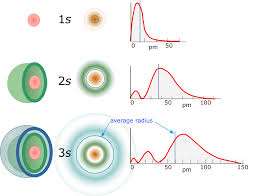
A radial distribution plot shows the probability of finding an electron at a certain distance from the nucleus. Different orbitals (s, p, d) have distinct distributions, affecting electron shielding and atomic size.
s orbitals: Highest probability near the nucleus.
p orbitals: Probability peaks further from the nucleus.
d orbitals: Even further, with more complex shapes.

Ionic Radius
Periodic Trend in Ionic Radius
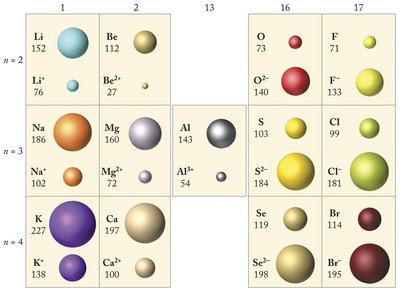
The ionic radius changes when atoms gain or lose electrons to form ions. Cations (positive ions) are smaller than their parent atoms due to loss of electrons and reduced electron-electron repulsion. Anions (negative ions) are larger due to increased electron-electron repulsion.
Cations: Smaller than parent atom.
Anions: Larger than parent atom.


Ionization Energy
Definition and Trends
Ionization energy is the energy required to remove one mole of electrons from one mole of gaseous atoms or ions. The first ionization energy refers to removing the first electron; subsequent ionization energies are higher due to increased attraction.
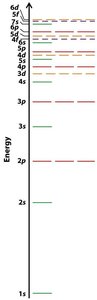
Decrease down a group: Easier to remove electrons from higher energy orbitals.
Increase across a period: Harder to remove electrons as nuclear charge increases.
Equation for first ionization energy:

Electron Affinity
Definition and Trends
Electron affinity is the energy released when one mole of gaseous atoms gains electrons to form anions. A more negative electron affinity indicates a greater attraction for electrons.
More negative across a period: Nonmetals have higher electron affinity.
Less negative down a group: Larger orbitals, less attraction.
Example:
EA1 = -349 kJ/mol

Summary Table: Periodic Trends
Property | Trend Across Period | Trend Down Group |
|---|---|---|
Atomic Radius | Decreases | Increases |
Ionization Energy | Increases | Decreases |
Electron Affinity | Becomes more negative | Becomes less negative |
Metallic Character | Decreases | Increases |
Nonmetallic Character | Increases | Decreases |
Example Question
Which element has a higher ionization energy, Zinc or Gallium?
According to periodic trends, Zinc has a higher ionization energy than Gallium. This is because Zinc is to the right of Gallium in the same period, and ionization energy generally increases across a period.
*Additional info: Academic context and explanations have been expanded for clarity and completeness. Only images directly relevant to the explanation have been included.*
