 Back
Periodic Trends: Atomic Size and Effective Nuclear Charge
Study Guide - Smart Notes
 Tailored notes based on your materials, expanded with key definitions, examples, and context.
Periodic Trends in Atomic Size and Effective Nuclear Charge
Introduction to Periodic Trends
The periodic table organizes elements based on recurring chemical properties, which are reflected in trends such as atomic size and effective nuclear charge. Understanding these trends is essential for predicting element behavior and chemical reactivity.
Orbital Blocks and Electron Configuration Exceptions
Transition and Inner-Transition Elements
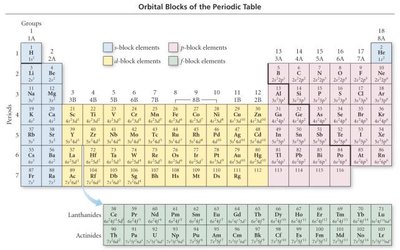
Transition metals (d-block) and inner-transition metals (f-block) often exhibit exceptions to the standard electron filling order due to the close energy levels of their orbitals.
Transition Metals (d-block): The 3d and 4s orbitals are very close in energy, leading to electron configurations that may not strictly follow the Aufbau principle. For example, copper (Cu) and chromium (Cr) have anomalous configurations to achieve greater stability.
Inner-Transition Metals (f-block): The filling of f-orbitals follows the rule that the principal quantum number n for f-orbitals is two less than the period number (n – 2). For example, the 4f orbitals fill in the sixth period.
Energy Similarity: In elements like europium (Eu) and gadolinium (Gd), the 4f and 5d orbitals are very close in energy, leading to unique electron configurations.
Periodic Trends in Atomic Size
Main Group Elements
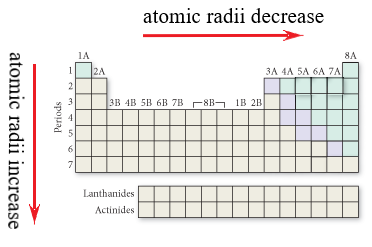
Atomic size, or atomic radius, varies predictably across the periodic table due to changes in principal quantum number and effective nuclear charge.
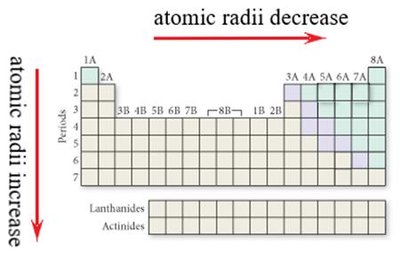
Down a Group: As you move down a column, the principal quantum number (n) increases, adding more electron shells. This results in larger atomic radii.
Across a Period: As you move from left to right across a row, the effective nuclear charge (Zeff) increases, pulling electrons closer to the nucleus and decreasing atomic radii.
Transition Group Elements
Transition metals show a different trend compared to main group elements:
Down a Group: Atomic size increases, similar to main group elements.
Across a Period: Atomic radii remain roughly constant (except for the first two elements), due to poor shielding by d-electrons, which causes the effective nuclear charge to increase but not significantly reduce atomic size.
Effective Nuclear Charge (Zeff)
Definition and Calculation
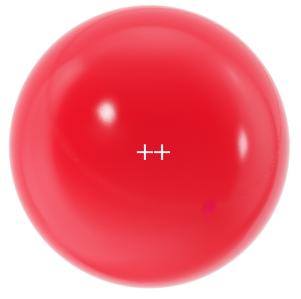
The effective nuclear charge is the net positive charge experienced by an electron in a multi-electron atom. It accounts for the actual nuclear charge minus the shielding effect of other electrons.
Formula: where is the atomic number (actual nuclear charge) and is the number of shielding (core) electrons.
Trend: Zeff increases across a period, causing atomic size to decrease.

Comparing Atomic Sizes
Examples and Applications
Understanding periodic trends allows us to compare atomic sizes between elements:
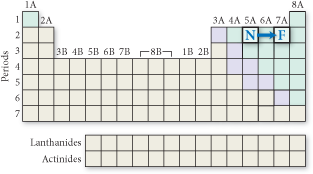
N vs. F: Fluorine is smaller than nitrogen because it is further right in the period (higher Zeff).
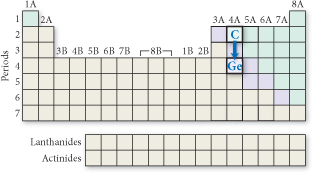
C vs. Ge: Germanium is larger than carbon because it is further down the group (higher n).
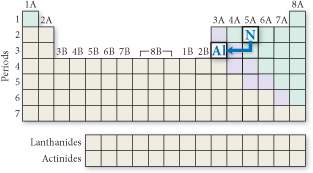
N vs. Al: Aluminum is larger than nitrogen because it is further down and to the left.
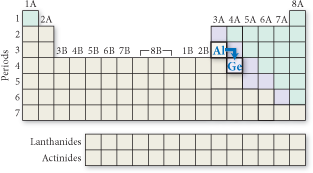
Al vs. Ge: Germanium is larger than aluminum because it is further down the group.
Ranking Atomic Radii
To rank elements by increasing atomic radius, consider both their group and period positions. For example, the order for S, Ca, F, Rb, Si is:
F < S < Si < Ca < Rb
Summary Table: Periodic Trends in Atomic Size
Direction | Trend in Atomic Radius | Reason |
|---|---|---|
Down a Group | Increases | Higher principal quantum number (n), more electron shells |
Across a Period (Left to Right) | Decreases | Increasing Zeff pulls electrons closer |
Transition Metals (Across a Period) | Radii remain nearly constant | Poor shielding by d-electrons |
Additional info: The periodic trends discussed here are foundational for understanding chemical reactivity, ionization energy, and other properties covered in later chapters.
