 Back
Periodic Trends in the Properties of Elements
Study Guide - Smart Notes
 Tailored notes based on your materials, expanded with key definitions, examples, and context.
Periodic Properties of the Elements
Introduction to Periodic Trends
The periodic table organizes elements according to their atomic number, revealing recurring patterns in their chemical and physical properties. These patterns, known as periodic trends, are primarily determined by the arrangement and number of valence electrons. Understanding these trends allows chemists to predict the behavior of elements and their compounds.
Periodic Law: The chemical properties of elements are largely determined by the number of valence electrons.
Periodic Trends: Properties such as atomic radius, ionic radius, ionization energy, electron affinity, and shielding effect follow predictable patterns across periods (rows) and groups (columns).
Effective Nuclear Charge (Zeff)
Effective nuclear charge is the net positive charge experienced by an electron in a multi-electron atom. It accounts for both the attraction to the nucleus and the repulsion from other electrons.
Formula: where is the atomic number and is the number of shielding electrons.
Trend: Increases from left to right across a period and from bottom to top within a group.
Significance: Higher effective nuclear charge results in stronger attraction between the nucleus and valence electrons.
Shielding Effect
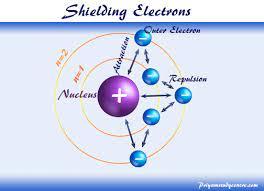
The shielding effect describes how inner (core) electrons reduce the attraction between the nucleus and outer (valence) electrons. This effect is crucial in determining atomic and ionic sizes, as well as ionization energies.
Trend: Increases down a group and from left to right across a period.
Mechanism: Core electrons repel valence electrons, decreasing the effective nuclear charge felt by the outermost electrons.
Screening: Outer electrons do not effectively shield each other.
Atomic Radius
The atomic radius is the distance from the nucleus to the outermost electron shell. It is a fundamental property that influences reactivity and bonding.
Trend: Increases down a group (due to additional electron shells) and decreases across a period (due to increased effective nuclear charge).
Explanation: As you move down a group, atoms gain more electron shells, making them larger. Across a period, increased nuclear charge pulls electrons closer, reducing size.
Ionic Radius
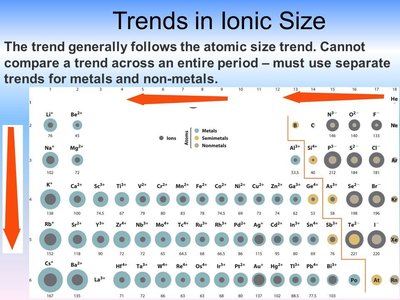
The ionic radius is the distance from the nucleus to the outer edge of the electron cloud in an ion. Ionic radii vary depending on whether the ion is a cation (positive) or anion (negative).
Trend: Increases down a group and decreases across a period for both cations and anions. However, trends must be considered separately for metals and nonmetals.
Cations: Smaller than their parent atoms due to loss of electrons.
Anions: Larger than their parent atoms due to gain of electrons.
Ionization Energy
Ionization energy is the energy required to remove an electron from an atom or ion in the gaseous state. It reflects the tendency of an atom to surrender an electron.
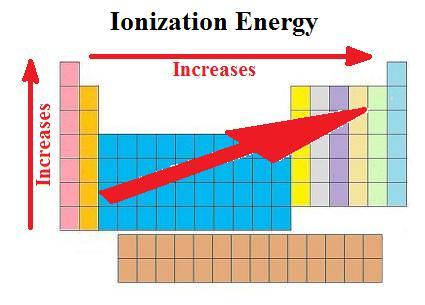
Trend: Increases across a period (left to right) and decreases down a group (top to bottom).
Explanation: Higher effective nuclear charge and smaller atomic radius make it harder to remove electrons.
Successive Ionization Energies: Each subsequent electron removed requires more energy.
Summary Table: Periodic Trends
The following table summarizes the main periodic trends for atomic and ionic properties:
Property | Trend Across Period (Left to Right) | Trend Down Group (Top to Bottom) |
|---|---|---|
Effective Nuclear Charge | Increases | Increases |
Atomic Radius | Decreases | Increases |
Ionic Radius | Decreases (for metals), increases (for nonmetals) | Increases |
Ionization Energy | Increases | Decreases |
Shielding Effect | Increases | Increases |
Coulomb’s Law and Periodic Trends
Coulomb’s Law describes the force between two charged particles. In chemistry, it explains the attraction between the nucleus and electrons:
Formula: where is the force, is a constant, and are charges, and is the distance between them.
Application: As atomic radius increases, the force of attraction decreases, affecting ionization energy and electron affinity.
Conclusion
Understanding periodic trends is essential for predicting the chemical behavior of elements. These trends are governed by the interplay of effective nuclear charge, shielding, and atomic structure, and are visually represented in the periodic table.
