 Back
BackPeriodic Trends, Ionization Energy, Electron Affinity, and Ionic Bonding
Study Guide - Smart Notes
 Tailored notes based on your materials, expanded with key definitions, examples, and context.
Periodic Trends, Ionic Bonds, and Lattice Energy
Periodic Trends in Atomic and Ionic Radii
Understanding periodic trends is essential for predicting the chemical behavior of elements. Atomic and ionic radii display clear trends across the periodic table:
Atomic radius increases down a group and decreases across a period.
Ionic radius follows similar trends: cations are smaller than their parent atoms, anions are larger, and ion size increases down a group.
Ionization Energy
Ionization energy (Ei) is the energy required to remove an electron from a gas-phase atom or ion:
General equation:
Ionization energies are always positive, as energy input is required to remove an electron.
Periodic Trends:
Ionization energy increases across a period (left to right).
Ionization energy decreases down a group (top to bottom).
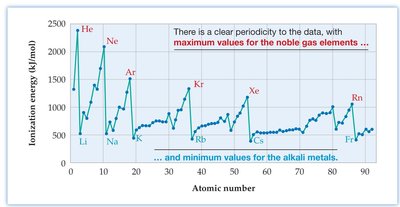
This periodicity is due to increasing effective nuclear charge (Zeff) across a period and increasing principal quantum number down a group, which increases the distance between the nucleus and valence electrons.
Irregularities in Ionization Energy Trends
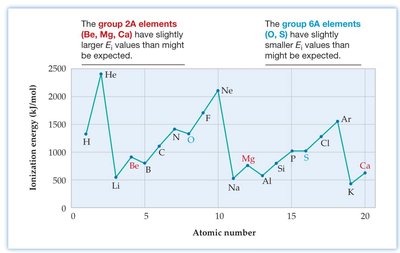
Some elements deviate from the general trend due to subshell configurations and electron pairing:
Group 2A elements (e.g., Be, Mg, Ca) have slightly higher Ei values than expected due to filled s-subshells.
Group 6A elements (e.g., O, S) have slightly lower Ei values due to electron pairing in p-orbitals, making paired electrons easier to remove.
Higher Order Ionization Energies
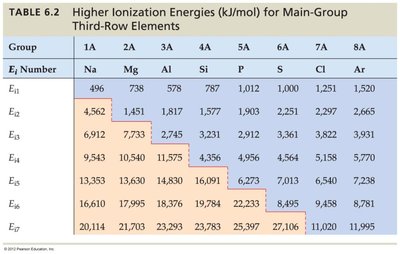
It is possible to remove more than one electron from an atom, resulting in second, third, and higher ionization energies:
Each successive ionization energy is larger than the previous, as it is harder to remove an electron from a cation than from a neutral atom.
There is always a significant jump in ionization energy when removing an electron from a filled valence shell.
Group | Ei1 | Ei2 | Ei3 | Ei4 | Ei5 | Ei6 | Ei7 |
|---|---|---|---|---|---|---|---|
Na | 496 | 4,562 | 6,912 | 9,543 | 13,353 | 16,610 | 20,114 |
Mg | 738 | 1,451 | 7,733 | 10,540 | 13,830 | 17,995 | 21,703 |
Al | 578 | 1,817 | 2,745 | 11,575 | 16,091 | 18,762 | 23,283 |
Si | 787 | 1,577 | 3,231 | 4,356 | 16,691 | 22,493 | 23,785 |
P | 1,012 | 1,901 | 2,909 | 3,747 | 7,073 | 8,495 | 27,106 |
S | 1,000 | 2,251 | 3,361 | 4,631 | 7,520 | 8,967 | 11,020 |
Cl | 1,251 | 2,300 | 3,825 | 5,507 | 7,288 | 8,995 | 11,999 |
Ar | 1,520 | 2,667 | 3,912 | 5,759 | 7,728 | 9,870 | 13,000 |
Electron Affinity
Electron affinity (Eea) is the energy change when an electron is added to a gas-phase atom:
General equation:
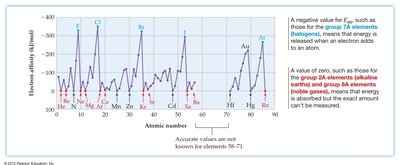
Electron affinities are generally negative, indicating energy is released.
Halogens have large, negative electron affinities; noble gases have positive values; alkaline earth metals have values near zero.
The Octet Rule
The octet rule states that main-group elements tend to react to achieve a filled valence shell, usually with eight electrons. This stability explains the chemical inertness of noble gases and the reactivity of alkali metals and halogens.
Noble gases are unreactive due to filled valence shells.
Alkali metals (good reducing agents) and halogens (good oxidizing agents) react to achieve filled shells.
Ionic Bond Formation
Ionic bonds form when electrons are transferred from atoms with low ionization energy (typically metals) to atoms with high electron affinity (typically nonmetals), resulting in cations and anions held together by electrostatic attraction.
The number of electrons lost or gained is governed by the octet rule.
Example: Formation of NaCl
Energetics of Ionic Bond Formation: The Born-Haber Cycle
The formation of an ionic compound like NaCl can be broken down into several steps, each with an associated energy change:
Heat of sublimation (solid to gas):
Bond dissociation energy (breaking Cl2):
First ionization energy:
Electron affinity:
Lattice energy (formation of solid):
The sum of these energies gives the net energy change for the reaction:
For NaCl:
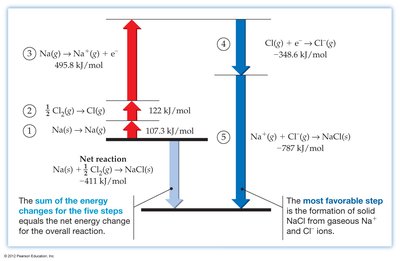
The large negative lattice energy is the driving force for ionic bond formation.
Lattice Energy and Ionic Bond Strength
Lattice energy is the energy released when gaseous ions combine to form an ionic solid. It is a measure of the strength of the ionic bond:
Larger charges lead to stronger ionic bonds and larger lattice energies.
Larger ions lead to weaker ionic bonds and smaller lattice energies.
Lattice energies are directly proportional to ionic bond strengths and are easier to measure experimentally.
Solubility and Ionic Bond Strength
Soluble ionic compounds tend to have weaker ionic bonds. Large, low-charge ions form weaker attractions, making them more likely to dissolve in water.
Estimating Lattice Energies
Lattice energies can be estimated using known values and the proportionality equation above. For example, the lattice energy of MgO can be estimated relative to NaCl:
Using this method, the estimated lattice energy for MgO is 4320 kJ/mol (actual value: 3791 kJ/mol).
Summary Table: Key Concepts
Concept | Trend/Rule |
|---|---|
Ionization Energy | Increases across a period, decreases down a group |
Electron Affinity | Halogens: large negative; Noble gases: positive; Alkaline earths: ~0 |
Octet Rule | Main-group elements react to achieve 8 valence electrons |
Lattice Energy | Proportional to product of charges, inversely to sum of radii |
