 Back
Periodic Trends: Ionization Energy, Electron Affinity, and Metallic Character
Study Guide - Smart Notes
 Tailored notes based on your materials, expanded with key definitions, examples, and context.
Periodic Trends: Ionization Energy, Electron Affinity, and Metallic Character
Ionization Energy (IE)
Ionization energy is a fundamental property that describes the energy required to remove an electron from an atom in the gaseous state. This property helps explain the reactivity and chemical behavior of elements across the periodic table.
Definition: The first ionization energy (IE1) is the energy needed to remove the first electron from a neutral atom.
Always positive: Removing an electron requires energy input, making ionization energy an endothermic process.
Successive Ionization Energies: IE2 is the energy to remove a second electron, and so on. Each successive ionization energy is larger than the previous due to increased effective nuclear charge on the remaining electrons.
Example: For lithium:
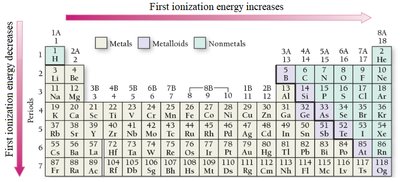
Trends in Ionization Energy
Across a Period (Left to Right): Ionization energy increases due to increasing effective nuclear charge, which holds electrons more tightly.
Down a Group (Top to Bottom): Ionization energy decreases because outer electrons are farther from the nucleus and more shielded by inner electrons.
Successive Ionization Energies: There is a large jump in ionization energy when removing a core (non-valence) electron.
Example:
Na: , ,
Mg: , ,
Exceptions to Ionization Energy Trends
s- and p-block Exception: The first ionization energy of Be () is higher than that of B () due to the stability of the filled 2s subshell in Be.
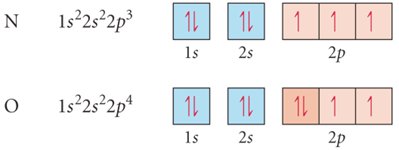
Pairing Energy Exception: Nitrogen () has a higher first ionization energy than oxygen () because of the stability of half-filled p orbitals in N.
Electron Affinity (EA)
Electron affinity measures the energy change when an atom in the gaseous state gains an electron to form an anion. It is an important indicator of an element's tendency to accept electrons during chemical reactions.
Definition: The energy change associated with the addition of an electron to a gaseous atom or ion.
Sign Convention: Electron affinity is usually negative, indicating that energy is released when an electron is added.
Example:
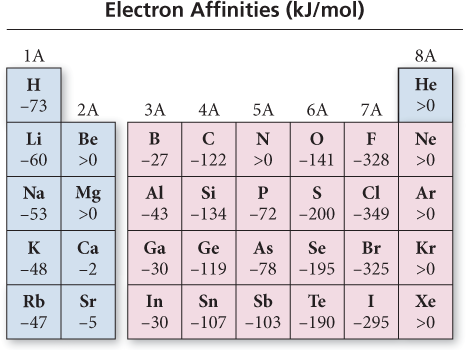
Trends in Electron Affinity
Across a Period: Electron affinity generally becomes more negative (greater tendency to gain electrons) from left to right due to increasing effective nuclear charge.
Down a Group: No clear trend, but values often become less negative (less energy released) as atomic size increases.
Exceptions: Noble gases have positive electron affinities (do not readily gain electrons), and some group 2 and group 15 elements have less negative or even positive values due to stable electron configurations.
Metallic Character
Metallic character refers to the set of properties associated with metals, such as electrical conductivity, malleability, and the tendency to lose electrons during chemical reactions.
Trend Across a Period: Metallic character decreases from left to right as elements become less likely to lose electrons.
Trend Down a Group: Metallic character increases as atoms become larger and more likely to lose electrons.
Examples:
Sn is more metallic than Ge; Rb is more metallic than Na.
Arrange Si, Cl, Na, Rb in increasing metallic character: Cl < Si < Na < Rb.
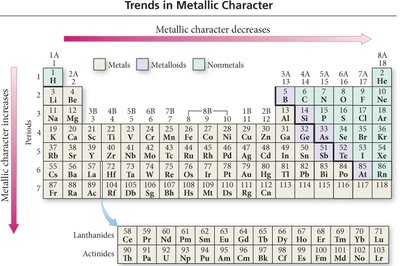
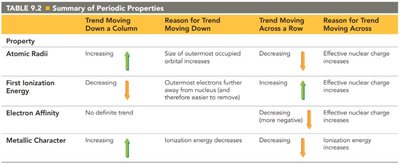
Summary of Periodic Trends
The periodic trends in atomic properties are explained by the electronic configurations of the elements. These trends help predict and rationalize the chemical behavior of elements.
Property | Trend Down a Column | Reason Down a Column | Trend Across a Row | Reason Across a Row |
|---|---|---|---|---|
Atomic Radii | Increasing | Size of outermost occupied orbital increases | Decreasing | Effective nuclear charge increases |
First Ionization Energy | Decreasing | Outermost electrons further from nucleus (easier to remove) | Increasing | Effective nuclear charge increases |
Electron Affinity | No definite trend | Decreasing (more negative) | Effective nuclear charge increases | |
Metallic Character | Increasing | Ionization energy decreases | Decreasing | Ionization energy increases |
Key Takeaways
Electronic structure determines periodic trends in atomic size, ionization energy, electron affinity, and metallic character.
Understanding these trends is essential for predicting chemical reactivity and bonding behavior.
