 Back
Phase Changes and Heat Calculations in Water
Study Guide - Smart Notes
 Tailored notes based on your materials, expanded with key definitions, examples, and context.
Phase Changes
Introduction to Phase Changes
Phase changes refer to the transformation of a substance from one physical state (solid, liquid, gas) to another. These transitions occur at specific temperatures and involve the absorption or release of heat. Common terms include:
Melting Point: The temperature at which a solid becomes a liquid.
Boiling Point: The temperature at which a liquid becomes a gas.
Freezing: The process where a liquid turns into a solid as heat is removed.
Condensation: The process where a gas turns into a liquid as heat is removed.
Cooling and Heating Curves
Cooling Curve
A cooling curve illustrates how the temperature of a substance changes as heat is removed. Plateaus on the curve represent phase changes, where temperature remains constant despite continued heat removal:
Boiling Point Plateau (W → X): Temperature remains constant as the substance transitions from gas to liquid (condensation).
Freezing Point Plateau (Y → Z): Temperature remains constant as the substance transitions from liquid to solid (freezing).
Heating Curve
A heating curve shows how the temperature of a substance changes as heat is added. Plateaus indicate phase changes where temperature does not increase until the transition is complete:
Melting Point Plateau (B → C): Temperature remains constant as the substance transitions from solid to liquid (melting).
Boiling Point Plateau (D → E): Temperature remains constant as the substance transitions from liquid to gas (boiling).
Key Concept: Isothermal Phase Changes
During a phase change, the temperature of a substance remains constant even as heat is added or removed. For example, at the melting point of water (0°C or 32°F), both ice and liquid water coexist at the same temperature until all the ice melts. Such phase changes are termed isothermal (constant temperature).
Phase Diagram of Water
Understanding the Phase Diagram
A phase diagram maps the physical states of a substance as a function of temperature and pressure. For water:
Triple Point: The unique set of conditions where solid, liquid, and gas phases coexist in equilibrium.
Critical Point: The end point of the liquid-gas boundary, beyond which the substance exists as a supercritical fluid.
Phase Boundaries: Lines separating regions of solid (ice), liquid (water), and gas (water vapor).
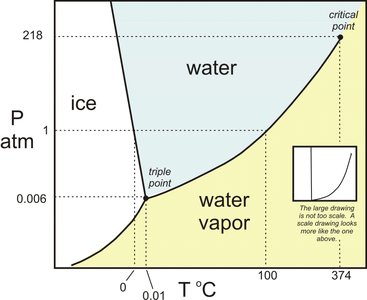
Phase Change Heat Calculations
Heat of Fusion and Heat of Vaporization
Phase changes require specific amounts of energy, known as enthalpy of fusion (ΔHfus) for melting/freezing and enthalpy of vaporization (ΔHvap) for boiling/condensation. These values are typically given per gram or per mole.
Heat of Fusion (ΔHfus): Energy required to change 1 gram (or 1 mole) of a substance from solid to liquid at its melting point.
Heat of Vaporization (ΔHvap): Energy required to change 1 gram (or 1 mole) of a substance from liquid to gas at its boiling point.
The heat required for a phase change can be calculated using:
(where n is the number of moles)
(where m is the mass in grams)
Example: Calculating Heat for Melting
Problem: How much heat is necessary to melt 55.8 g of ice (solid H2O) at 0°C? The heat of fusion of H2O is 79.9 cal/g.
Use:
Calculation:
Example: Calculating Heat for Boiling
Problem: How much heat is necessary to vaporize 685 g of H2O at 100°C? The heat of vaporization of H2O is 540 cal/g.
Use:
Calculation:
Advanced: Multi-Step Heat Calculations
To calculate the total heat required to take a sample of water from a temperature below freezing to steam above boiling, sum the heat for each step:
Heating the solid (ice) to 0°C
Melting the ice to liquid water
Heating the liquid water to 100°C
Vaporizing the water to steam
Heating the steam to the final temperature
Each step uses a different formula (specific heat or enthalpy of phase change) and must be calculated separately, then added together for the total heat (q).
General Formula:
For temperature changes (no phase change):
For phase changes: or
Additional info: The specific heat (c) values for ice, liquid water, and steam differ and must be used appropriately for each segment of the calculation.
