 Back
BackPolarity and Molecular Dipole Moments in Water (H₂O)
Study Guide - Smart Notes
 Tailored notes based on your materials, expanded with key definitions, examples, and context.
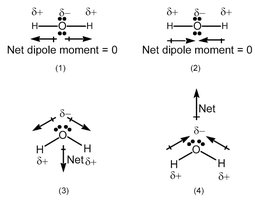
Q38. Which drawing best accounts for the polarity of H₂O and its bond polarities?
Background
Topic: Molecular Polarity and Dipole Moments
This question tests your understanding of how molecular shape and bond polarities combine to produce a net dipole moment in a molecule, specifically water (H₂O).
Key Terms and Concepts:
Polarity: A molecule is polar if it has a net dipole moment due to uneven distribution of electron density.
Dipole Moment: A vector quantity representing the separation of charge in a molecule.
Bond Polarity: Bonds are polar if there is a significant difference in electronegativity between the atoms.
VSEPR Theory: Predicts the shape of molecules based on repulsion between electron pairs.
Step-by-Step Guidance
Recall that water (H₂O) has a bent molecular geometry due to two lone pairs on oxygen, resulting in a bond angle of about 104.5°.
Each O–H bond is polar because oxygen is more electronegative than hydrogen, so the dipole arrows point toward oxygen.
Consider how the individual bond dipoles combine: In a bent molecule, the dipoles do not cancel out, so there is a net dipole moment.
Examine the diagrams: Look for the one that shows both the correct bond polarities (arrows toward O) and a net dipole moment (resultant arrow).
Try solving on your own before revealing the answer!
Final Answer: Drawing (3)
Drawing (3) correctly shows the bent shape of H₂O, the bond dipoles pointing toward oxygen, and a net dipole moment. The other drawings either show linear geometry or canceling dipoles, which do not represent water's polarity.
