 Back
BackPolarity of Bonds and Properties of Nitrogen Molecule (N₂)
Study Guide - Smart Notes
 Tailored notes based on your materials, expanded with key definitions, examples, and context.
Q5. Which of the following bonds is the most polar?
Background
Topic: Bond Polarity and Electronegativity
This question tests your understanding of how differences in electronegativity between two atoms affect the polarity of a chemical bond. The greater the difference, the more polar the bond.
Key Terms and Formulas
Electronegativity: A measure of an atom's ability to attract shared electrons in a bond.
Bond Polarity: Determined by the difference in electronegativity () between the two atoms.
Polarity Formula:
Step-by-Step Guidance
List the electronegativity values for each atom in the bonds (refer to your equation sheet or periodic table).
Calculate the difference in electronegativity () for each bond option: C–H, S–Cl, H–Cl, Al–B, S–F.
Compare the values. The bond with the largest difference is the most polar.
Recall that a higher means a greater separation of charge and thus higher polarity.
Try solving on your own before revealing the answer!
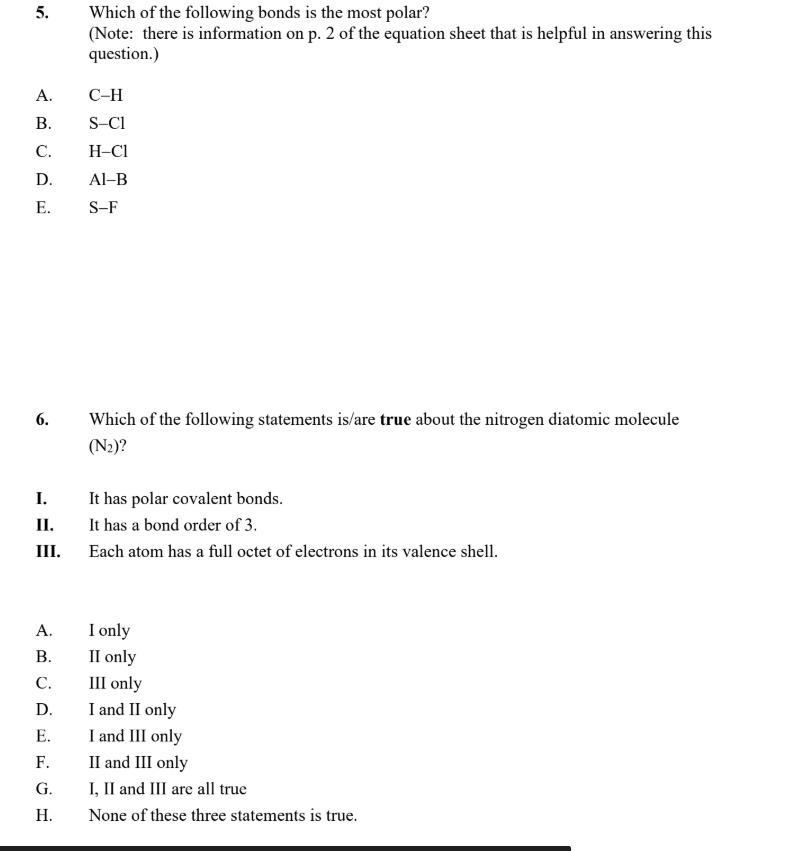
Q6. Which of the following statements is/are true about the nitrogen diatomic molecule (N₂)?
Background
Topic: Molecular Structure, Bond Order, and Octet Rule
This question tests your knowledge of the properties of N₂, including bond type, bond order, and electron configuration.
Key Terms and Formulas
Bond Order: The number of chemical bonds between a pair of atoms. For N₂, bond order is calculated using molecular orbital theory.
Octet Rule: Atoms tend to have eight electrons in their valence shell for stability.
Polar Covalent Bond: A bond where electrons are shared unequally due to differences in electronegativity.
Bond Order Formula:
Step-by-Step Guidance
Recall the structure of N₂: two nitrogen atoms triple-bonded together.
Determine if the N–N bond is polar or nonpolar by comparing the electronegativities of the two nitrogen atoms.
Calculate the bond order for N₂ using the molecular orbital diagram or by counting the bonds (single, double, triple).
Check if each nitrogen atom achieves a full octet in the N₂ molecule.
Try solving on your own before revealing the answer!
