 Back
Practice Exam 3 – General Chemistry: Molecular Structure, Bonding, and Stoichiometry
Study Guide - Smart Notes
 Tailored notes based on your materials, expanded with key definitions, examples, and context.
Q11. Use the following incomplete MO energy diagrams and predict the bond orders for He2 and He22+. Which does not exist?
Background
Topic: Molecular Orbital (MO) Theory
This question tests your understanding of how to use molecular orbital diagrams to determine bond order and molecular stability. You are asked to complete the MO diagrams for He2 and He22+, calculate their bond orders, and decide which species is stable (exists) based on the bond order.
Key Terms and Formulas
Molecular Orbital (MO) Diagram: A diagram that shows the relative energies and electron configurations of molecular orbitals formed from atomic orbitals.
Bond Order: Indicates the strength and stability of a bond. Calculated as:
Bonding MO: Lower energy orbital (e.g., ) that stabilizes the molecule.
Antibonding MO: Higher energy orbital (e.g., ) that destabilizes the molecule.
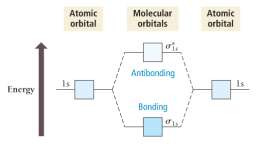
Step-by-Step Guidance
Determine the total number of electrons for each species:
He2: Each He atom has 2 electrons, so He2 has 4 electrons.
He22+: Remove 2 electrons from He2, so it has 2 electrons.
Fill the molecular orbitals in order of increasing energy, starting with the lowest (bonding) orbital:
First fill (bonding), then (antibonding).
Assign electrons to the MOs for each species, following the Pauli exclusion principle and Hund's rule as needed.
Calculate the bond order for each species using the formula above.
Interpret the bond order: If the bond order is zero or negative, the molecule does not exist under normal conditions. If it is positive, the molecule is stable.
Try solving on your own before revealing the answer!
Final Answer:
He2: Bond order = 0. (Does not exist.)
He22+: Bond order = 1. (Exists.)
For He2, all electrons fill both the bonding and antibonding orbitals equally, resulting in a bond order of zero, so it does not exist. For He22+, only the bonding orbital is filled, giving a bond order of 1, so it is stable and exists.
