 Back
BackPrecipitation, Reaction Quotient (Q), and Selective Precipitation in Aqueous Solutions
Study Guide - Smart Notes
 Tailored notes based on your materials, expanded with key definitions, examples, and context.
Precipitation and the Reaction Quotient (Q)
Understanding Precipitation in Aqueous Solutions
Precipitation occurs when the concentration of ions in solution exceeds the solubility of an ionic compound, resulting in the formation of a solid. The extent of solubility is quantified by the solubility product constant (Ksp), and the prediction of precipitation is made using the reaction quotient (Q).
Ksp is the equilibrium constant for the dissolution of a sparingly soluble salt.
Q is calculated using the actual (not necessarily equilibrium) concentrations of ions at any moment.
For a salt such as CaF2:
To determine the state of the solution, compare Q to Ksp:
Q < Ksp: Solution is unsaturated; more solid can dissolve, no precipitation occurs.
Q = Ksp: Solution is saturated; at equilibrium, no net change.
Q > Ksp: Solution is supersaturated; precipitation occurs until Q is reduced to Ksp.
Condition | Solution State | What Happens? | Example |
|---|---|---|---|
Q < Ksp | Unsaturated | More solid dissolves; no precipitation | Drop solid into water → it dissolves |
Q = Ksp | Saturated (equilibrium) | No net change; solid in equilibrium with ions | Excess solid in contact with solution |
Q > Ksp | Supersaturated | Solid precipitates until Q = Ksp | Mix two solutions → precipitation |
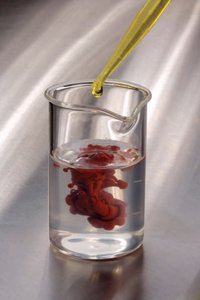
Supersaturated Solutions
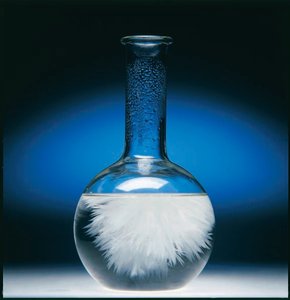
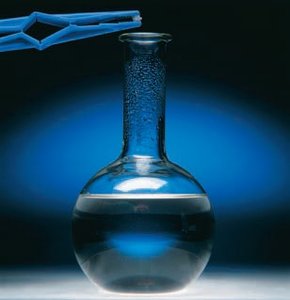
Supersaturated solutions contain more dissolved solute than allowed by equilibrium. Precipitation may not occur immediately due to kinetic hindrance, but the addition of a seed crystal can trigger rapid crystallization.
Example: Supersaturated sodium acetate solution (Q > Ksp).
Crystallization is thermodynamically favored but kinetically hindered until a nucleation site is provided.
Predicting Precipitation: Step-by-Step Method
How to Determine if a Precipitate Will Form
Identify cross products: When mixing solutions, determine all possible ion pairs. Only those with low Ksp (insoluble) can precipitate.
Write the Q expression: For the potentially insoluble product, write using the Ksp stoichiometry.
Calculate ion concentrations after mixing: Account for dilution. If equal volumes are mixed, new [ion] = old [ion] / 2. Otherwise, use .
Calculate Q: Substitute the post-mixing concentrations into the Q expression.
Compare Q to Ksp: If Q > Ksp, a precipitate forms. If Q < Ksp, no precipitate forms. If Q = Ksp, the solution is at equilibrium (rare).
Example: Predicting Precipitation
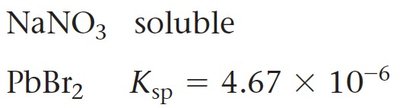
Problem: A solution containing lead(II) nitrate is mixed with one containing sodium bromide to form a solution that is 0.0150 M in Pb(NO3)2 and 0.00350 M in NaBr. Does a precipitate form? (Ksp for PbBr2 = )
Possible cross product: PbBr2 (potentially insoluble)
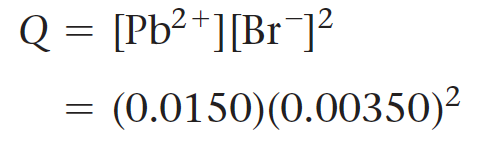
Q = [Pb2+][Br-]2 = (0.0150)(0.00350)2 =
Since Q < Ksp, no precipitate forms; the solution remains unsaturated.
Practice Problem: Will AgI Precipitate?
Stepwise Solution
Given: [AgNO3] = 0.010 M, [KI] = 0.015 M, Ksp (AgI) =
Q = [Ag+][I-] = (0.010)(0.015) =
Q >> Ksp → AgI will precipitate
Limiting ion: Ag+ (smaller moles); after precipitation, Ag+ is nearly zero, excess I- remains.
Selective Precipitation: Separating Mixed Metal Cations
Principles and Strategy
Selective precipitation is a technique to separate ions in a mixture by adding a reagent that precipitates one ion but not others. The key is to choose a precipitating anion so that:
Q > Ksp for the less soluble compound (target) → it precipitates first.
Q < Ksp for the more soluble compound → it stays dissolved.
Ksp values should differ by at least a factor of 103 for effective separation.
Example: Mg2+ and Ca2+ in seawater with KOH.
Mg(OH)2: Ksp = (less soluble, precipitates first)
Ca(OH)2: Ksp = (more soluble, stays dissolved)
Finding Minimum Reagent Concentration for Selective Precipitation
To find the minimum [OH-] to precipitate Mg2+ from seawater, set Q = Ksp and solve for [OH-]:
Given [Mg2+] = 0.059 M
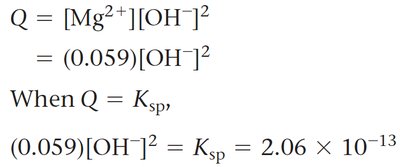
Q = [Mg2+][OH-]2 = (0.059)[OH-]2
Set Q = Ksp:
Solve for [OH-]: [OH-] = M triggers Mg(OH)2 precipitation
Finding Ion Concentration After Selective Precipitation
To find [Mg2+] remaining when Ca(OH)2 just begins to precipitate:
Find [OH-] for Ca(OH)2 precipitation:
Calculate [Mg2+] at this [OH-] using Ksp of Mg(OH)2
Result: [Mg2+] = M when Ca2+ begins to precipitate

Practice Problem: Selective Precipitation of Ba2+ and Ca2+
Given: [Ba2+] = 0.025 M, [Ca2+] = 0.025 M, Ksp (BaSO4) = , Ksp (CaSO4) =
(a) BaSO4 has the smaller Ksp → precipitates first
(b) Minimum [SO42-] to begin precipitating Ba2+: → [SO42-] = M
(c) [SO42-] when Ca2+ begins to precipitate: → [SO42-] = M
[Ba2+] remaining: M
Conclusion: Ba2+ is essentially completely removed before Ca2+ begins to precipitate.

Practice Problem: Precipitation of PbCl2
Mix 50.0 mL of 0.0200 M Pb(NO3)2 with 50.0 mL of 0.0300 M NaCl.
(a) Ksp expression: PbCl2(s) ⇌ Pb2+(aq) + 2 Cl-(aq);
(b) After mixing, concentrations are halved: [Pb2+] = 0.0100 M, [Cl-] = 0.0150 M
Q = (0.0100)(0.0150)2 =
(c) Q < Ksp () → no precipitate forms
(d) No limiting reagent applies since no precipitation occurs.

Key Takeaways
Q is calculated like Ksp but with actual (not equilibrium) concentrations at any moment.
Q < Ksp: unsaturated (no ppt); Q = Ksp: saturated (equilibrium); Q > Ksp: precipitate forms.
When solutions mix, concentrations are diluted—always recalculate concentrations before finding Q.
Selective precipitation: choose a reagent anion to precipitate the less-soluble compound first.
Selective precipitation requires Ksp values to differ by ≥ 103 for practical separation.
Find minimum reagent concentration: set Q = Ksp for target compound and solve for reagent ion.
