 Back
5 Pressure and the Simple Gas Laws: Study Notes for General Chemistry
Study Guide - Smart Notes
 Tailored notes based on your materials, expanded with key definitions, examples, and context.
Phases of Matter and Physical Properties of Gases
States of Matter and Macroscopic Properties
The three primary phases of matter are solid, liquid, and gas. Gases are characterized by their ability to expand spontaneously to fill any container, high compressibility, and the tendency of their molecules to be far apart, resulting in most of the gas being empty space. Despite differences in chemical properties, gases behave similarly in terms of their physical properties.
Solids: Definite shape and volume.
Liquids: Definite volume, no definite shape.
Gases: No definite shape or volume; fill any container.
Gases mix homogeneously and are highly compressible.
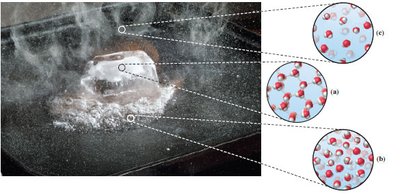
Example: Hydrogen (H2) and methane (CH4) are combustible gases, while helium (He) and neon (Ne) are chemically unreactive but all behave similarly as gases in terms of expansion and compressibility.
Pressure: Definition and Units
Definition of Pressure
Pressure is defined as the force exerted per unit area perpendicular to the surface:
Force (F): Measured in Newtons (N), where (mass × acceleration).
Area (A): Measured in square meters (m2).
Pressure is a scalar quantity.
Units of Pressure
Pressure can be measured in several units. The SI unit is the pascal (Pa), but other units are commonly used in chemistry and physics.
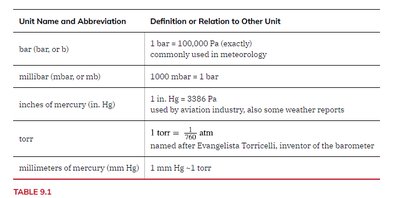
Unit Name and Abbreviation | Definition or Relation to Other Unit |
|---|---|
bar (bar, or b) | 1 bar = 100,000 Pa (exactly); commonly used in meteorology |
millibar (mbar, or mb) | 1000 mbar = 1 bar |
inches of mercury (in. Hg) | 1 in. Hg = 3386 Pa; used by aviation industry |
torr | 1 torr = atm; named after Torricelli |
millimeters of mercury (mm Hg) | 1 mm Hg = 1 torr |
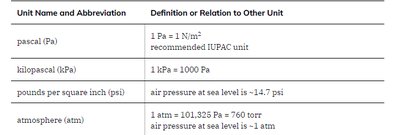
Unit Name and Abbreviation | Definition or Relation to Other Unit |
|---|---|
pascal (Pa) | 1 Pa = 1 N/m2; recommended IUPAC unit |
kilopascal (kPa) | 1 kPa = 1000 Pa |
pounds per square inch (psi) | Air pressure at sea level is ~14.7 psi |
atmosphere (atm) | 1 atm = 101,325 Pa = 760 torr; air pressure at sea level |
Standard Temperature and Pressure (STP): 0°C and 1 bar (100,000 Pa)
Normal Temperature and Pressure (NTP): 20°C and 1 atm
Gas and Liquid Pressure
Gas Pressure
In a closed container, the pressure of a gas is constant everywhere if the weight of the fluid can be neglected. Gas pressure results from the collisions of gas molecules with the walls of the container.
Liquid Pressure and Pressure at Depth
Liquid pressure depends on the density and height of the liquid column. The pressure at a depth h in a fluid is given by:
P0: Pressure at the surface (often atmospheric pressure)
ρ: Density of the liquid (kg/m3)
g: Acceleration due to gravity (9.81 m/s2)
h: Height (depth) of the liquid column (m)
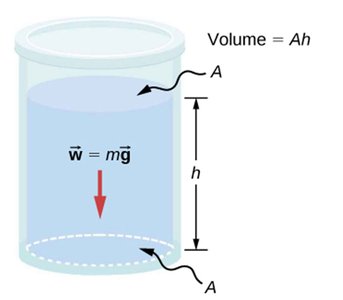
Example: The pressure at the bottom of a swimming pool is greater than at the surface due to the weight of the water above.
Gauge Pressure vs. Absolute Pressure
Definitions
Absolute pressure is the total pressure exerted, including atmospheric pressure. Gauge pressure is the pressure relative to atmospheric pressure:
psig: Pounds per square inch gauge (relative to atmospheric pressure)
psia: Pounds per square inch absolute (includes atmospheric pressure)
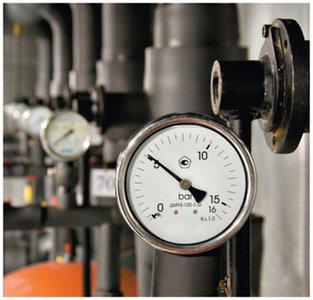
Example: A car tire gauge reads the pressure above atmospheric pressure (gauge pressure).
Pressure Measurement Devices
Barometer
A barometer measures atmospheric pressure. It consists of a closed-end tube filled with a non-volatile liquid (usually mercury) and inverted in a dish of the same liquid. The height of the liquid column is proportional to atmospheric pressure.

Manometer
A manometer measures the pressure of a gas in a vessel. There are two main types:
Closed-end manometer: One end is sealed (vacuum); measures absolute pressure.
Open-end manometer: One end is open to the atmosphere; measures gauge pressure.
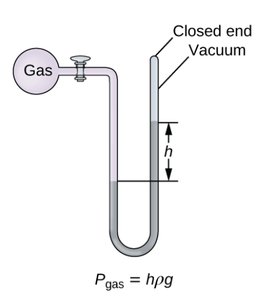
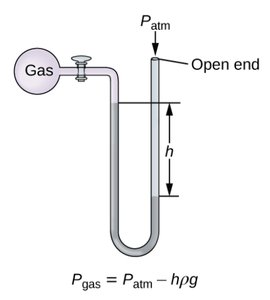
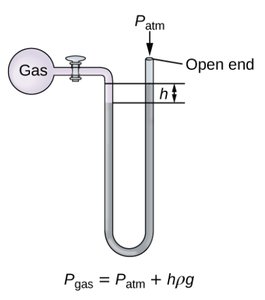
Example: If the height difference in a glycerin manometer is 0.250 m and atmospheric pressure is 101 kPa, the absolute pressure can be calculated using .
The Simple Gas Laws
State Variables for Gases
Four variables define the state of a gas:
Pressure (P)
Volume (V)
Temperature (T) (in Kelvin)
Amount of gas (n) (in moles)
The relationships between these variables are described by the simple gas laws, which are empirical and consistent with molecular theory.
Boyle’s Law
Boyle’s Law states that for a fixed amount of gas at constant temperature, the volume of the gas is inversely proportional to its pressure:
(where is a constant for a given amount of gas at constant temperature)
Or, for two states:

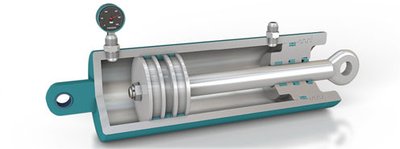
Example: Compressing a gas in a syringe (decreasing volume) increases its pressure if temperature is constant.
Charles’s Law
Charles’s Law states that the volume of a fixed amount of gas at constant pressure is directly proportional to the Kelvin temperature:
(where is a constant for a given amount of gas at constant pressure)
Or, for two states:

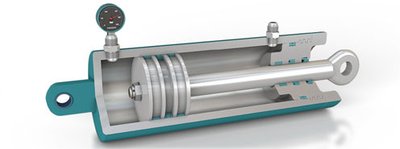
Example: Heating a balloon causes it to expand as the temperature increases, provided the pressure remains constant.
Avogadro’s Law
Avogadro’s Law states that at fixed temperature and pressure, the volume of a gas is directly proportional to the amount of gas (in moles):
(where is a proportionality constant)
Or, for two states:

Example: Doubling the number of moles of gas in a container (at constant T and P) doubles the volume.
Applications and Example Problems
Calculating Pressure at Depth: Use for fluids.
Using Manometers: For closed-end, ; for open-end, depending on the relative heights.
Gas Law Calculations: Use the appropriate law (Boyle’s, Charles’s, or Avogadro’s) based on which variables are held constant.
Example Problem: A gas at 1.00 L and 25°C is heated to 50°C at constant pressure. What is the new volume?
Convert temperatures to Kelvin: K, K
L
Answer: 1.08 L
Additional info: These laws are foundational for understanding the behavior of gases and are further extended in the ideal gas law, which combines all these relationships into a single equation: .
