 Back
Pressure, Temperature, and Molecular Motion in Gases
Study Guide - Smart Notes
 Tailored notes based on your materials, expanded with key definitions, examples, and context.
Pressure, Temperature, and RMS Speed
Macroscopic and Microscopic Properties of Gases
The kinetic theory of gases connects the observable properties of gases, such as pressure and temperature, to the microscopic behavior of gas molecules. This theory is based on several key assumptions about ideal gases:
Gas molecules are numerous, identical, and each has mass m.
Molecules move randomly and obey Newton's laws.
The volume of molecules is negligible compared to the container's volume.
Collisions between molecules and with the container walls are perfectly elastic.
Pressure arises from collisions of molecules with the container walls. The more frequent and energetic these collisions, the higher the pressure. Temperature is a measure of the average kinetic energy of the molecules.
Kinetic Theory and the Ideal Gas Law
By analyzing the motion and collisions of molecules in a container, we derive the ideal gas law and relate temperature to molecular kinetic energy. For a monatomic ideal gas, the only energy is translational kinetic energy.
The average force exerted by molecules on the wall leads to the equation:
Combining with the ideal gas law gives:
The average kinetic energy per molecule is thus:
The internal energy of a monatomic ideal gas is:
Root-Mean-Square (RMS) Speed
The root-mean-square (rms) speed of a molecule is a measure of the typical speed of molecules in a gas:
Alternatively, in terms of the gas constant R and molar mass M:
The rms speed increases with temperature and decreases with increasing molecular mass.
Example: Kinetic Energy and RMS Speed of Nitrogen
At 20°C (293 K), the average kinetic energy of a nitrogen molecule is J.
The rms speed of a nitrogen molecule () is 511 m/s.
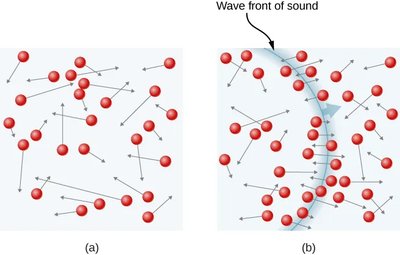
Figure: (a) Gas molecules move rapidly and collide frequently. (b) Sound waves propagate as disturbances in molecular motion, with the wave front moving at a speed related to the rms speed of molecules.
Escape Velocity and Atmospheric Loss
Gas molecules can escape a planet's atmosphere if their speed exceeds the escape velocity. The temperature at which the rms speed of helium equals Earth's escape velocity (11.1 km/s) is extremely high ( K), explaining why light gases like helium are rare in Earth's atmosphere. Heavier gases are retained more effectively due to their lower rms speeds.

Figure: The Moon has virtually no atmosphere because its low gravity allows gas molecules to escape easily, as illustrated by the black sky in this lunar surface image.
Vapor Pressure, Partial Pressure, and Dalton’s Law
Partial Pressure and Dalton’s Law
In a mixture of ideal gases, each gas exerts a partial pressure as if it were alone in the container. Dalton’s law of partial pressures states:
Each gas obeys the ideal gas law independently.
The number of molecules of each gas is proportional to its partial pressure at equilibrium.
Partial pressure is crucial in chemistry, especially for determining reaction rates and physiological effects (e.g., oxygen partial pressure in the lungs).
Vapor Pressure and Relative Humidity
Vapor pressure is the partial pressure of a vapor in equilibrium with its liquid (or solid) phase. The relative humidity (R.H.) at temperature T is:
When R.H. = 100%, the air is saturated and condensation occurs (dew point).
Temperature (°C) | Vapor Pressure (Pa) |
|---|---|
0 | 610.5 |
10 | 1228 |
20 | 2338 |
25 | 3167 |
30 | 4243 |
40 | 7376 |
Example: If the air temperature is 25°C and the dew point is 15°C, the relative humidity is:
Mean Free Path and Mean Free Time
Collisions and Mean Free Path
The mean free path () is the average distance a molecule travels between collisions. For molecules modeled as spheres of radius r:
For an ideal gas, substituting gives:
Mean Free Time
The mean free time () is the average time between collisions:
Example: For argon at 0°C and 1 atm, with atomic radius m, s.
Summary Table: Key Equations
Quantity | Equation |
|---|---|
Ideal Gas Law | |
Average Kinetic Energy | |
RMS Speed | |
Mean Free Path | |
Mean Free Time |
Additional info: The kinetic theory provides a foundation for understanding gas laws, transport phenomena, and the behavior of real gases under various conditions. Quantum effects become important for rotational and vibrational energies in diatomic and polyatomic gases, but for monatomic gases at ordinary temperatures, translational kinetic energy dominates.
