 Back
Properties and States of Matter: Foundations of General Chemistry
Study Guide - Smart Notes
 Tailored notes based on your materials, expanded with key definitions, examples, and context.
Properties of Matter
Physical vs. Chemical Properties
The properties of matter are fundamental characteristics that help us identify and classify substances. These properties are divided into two main categories: physical properties and chemical properties.
Physical Properties: Characteristics that can be observed or measured without changing the substance's chemical identity. Examples include density, color, hardness, melting point, and boiling point.
Chemical Properties: Characteristics that can only be observed when a substance undergoes a chemical change or reaction, resulting in the formation of a new substance. Examples include reactivity with oxygen, flammability, and acidity.
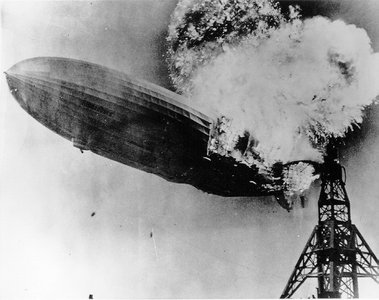
Example: Hydrogen gas reacts explosively with oxygen to form water, demonstrating a chemical property (reactivity).
Extensive vs. Intensive Properties
Properties of matter can also be classified based on their dependence on the amount of substance present:
Intensive Properties: Independent of the amount of substance. Examples include color, temperature, density, boiling point, and conductivity.
Extensive Properties: Dependent on the quantity of substance. Examples include mass, volume, length, and energy.
Key Point: The ratio of two extensive properties that scale in the same way (such as mass and volume) yields an intensive property (such as density).
Density: A Key Physical Property
Definition and Formula
Density is an intensive property defined as the mass of a substance per unit volume. It is a useful parameter for identifying substances and predicting their behavior in mixtures.
Formula:
Rearranged forms:
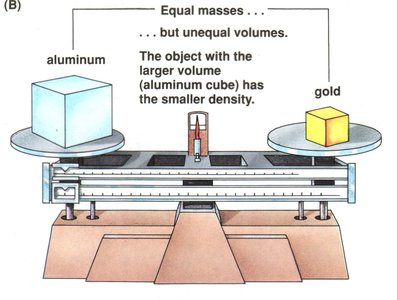
Example Calculation: If a liquid has a density of 0.87 g/mL, what volume is occupied by 25 g of the liquid?
States of Matter
Classification and Properties
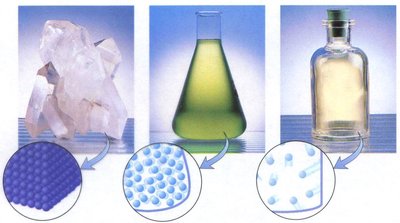
Matter exists in three primary states, each with distinct physical characteristics:
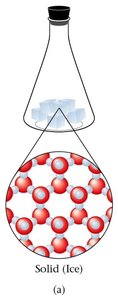
Solid (s): Definite shape and volume. Particles are closely packed in a fixed arrangement.
Liquid (l): Definite volume but no definite shape. Particles are close together but can move past one another.
Gas (g): Neither definite shape nor volume. Particles are far apart and move freely.
Microscopic View of States
The arrangement and movement of particles differ in each state:
Solids: Particles vibrate in fixed positions.
Liquids: Particles move more freely but remain in contact.
Gases: Particles move independently and are widely separated.
Phase Changes and Energy
Energy Changes Accompanying Phase Transitions
Transitions between states of matter involve energy changes:
Melting: Solid to liquid (energy absorbed)
Freezing: Liquid to solid (energy released)
Vaporization: Liquid to gas (energy absorbed)
Condensation: Gas to liquid (energy released)
Sublimation: Solid to gas (energy absorbed)
Deposition: Gas to solid (energy released)
Phase Diagrams
Understanding Phase Diagrams
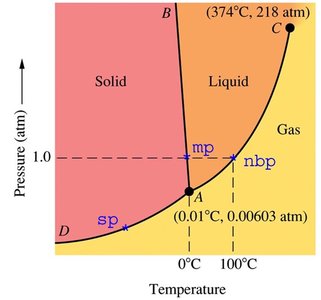
A phase diagram is a graphical representation showing the state of a substance as a function of temperature and pressure. It helps predict the conditions under which a substance exists as a solid, liquid, or gas.
Key Points: The lines (boundaries) indicate conditions where two phases coexist in equilibrium. The triple point is where all three phases coexist. The critical point marks the end of the liquid-gas boundary.
Summary Table: Properties of Matter
Property Type | Definition | Examples |
|---|---|---|
Physical | Observed without changing chemical identity | Density, color, melting point |
Chemical | Observed during a chemical change | Reactivity, flammability |
Intensive | Independent of amount | Density, temperature |
Extensive | Dependent on amount | Mass, volume |
