 Back
Properties of Solutions, Electrolytes, Precipitation, and Solution Stoichiometry
Study Guide - Smart Notes
 Tailored notes based on your materials, expanded with key definitions, examples, and context.
General Properties of Solutions
Definition and Components
Solutions are homogeneous mixtures of two or more pure substances. The solvent is the substance present in greatest abundance, typically a liquid, while solutes can be solids, liquids, or gases. When water is the solvent, the solution is termed an aqueous solution.
Solvent: The major component, usually a liquid.
Solute: The minor component(s), can be solid, liquid, or gas.
Aqueous solution: Water is the solvent.
Example: Sodium chloride (NaCl) dissolved in water forms an aqueous solution. 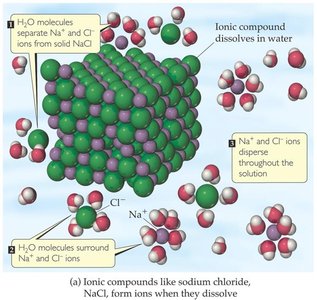
Dissolution of Ionic and Molecular Compounds
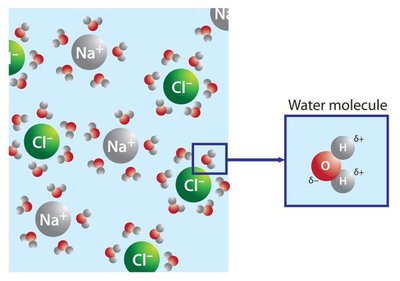
When ionic compounds dissolve in water, their ions dissociate and become surrounded by water molecules, forming solvated ions. Molecular compounds, such as methanol (CH3OH), dissolve without forming ions.
Dissociation: Ionic compounds separate into ions.
Solvation: Water molecules surround the ions.
Molecular compounds: Dissolve without ion formation.
Example: NaCl dissociates into Na+ and Cl- ions, while CH3OH dissolves as intact molecules. 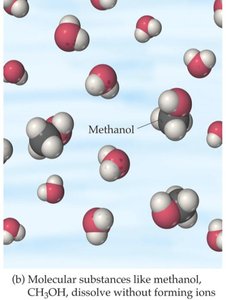
Electrolytic Properties
Types of Electrolytes
Electrolytes are substances whose aqueous solutions conduct electricity due to the presence of ions. They are classified as strong, weak, or nonelectrolytes.
Strong Electrolytes: Dissociate completely in water, producing many ions and conducting electricity well. Examples: NaCl, KBr, strong acids and bases.
Weak Electrolytes: Partially dissociate, producing fewer ions and conducting poorly. Examples: CH3COOH, NH3.
Nonelectrolytes: Do not produce ions; their solutions do not conduct electricity. Examples: sugar, methanol.
Example: The degree of ion formation in solution can be visualized by the number of ions present in beakers. 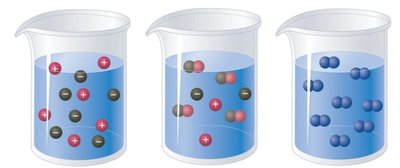
Precipitation Reactions
Formation of Precipitates
A precipitation reaction occurs when two solutions of soluble ionic compounds are mixed and an insoluble product (precipitate) forms. The solubility of a substance is the maximum amount that can dissolve in a given quantity of solvent at a specific temperature.
Precipitate: An insoluble solid formed in solution.
Solubility: If less than 0.01 mol/L, the compound is considered insoluble.
Example: Mixing Pb(NO3)2 and KI forms PbI2 precipitate. 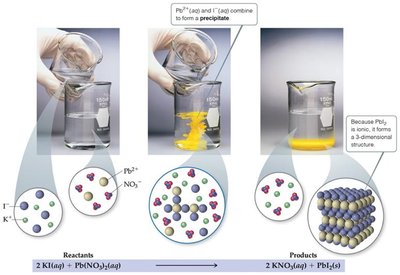
Solubility Rules
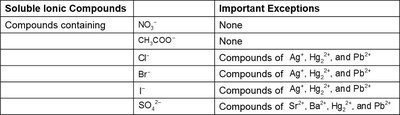
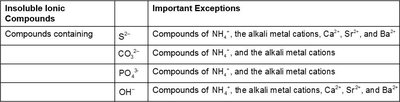
Solubility rules help predict whether a compound will dissolve in water or form a precipitate. Tables list common soluble and insoluble ionic compounds and their exceptions.
Soluble compounds: Nitrates, acetates, most chlorides, bromides, iodides, and sulfates.
Insoluble compounds: Sulfides, carbonates, phosphates, hydroxides (with exceptions).
Example: Use solubility tables to determine if a reaction will produce a precipitate.
Soluble Ionic Compounds | Important Exceptions |
|---|---|
NO3- | None |
CH3COO- | None |
Cl- | Ag+, Hg22+, Pb2+ |
Br- | Ag+, Hg22+, Pb2+ |
I- | Ag+, Hg22+, Pb2+ |
SO42- | Sr2+, Ba2+, Hg22+, Pb2+ |
Insoluble Ionic Compounds | Important Exceptions |
|---|---|
S2- | NH4+, alkali metal cations, Ca2+, Sr2+, Ba2+ |
CO32- | NH4+, alkali metal cations |
PO43- | NH4+, alkali metal cations |
OH- | NH4+, alkali metal cations, Ca2+, Sr2+, Ba2+ |
Exchange (Metathesis) Reactions
Reaction Mechanism and Balancing
Exchange reactions involve the swapping of ions between two soluble ionic compounds, often resulting in a precipitate. The general form is:
General equation:
Balance the equation by ensuring equal numbers of each atom on both sides.
Example: AgNO3(aq) + KCl(aq) → AgCl(s) + KNO3(aq)
Ionic Equations
Molecular, Complete Ionic, and Net Ionic Equations
Chemical reactions in solution can be represented in three ways:
Molecular Equation (ME): Shows all reactants and products in their complete chemical forms.
Complete Ionic Equation (CIE): Shows all strong electrolytes as ions.
Net Ionic Equation (NIE): Shows only the species that change during the reaction; spectator ions are omitted.
Example:
ME: AgNO3(aq) + KCl(aq) → AgCl(s) + KNO3(aq)
CIE: Ag+(aq) + NO3-(aq) + K+(aq) + Cl-(aq) → AgCl(s) + K+(aq) + NO3-(aq)
NIE: Ag+(aq) + Cl-(aq) → AgCl(s)
Acids and Bases
Bronsted-Lowry Definition
Acids and bases are defined by their ability to donate or accept protons (H+):
Acid: Donates H+ to another substance.
Base: Accepts H+ from another substance.
Neutralization: Reaction between an acid and a base, producing a salt and water.
Example: HCl(aq) + NaOH(aq) → NaCl(aq) + H2O(l)
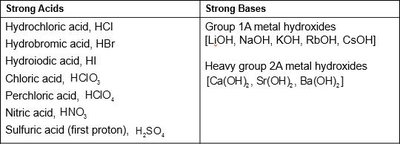
Strong Acids | Strong Bases |
|---|---|
Hydrochloric acid, HCl | Group 1A metal hydroxides (LiOH, NaOH, KOH, RbOH, CsOH) |
Hydrobromic acid, HBr | Heavy group 2A metal hydroxides (Ca(OH)2, Sr(OH)2, Ba(OH)2) |
Hydroiodic acid, HI | |
Chloric acid, HClO3 | |
Perchloric acid, HClO4 | |
Nitric acid, HNO3 | |
Sulfuric acid (first proton), H2SO4 |
Concentration of Solutions
Molarity
Molarity (M) is a measure of concentration, defined as moles of solute per liter of solution.
Formula:
Units: mol/L
Example: Calculate the molarity of a solution containing 5.30 moles of CuSO4 in 0.750 L:
Expressing Ion Concentrations
When ionic compounds dissolve, the concentration of each ion depends on the compound's formula.
1 mol NaCl → 1 mol Na+ + 1 mol Cl-
1 M NaCl solution → 1 M Na+ and 1 M Cl-
1 mol Na2SO4 → 2 mol Na+ + 1 mol SO42-
Mass-Related Concentrations
Mass Percentage, ppm, and ppb
Concentration can also be expressed as mass percentage, parts per million (ppm), or parts per billion (ppb).
Mass %:
ppm:
ppb:
Dilutions
Preparing Dilute Solutions
Dilution involves adding solvent to a concentrated solution to decrease its solute concentration. The number of moles of solute remains constant before and after dilution.
Formula:
= initial molarity, = initial volume
= final molarity, = final volume
Example: How many mL of 4.0 M AgNO3 are needed to make 320 mL of 0.2 M AgNO3?
Solution Stoichiometry and Chemical Analysis
Stoichiometry in Solution Reactions
Stoichiometry involves using balanced chemical equations to relate quantities of reactants and products. In solution, the number of moles is calculated using molarity and volume.
Formula:
Use molar ratios from the balanced equation to relate reactants and products.
Example: What mass of NaOH is needed to precipitate Cd2+ ions from 20.0 mL of 0.100 M Cd(NO3)2?
Step 1: Calculate moles of Cd(NO3)2
Step 2: Use molar ratio to find moles of NaOH
Step 3: Calculate mass of NaOH
Summary Table: Strong Acids and Bases
Strong Acids | Strong Bases |
|---|---|
HCl, HBr, HI, HClO3, HClO4, HNO3, H2SO4 (first proton) | LiOH, NaOH, KOH, RbOH, CsOH, Ca(OH)2, Sr(OH)2, Ba(OH)2 |
Additional info: Academic context and examples have been expanded for clarity and completeness. All included images directly reinforce the explanation of the adjacent paragraph.
