 Back
BackProperties of Solutions: Structure, Formation, and Colligative Effects
Study Guide - Smart Notes
 Tailored notes based on your materials, expanded with key definitions, examples, and context.
Properties of Solutions
Introduction to Solutions
Solutions are homogeneous mixtures composed of a solute and a solvent. The solvent is the major component, while the solute is the minor component, uniformly dispersed throughout the solvent. Solutions can exist in various states: gas, liquid, or solid.
Solute: The substance being dissolved.
Solvent: The substance doing the dissolving.
Homogeneous: Uniform composition throughout.
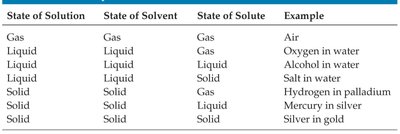
State of Solution | State of Solvent | State of Solute | Example |
|---|---|---|---|
Gas | Gas | Gas | Air |
Liquid | Liquid | Gas | Oxygen in water |
Liquid | Liquid | Liquid | Alcohol in water |
Liquid | Liquid | Solid | Salt in water |
Solid | Solid | Gas | Hydrogen in palladium |
Solid | Solid | Liquid | Mercury in silver |
Solid | Solid | Solid | Silver in gold |
Energy Changes in Solution Formation
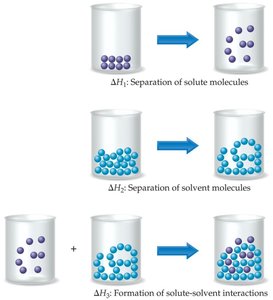
The formation of a solution involves three main energy changes:
\( \Delta H_1 \): Separation of solute particles (endothermic, \( \Delta H_1 > 0 \)).
\( \Delta H_2 \): Separation of solvent particles (endothermic, \( \Delta H_2 > 0 \)).
\( \Delta H_3 \): Formation of solute-solvent interactions (exothermic, \( \Delta H_3 < 0 \)).
The overall enthalpy change for solution formation is:
If \( \Delta H_3 > (\Delta H_1 + \Delta H_2) \), the process is exothermic. If \( \Delta H_3 < (\Delta H_1 + \Delta H_2) \), the process is endothermic.
Example (Exothermic): MgSO4 in water, \( \Delta H_{soln} = -91.21 \) kJ/mol.
Example (Endothermic): NH4NO3 in water, \( \Delta H_{soln} = +26.4 \) kJ/mol.
Entropy and Solution Formation
In addition to enthalpy, entropy (S)—a measure of randomness—also favors solution formation. Higher entropy means greater disorder:
The Solution Process
Solvation and Dissolution
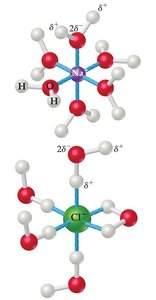
As a solution forms, the solvent pulls solute particles apart and surrounds them, a process called solvation (or hydration in water).
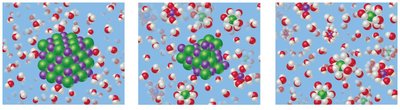
For ionic salts, ion-dipole interactions between ions and water molecules overcome the lattice energy of the salt crystal, allowing dissolution.
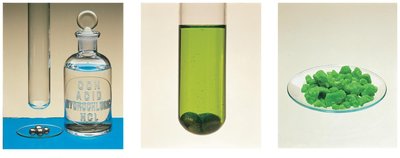
Distinguishing Dissolution from Disappearance
Not all substances that disappear in a solvent are dissolved; some may react or form a suspension.
Saturated Solution and Solubility
Types of Solutions
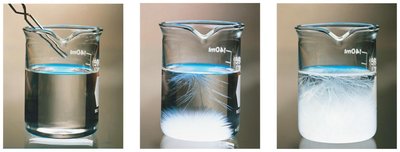
Solutions can be classified based on the amount of solute relative to solvent:
Unsaturated: Contains less solute than the solvent can hold.
Saturated: Solute and solvent are in equilibrium; maximum solute dissolved.
Supersaturated: Contains more solute than the solvent can normally hold.
Factors Affecting Solubility
Solute-Solvent Interactions
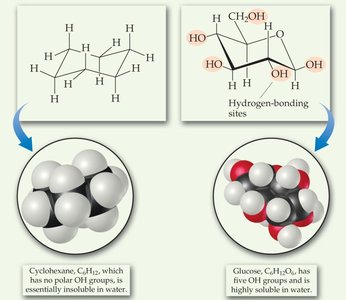
The solubility of a solute depends on the strength of attractive forces between solute and solvent molecules. Substances with similar intermolecular forces tend to dissolve in one another:
Polar substances dissolve in polar solvents.
Non-polar substances dissolve in non-polar solvents.
"Like dissolves like" is a useful rule of thumb.
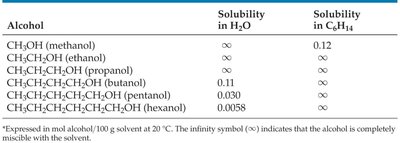
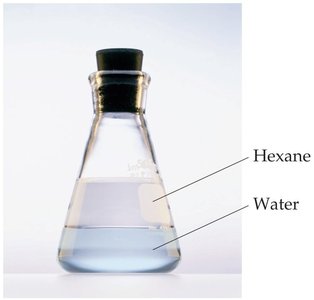
For example, water (polar) and hexane (non-polar) will not mix; they are immiscible.
Glucose, which forms hydrogen bonds, is highly soluble in water, while cyclohexane, which only has dispersion forces, is not.
Pressure Effect
The solubility of gases in liquids increases with increasing pressure, described by Henry's Law:
= solubility of the gas
= Henry's Law constant
= partial pressure of the gas above the liquid
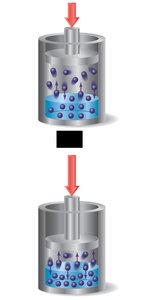
Example: The solubility of O2 in water at 25°C and 0.21 atm is .
Temperature Effect
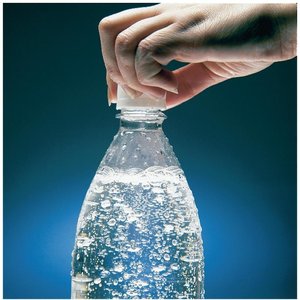
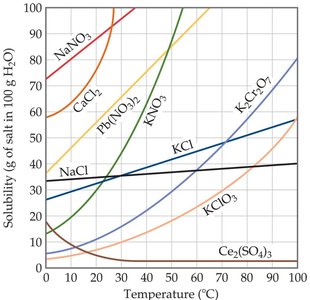
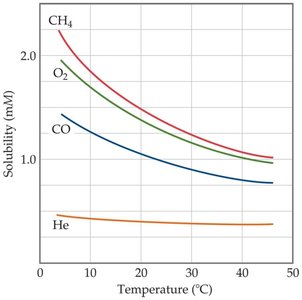
Generally, the solubility of solid solutes in liquid solvents increases with temperature, while the solubility of gases decreases with temperature.
Warm lakes have less dissolved O2 than cool lakes, and carbonated drinks lose their fizz when warm.
Expressing Concentrations of Solutions
Mass Percent
Mass percent is the mass of solute divided by the total mass of solution, multiplied by 100:
Parts per Million (ppm) and Parts per Billion (ppb)
These units are used for very dilute solutions:
Mole Fraction (X)
The mole fraction is the ratio of moles of a component to the total moles in the solution:
Molarity (M)
Molarity is the number of moles of solute per liter of solution:
Note: Molarity is temperature-dependent because volume changes with temperature.
Molality (m)
Molality is the number of moles of solute per kilogram of solvent:
Molality is not temperature-dependent.
Colligative Properties
Definition and Types
Colligative properties depend only on the number of solute particles, not their identity. These include:
Vapor pressure lowering
Boiling point elevation
Freezing point depression
Osmotic pressure
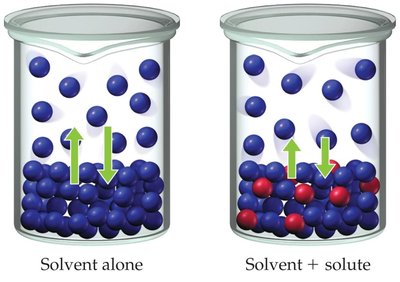
Vapor Pressure Lowering
Dissolving a non-volatile solute lowers the vapor pressure of the solvent, described by Raoult's Law:
= mole fraction of solvent
= vapor pressure of pure solvent
= vapor pressure of solution
Boiling Point Elevation
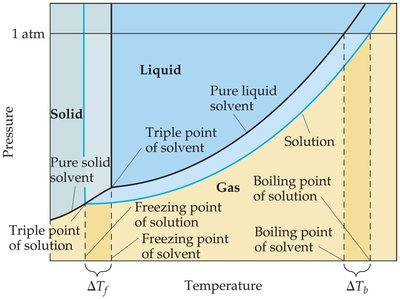
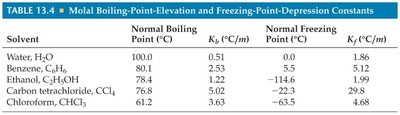
Adding a nonvolatile solute increases the boiling point of the solvent:
= molal boiling point elevation constant
= molality
Boiling point of solution:
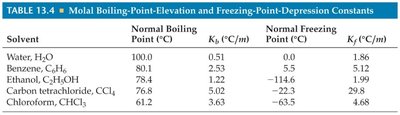
Solvent | Normal Boiling Point (°C) | Kb (°C/m) |
|---|---|---|
Water, H2O | 100.0 | 0.51 |
Benzene, C6H6 | 80.1 | 2.53 |
Ethanol, C2H5OH | 78.4 | 1.22 |
Carbon tetrachloride, CCl4 | 76.8 | 5.02 |
Chloroform, CHCl3 | 61.2 | 3.63 |
Freezing Point Depression
Adding a nonvolatile solute lowers the freezing point of the solvent:
= molal freezing point depression constant
= molality
Freezing point of solution:
Osmosis and Osmotic Pressure
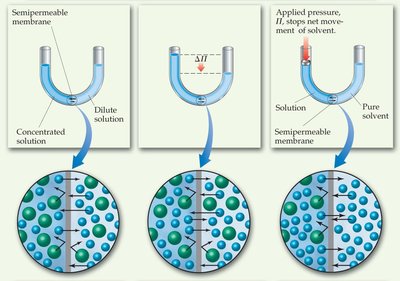
Osmosis is the movement of solvent molecules from an area of higher solvent concentration to lower solvent concentration through a semi-permeable membrane. Osmotic pressure (\( \pi \)) is the pressure required to stop osmosis:
= molarity
= ideal gas constant
= temperature (K)
Osmosis in Blood Cells
Hypertonic, Hypotonic, and Isotonic Solutions
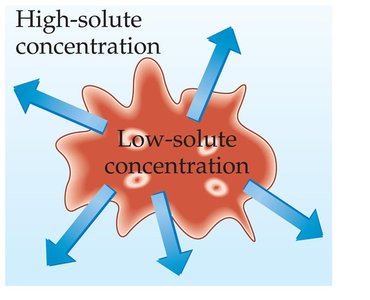
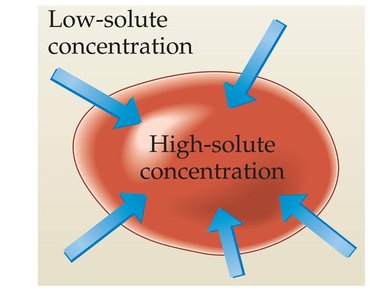
Blood cells respond to the osmotic pressure of their environment:
Hypertonic: Solute concentration outside the cell is greater; water flows out, causing crenation.
Hypotonic: Solute concentration outside the cell is less; water flows in, causing hemolysis.
Isotonic: Equal solute concentration; no net water movement.
Additional info: All equations are provided in LaTeX format for clarity. Tables are recreated for comparison and classification. Images are included only when directly relevant to the explanation of the paragraph.
