 Back
BackQuantum Mechanical Model of the Atom – Study Notes
Study Guide - Smart Notes
 Tailored notes based on your materials, expanded with key definitions, examples, and context.
Quantum Mechanical Model of the Atom
Properties of Light as a Wave
The quantum mechanical model of the atom begins with understanding the nature of light. Light exhibits wave-like properties, which are characterized by several key parameters:
Wavelength (\(\lambda\)): The distance between identical points on successive waves, typically measured in meters (m).
Frequency (\(\nu\)): The number of waves that pass a particular point in one second, measured in Hertz (Hz).
Amplitude (A): The vertical distance from the midline of a wave to its peak or trough, indicating the wave's intensity.
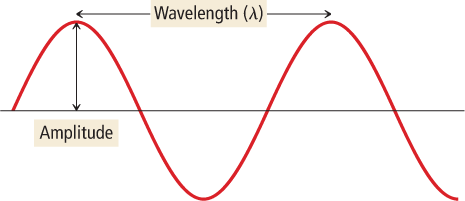
The relationship between wavelength and frequency for light is given by the equation:
Where c is the speed of light (\(3.00 \times 10^8\) m/s).
The Electromagnetic Spectrum
The electromagnetic spectrum encompasses all types of electromagnetic radiation, ranging from radio waves to gamma rays. Each type of radiation is defined by its wavelength and frequency. Visible light is only a small portion of this spectrum.
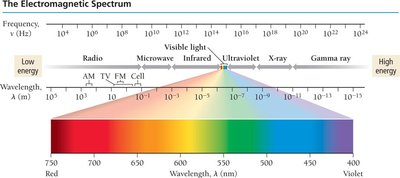
Low energy: Radio, microwave, infrared
Visible light: 400–750 nm (violet to red)
High energy: Ultraviolet, X-ray, gamma ray
Wave Interference and Diffraction
Waves can interact with each other in two primary ways:
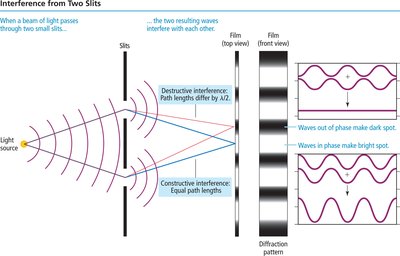
Constructive interference: Occurs when waves are in phase, resulting in a wave of greater amplitude.
Destructive interference: Occurs when waves are out of phase, resulting in cancellation.
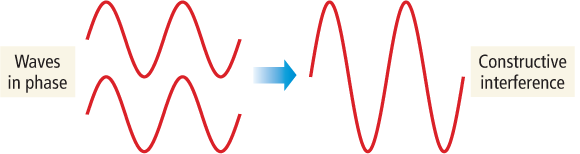
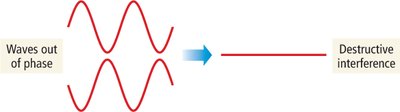
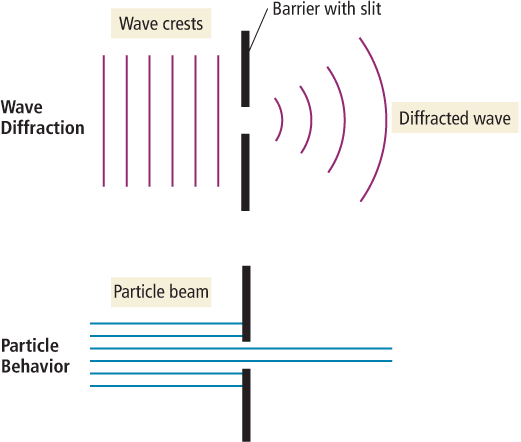
Diffraction is the bending of waves around obstacles or through slits, demonstrating the wave nature of light.
When light passes through two slits, the resulting waves interfere, creating a pattern of bright and dark spots due to constructive and destructive interference.
The Photoelectric Effect and the Particle Nature of Light
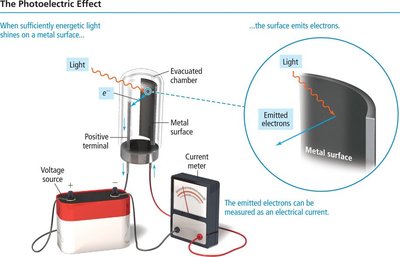
Light also exhibits particle-like properties. The photoelectric effect, explained by Einstein, shows that light can eject electrons from a metal surface if it has sufficient energy. This energy is delivered in discrete packets called photons.
The energy of a photon is given by:
Where h is Planck's constant (\(6.626 \times 10^{-34}\) J·s).
Bohr Model and Quantization of Energy Levels
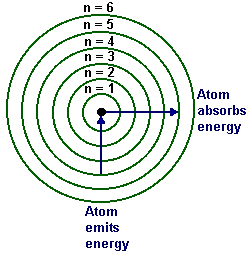
Niels Bohr proposed that electrons in atoms occupy quantized energy levels. Electrons can only exist in specific orbits (energy levels) and not between them. Energy is absorbed or emitted when an electron transitions between these levels.
Ground state: Lowest energy level (n = 1)
Excited states: Higher energy levels (n = 2, 3, ...)

The energy of each level in the hydrogen atom is given by:
Where n is the principal quantum number.
Atomic Spectra and Electron Transitions
When electrons transition between energy levels, they absorb or emit photons of specific energies, producing line spectra. The emission spectrum of hydrogen consists of distinct lines corresponding to these transitions.
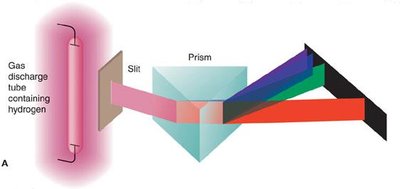

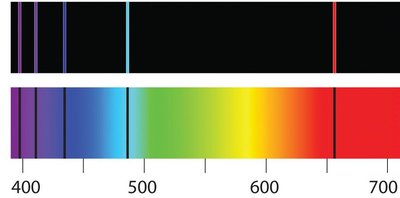
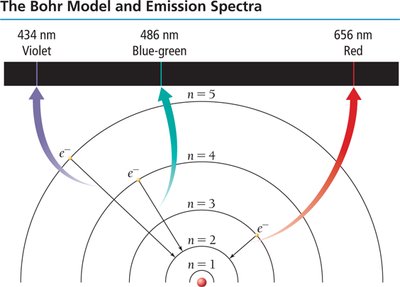
Absorption: Electron absorbs a photon and moves to a higher energy level.
Emission: Electron emits a photon and falls to a lower energy level.
The energy change for a transition is:
The wavelength of the emitted or absorbed photon is related to the energy by:
de Broglie Hypothesis and Matter Waves
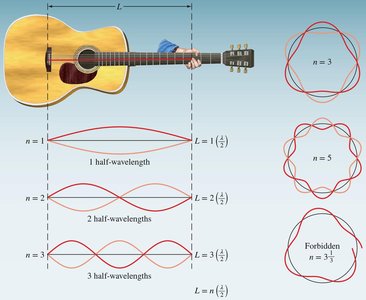
Louis de Broglie proposed that particles such as electrons also have wave-like properties. The wavelength associated with a particle is given by:
Where m is mass and v is velocity.
Heisenberg Uncertainty Principle
Werner Heisenberg formulated the uncertainty principle, which states that it is impossible to know both the position and momentum of a particle with absolute certainty. The more precisely one is known, the less precise the other becomes.
Where \(\Delta x\) is the uncertainty in position and \(\Delta p\) is the uncertainty in momentum.

Quantum Mechanical Model: Probability and Orbitals
Quantum mechanics describes electrons in terms of probability distributions rather than fixed orbits. The wavefunction (\(\Psi\)) describes the probability amplitude, and \(\Psi^2\) gives the probability density of finding an electron in a particular region.

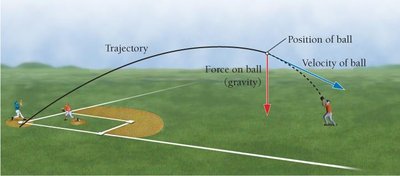
Atomic orbitals are regions in space with a high probability of finding an electron.
Quantum Numbers and Atomic Orbitals
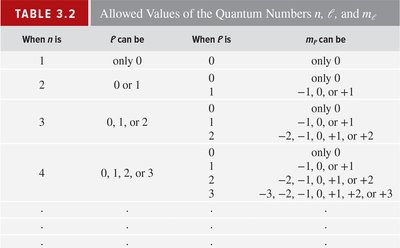
Quantum numbers describe the properties of atomic orbitals and the electrons within them:
n: Principal quantum number (energy level, size of orbital)
l: Angular momentum quantum number (shape of orbital; 0 = s, 1 = p, 2 = d, 3 = f)
m_l: Magnetic quantum number (orientation of orbital in space)
m_s: Spin quantum number (+1/2 or -1/2; direction of electron spin)



Pauli Exclusion Principle: No two electrons in an atom can have the same set of four quantum numbers. Each orbital can hold a maximum of two electrons with opposite spins.
Shapes and Energies of Atomic Orbitals
Atomic orbitals have characteristic shapes and energies:
s orbitals: Spherical shape
p orbitals: Dumbbell shape, oriented along x, y, or z axes
d and f orbitals: More complex shapes
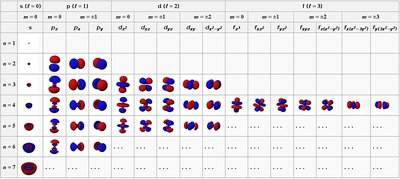
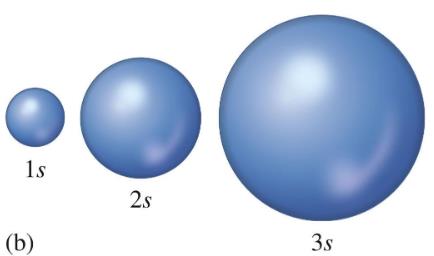
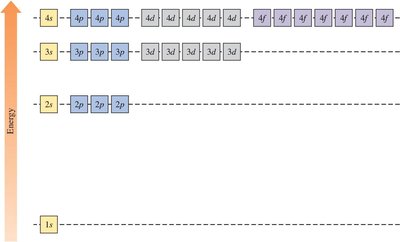
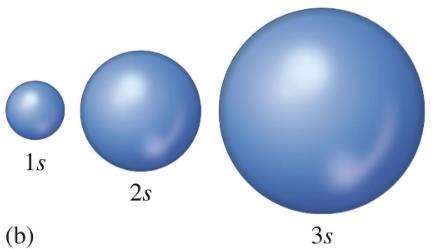
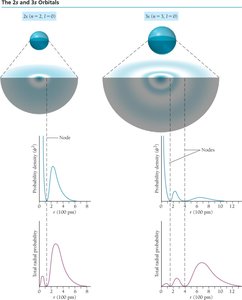
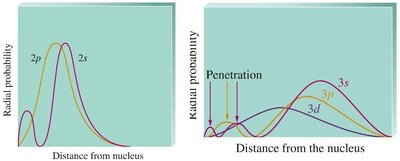
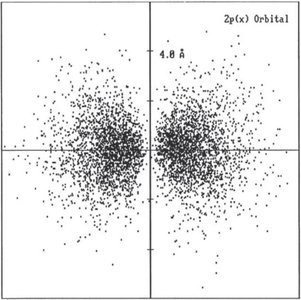
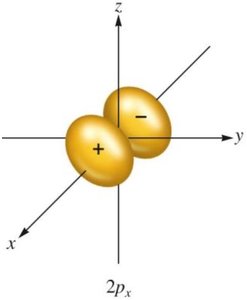
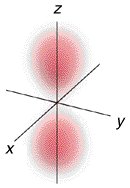
The number of orbitals in a subshell is determined by the possible values of m_l.
For a given shell (n):
1 s orbital (l = 0)
3 p orbitals (l = 1)
5 d orbitals (l = 2)
7 f orbitals (l = 3)
Summary Table: Quantum Numbers and Orbitals
l | 0 | 1 | 2 | 3 |
|---|---|---|---|---|
Orbital designation | s | p | d | f |
When n is | l can be | When l is | m_l can be |
|---|---|---|---|
1 | only 0 | 0 | only 0 |
2 | 0 or 1 | 0 | only 0 |
1 | -1, 0, or +1 | ||
3 | 0, 1, or 2 | 0 | only 0 |
1 | -1, 0, or +1 | ||
2 | -2, -1, 0, +1, or +2 | ||
4 | 0, 1, 2, or 3 | 0 | only 0 |
1 | -1, 0, or +1 | ||
2 | -2, -1, 0, +1, or +2 | ||
3 | -3, -2, -1, 0, +1, +2, or +3 |
Additional info: These notes provide a comprehensive overview of the quantum mechanical model of the atom, including the wave and particle nature of light, quantization of energy, atomic spectra, quantum numbers, and the shapes and energies of atomic orbitals. Practice problems and further examples can be found in the original lecture slides or textbook for deeper understanding.
