 Back
Quantum Mechanical Model of the Atom: Study Notes for General Chemistry
Study Guide - Smart Notes
 Tailored notes based on your materials, expanded with key definitions, examples, and context.
Quantum Mechanical Model of the Atom
Atomic Spectra
The study of atomic spectra provides insight into the energy and location of electrons within atoms. When atoms absorb or emit light, they produce characteristic spectra that can be analyzed to determine electronic structure.
Atomic Spectra: The unique set of wavelengths emitted or absorbed by an element.
Energy Levels: Electrons occupy discrete energy levels; transitions between these levels result in absorption or emission of photons.
Electron Transitions: Movement of electrons between energy levels is called an electron transition.
Ground State: The lowest energy level available to an electron.
Excited State: Any energy state above the ground state.
Quantization: Energy absorbed and emitted by atoms is quantized.
Example: The absorption spectrum of helium shows distinct lines corresponding to specific energy transitions.
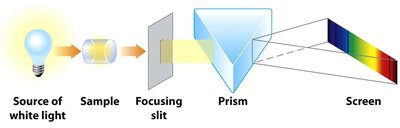
Example: The process of passing light through a sample and a prism to produce a spectrum on a screen.

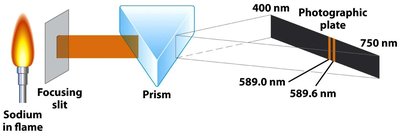
Example: Sodium in flame produces characteristic emission lines when analyzed with a prism.
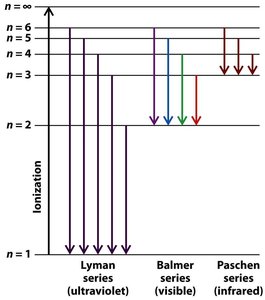
Example: Electron transitions between energy levels result in absorption and emission of photons of specific wavelengths.


Photoelectric Effect
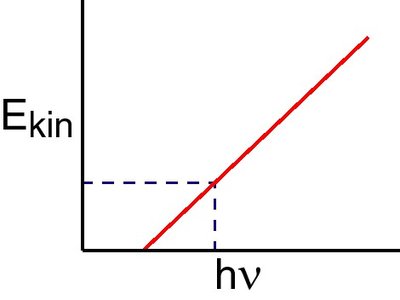
The photoelectric effect demonstrates that light can behave as a particle, supporting the quantum theory of light. When light of sufficient frequency strikes a metal surface, electrons are ejected.
Work Function (Φ): The minimum energy required to eject an electron from a metal.
Energy of Photon:
Threshold Frequency: No electrons are emitted if the frequency of light is below a certain threshold.
Photoelectric Equation:
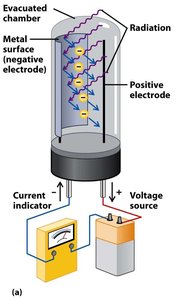
Example: Experimental setup for the photoelectric effect.
Example: Graph showing kinetic energy of ejected electrons versus photon energy.
Bohr Model of the Hydrogen Atom
The Bohr model was an early attempt to explain atomic structure. It introduced the concept of quantized orbits for electrons and explained the connection between atomic spectra and electron structure.
Stationary Orbits: Electrons orbit the nucleus in stable, quantized paths without radiating energy.
Energy Levels: Orbits have specific energies and sizes; larger orbits correspond to higher energy.
Photon Absorption/Emission: Electrons absorb photons to move to higher energy levels and emit photons to return to lower levels.
Limitations: The Bohr model is only applicable to one-electron atoms and does not explain spectra of multi-electron atoms.
Bohr Model Equations:
J
J
m
Example: Calculation of absorbed photon wavelength when an electron emits two photons during relaxation.

Wave-Particle Duality and Matter Waves
Electrons and other particles exhibit both wave-like and particle-like properties. The de Broglie hypothesis states that particles have a wavelength associated with their momentum.
de Broglie Wavelength:
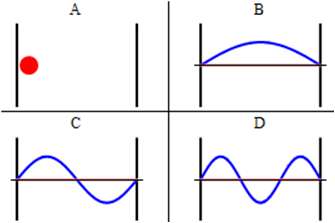
Standing Waves: Electrons in atoms can be described as standing waves.
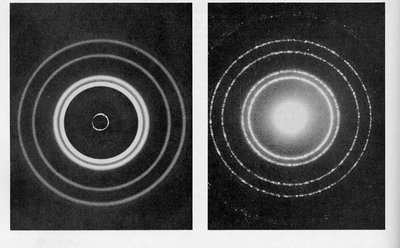
Diffraction: Electrons produce diffraction patterns similar to light, confirming their wave nature.
Example: Diffraction patterns of X-rays and electrons through thin foil.
Example: Standing wave patterns and their relation to quantum numbers.

Schrödinger Equation and Wave Functions
The Schrödinger equation describes the behavior of electrons in atoms as wave functions. The solutions to this equation, called orbitals, provide the probability distribution for finding an electron in space.
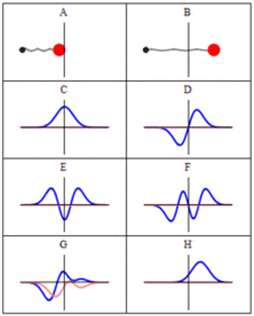
Wave Function (Ψ): Mathematical function describing the electron's properties.
Probability Distribution: gives the probability of finding an electron at a particular point.
Orbitals: Specific wave functions for electrons in atoms.
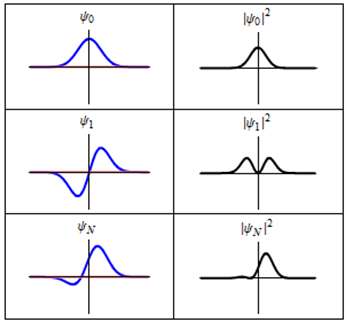
Example: Probability distributions for different quantum states.
Heisenberg Uncertainty Principle
The Heisenberg uncertainty principle states that it is impossible to simultaneously determine the exact position and momentum of an electron. This principle is fundamental to quantum mechanics.
Uncertainty Principle Equation:
Implication: The exact position of an electron is never known; only probability distributions can be described.
Quantum Numbers and Atomic Orbitals
Quantum numbers arise from the solutions to the wave equation and define the properties of atomic orbitals.
Principal Quantum Number (n): Indicates the shell and relative size of the orbital.
Orbital Quantum Number (l): Defines the shape of the orbital; values range from 0 to n-1.
Magnetic Quantum Number (ml): Defines the orientation of the orbital; values range from -l to +l.
Spin Quantum Number (ms): Accounts for the two possible spin states; values are +1/2 and -1/2.
Table: Quantum Numbers and Orbitals
n | l | ml | Number of Orbitals |
|---|---|---|---|
1 | 0 | 0 | 1 |
2 | 0 | 0 | 1 |
2 | 1 | -1, 0, +1 | 3 |
3 | 0 | 0 | 1 |
3 | 1 | -1, 0, +1 | 3 |
3 | 2 | -2, -1, 0, +1, +2 | 5 |
Shapes of Atomic Orbitals
The shapes and orientations of atomic orbitals are defined by the quantum numbers n, l, and ml. The probability of finding an electron is highest in certain regions, described by the square of the wave function (ψ²).
S Orbitals: Spherical shape; radial distribution plot shows probability as a function of distance from nucleus.
P Orbitals: Dumbbell shape; three orientations (px, py, pz).
D Orbitals: More complex shapes; five orientations.
Example: Radial distribution plot for s orbitals.
Example: Shapes and orientations of p orbitals.
Example: Shapes and orientations of d orbitals.

Summary Table: Quantum Numbers and Orbital Types
l Value | Letter Identifier |
|---|---|
0 | s |
1 | p |
2 | d |
3 | f |
4 | g |
Additional info: These notes expand on the lecture slides by providing definitions, equations, and examples for each major concept in the quantum mechanical model of the atom, suitable for General Chemistry students.
