 Back
Quantum-Mechanical Model of the Atom: Light, Matter, and Atomic Structure
Study Guide - Smart Notes
 Tailored notes based on your materials, expanded with key definitions, examples, and context.
Light and the Quantum-Mechanical Model
The Nature of Light
Light is a form of electromagnetic radiation, fundamental to understanding atomic structure and quantum mechanics. It consists of oscillating electric and magnetic fields that propagate through space at a constant speed.
Electromagnetic radiation is composed of perpendicular electric and magnetic field waves.
All electromagnetic waves travel at the speed of light, c, which is m/s.
Light exhibits both wave-like and particle-like properties, a concept known as wave-particle duality.
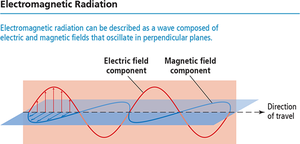
Wave Properties: Wavelength, Frequency, and Amplitude
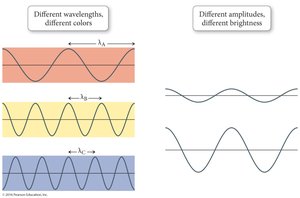
The characteristics of light waves include wavelength, frequency, and amplitude, which determine color and intensity.
Wavelength (\lambda): The distance between successive peaks of a wave, measured in meters (m).
Frequency (\nu): The number of wave cycles per second, measured in s–1 (Hz).
Amplitude: The height of the wave, related to the brightness or intensity of light.
Wavelength and frequency are inversely related:
The Electromagnetic Spectrum
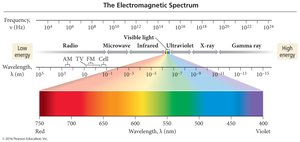
The electromagnetic spectrum encompasses all types of electromagnetic radiation, classified by wavelength and frequency. Visible light is only a small portion of this spectrum.
Short-wavelength (high-frequency) radiation has high energy (e.g., gamma rays).
Long-wavelength (low-frequency) radiation has low energy (e.g., radio waves).
Visible light ranges from approximately 400 nm (violet) to 700 nm (red).
Color and Intensity
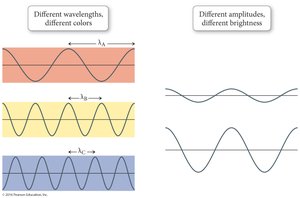
The color of light is determined by its wavelength or frequency, while intensity is determined by amplitude. White light is a mixture of all visible wavelengths.
Objects appear colored when they absorb certain wavelengths and reflect others.
Intensity (brightness) is proportional to the amplitude of the wave.
Wave Behavior of Light
Interference and Diffraction
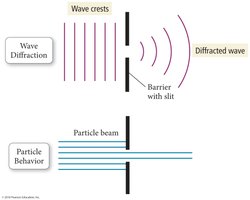
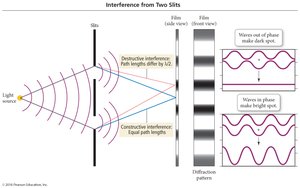
Light waves exhibit interference and diffraction, behaviors characteristic of waves.
Interference: When two waves overlap, they can reinforce (constructive interference) or cancel (destructive interference) each other.
Diffraction: Light bends around obstacles or passes through slits, creating patterns. Particles do not diffract.
Dual Nature of Light and Matter
Wave-Particle Duality
Light and matter both exhibit dual characteristics: wave-like and particle-like behaviors. This duality is central to quantum mechanics.
Electrons and other subatomic particles behave as both particles and waves.
The quantum-mechanical model describes these behaviors and explains atomic properties.
The Photoelectric Effect
Experimental Observations
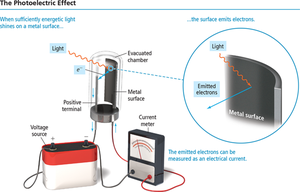
The photoelectric effect demonstrates the particle nature of light. When light shines on a metal surface, electrons are emitted if the light has sufficient frequency.
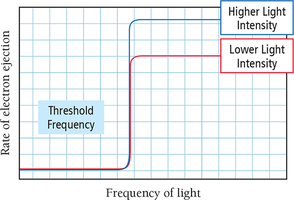
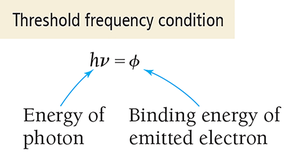
A minimum frequency (threshold frequency) is required for electron emission, regardless of intensity.
High-frequency light from a dim source can cause immediate electron emission.
Einstein's Explanation and Energy Quantization
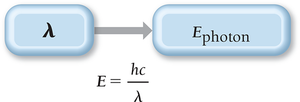
Einstein proposed that light energy is delivered in discrete packets called photons. The energy of a photon is proportional to its frequency and inversely proportional to its wavelength.
Planck's constant, h, is J·s.
Energy of a photon:
Energy in terms of wavelength:
Binding energy (\phi): Minimum energy required to eject an electron.
Kinetic energy of ejected electron:
Wave Behavior of Electrons and Matter
de Broglie Hypothesis
de Broglie proposed that all moving objects have wave properties, with wavelength inversely proportional to momentum.
de Broglie wavelength:
Electrons, due to their small mass, exhibit significant wave behavior.
Experimental evidence: Electron beams produce interference patterns, confirming their wave nature.
Atomic Spectra and Models
Emission Spectra and Line Spectra
Atoms emit light at specific wavelengths when excited, producing unique line spectra. These spectra are used to identify elements.
Emission spectrum: Pattern of lines unique to each element.
Rutherford's model could not explain line spectra; Bohr's model introduced quantized energy levels.
Bohr Model of the Atom
Bohr proposed that electrons occupy discrete energy levels (orbits) around the nucleus. Energy absorption or emission occurs in quantized packets.
Energy levels designated by quantum number n (n = 1, 2, 3, ...).
Bohr's model explained hydrogen's line spectrum but was limited for other elements.
Quantum Mechanics and Atomic Structure
Schrödinger's Model and Quantum Numbers
Schrödinger developed a wave equation describing the probability of finding an electron in an atom. Solutions yield quantum numbers that specify electron location and energy.
Principal quantum number (n): Energy level (shell).
Angular momentum quantum number (l): Orbital shape (subshell).
Magnetic quantum number (ml): Orbital orientation.
Spin quantum number (ms): Electron spin direction.
Pauli exclusion principle: No two electrons can have the same set of quantum numbers.
Heisenberg's Uncertainty Principle
The uncertainty principle states that it is impossible to know both the exact position and momentum of an electron simultaneously.
Electron is described as a probability cloud, not a precise orbit.
Shapes of Atomic Orbitals
Quantum numbers determine the shapes and orientations of atomic orbitals.
s orbitals (l = 0): Spherical shape.
p orbitals (l = 1): Dumbbell shape, three orientations.
d orbitals (l = 2): Cloverleaf and doughnut shapes, five types.
f orbitals (l = 3): Complex shapes, seven types.
Summary
Quantum mechanics explains atomic structure, chemical bonding, and periodic properties.
Light and matter exhibit dual wave-particle nature.
Energy is quantized; electrons occupy discrete energy levels.
Atomic spectra and quantum numbers are fundamental to understanding electron behavior.
