 Back
Quantum Mechanical Model of the Hydrogen Atom: Atomic Spectra, Photoelectric Effect, and Electron Waves
Study Guide - Smart Notes
 Tailored notes based on your materials, expanded with key definitions, examples, and context.
Quantum Mechanical Model of the Hydrogen Atom
Introduction to Atomic Spectra
The study of atomic spectra provides crucial insights into the energy and location of electrons within atoms. When atoms absorb or emit light, they produce characteristic spectra that can be analyzed to determine electronic structure.
Atomic Spectra: The unique set of wavelengths emitted or absorbed by an element.
Energy Levels: Electrons occupy discrete energy levels; transitions between these levels result in absorption or emission of photons.
Electron Transitions: Movement of electrons between energy levels, resulting in quantized energy changes.
Ground State: The lowest energy state of an electron in an atom.
Excited State: Any energy state above the ground state.
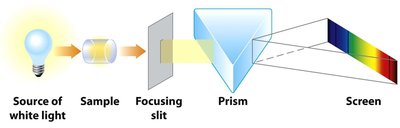
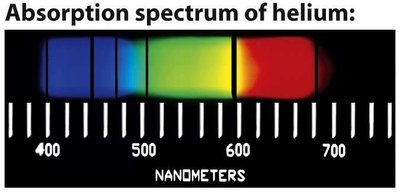
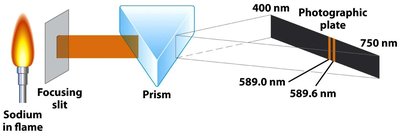
The Photoelectric Effect
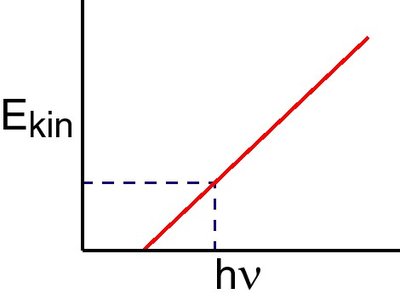
The photoelectric effect demonstrates the particle-like behavior of light. When light of sufficient frequency strikes a metal surface, electrons are ejected, providing evidence for quantized energy transfer.
Key Concept: Light can behave as both a wave and a particle (photon).
Work Function (Φ): The minimum energy required to remove an electron from a metal surface.
Photoelectric Equation: , where is photon energy, is Planck's constant, is frequency, is the speed of light, and is wavelength.
Threshold Frequency: No electrons are emitted if the incident light's frequency is below a certain threshold, regardless of intensity.
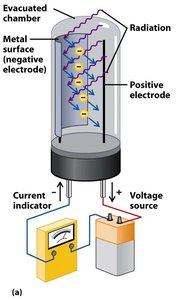
The Bohr Model of the Hydrogen Atom
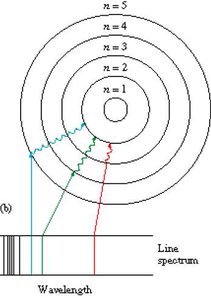
Niels Bohr proposed a model in which electrons orbit the nucleus in specific, quantized orbits without radiating energy. Transitions between orbits correspond to absorption or emission of photons with energy equal to the difference between energy levels.
Stationary Orbits: Electrons can only occupy certain allowed orbits with fixed energies.
Energy Quantization: J, where is the principal quantum number.
Photon Emission/Absorption:
Limitations: The Bohr model only accurately describes hydrogen-like (one-electron) atoms and does not account for multi-electron systems or electron wave behavior.


Quantization of Energy and Atomic Spectra
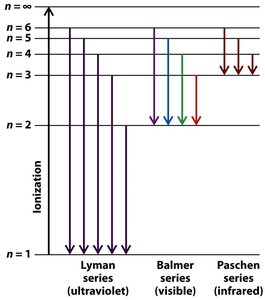
The energy absorbed or emitted by atoms is quantized, leading to discrete spectral lines. The Rydberg formula describes the wavelengths of spectral lines in hydrogen:
Rydberg Formula: , where and are initial and final energy levels.
Ionization: Transition from to corresponds to ionization energy.
Sample Problem: Photon Absorption and Emission
When an electron absorbs a photon and then relaxes by emitting two photons of known wavelengths, the wavelength of the absorbed photon can be determined by energy conservation:
Energy Conservation:
Photon Energy:


Wave-Particle Duality and Matter Waves
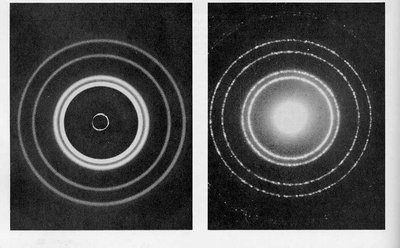
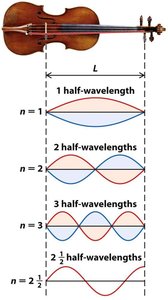
Electrons exhibit both wave-like and particle-like properties. The de Broglie hypothesis states that any moving particle has an associated wavelength:
de Broglie Wavelength: , where is momentum.
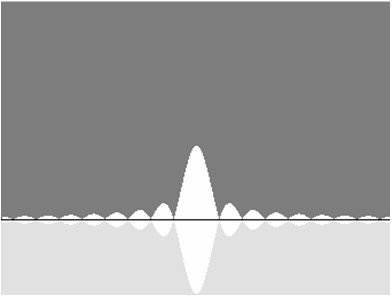
Electron Diffraction: Electrons can produce diffraction patterns, confirming their wave nature.

The Schrödinger Equation and Quantum Numbers
Schrödinger developed a wave equation to describe the behavior of electrons in atoms. Solutions to this equation yield wave functions (Ψ), which describe the probability distribution of electrons.
Wave Function (Ψ): Mathematical function describing the electron's state.
Probability Density: gives the probability of finding an electron at a particular location.
Quantum Numbers: Four quantum numbers describe the state of an electron:
Principal quantum number (n): Shell and size of orbital (n = 1, 2, 3, ...)
Orbital angular momentum quantum number (l): Shape of orbital (l = 0 to n-1; s, p, d, f, ...)
Magnetic quantum number (ml): Orientation of orbital (ml = -l to +l)
Spin quantum number (ms): Electron spin (+1/2 or -1/2)
Heisenberg Uncertainty Principle
The Heisenberg uncertainty principle states that it is impossible to simultaneously know both the exact position and momentum of an electron. This principle is fundamental to quantum mechanics and explains the probabilistic nature of electron locations.
Uncertainty Principle:
Implication: The more precisely one property is known, the less precisely the other can be known.
Shapes of Atomic Orbitals
Atomic orbitals are regions in space where the probability of finding an electron is high. The shape and orientation of orbitals are determined by quantum numbers.
s Orbitals (l = 0): Spherical symmetry.
p Orbitals (l = 1): Dumbbell-shaped, three orientations (px, py, pz).
d Orbitals (l = 2): More complex shapes, five orientations.
Radial Distribution Plot: Shows the probability of finding an electron at a certain distance from the nucleus.
Summary Table: Quantum Numbers and Orbitals
n | l | ml | Number of Orbitals |
|---|---|---|---|
1 | 0 | 0 | 1 (1s) |
2 | 0 | 0 | 1 (2s) |
2 | 1 | -1, 0, +1 | 3 (2p) |
3 | 0 | 0 | 1 (3s) |
3 | 1 | -1, 0, +1 | 3 (3p) |
3 | 2 | -2, -1, 0, +1, +2 | 5 (3d) |
Additional info: The notes above expand on the original lecture content by providing definitions, equations, and context for each concept, ensuring a self-contained and comprehensive study guide for students preparing for exams on quantum mechanics and atomic structure in general chemistry.
