 Back
BackQuantum Mechanics, Electron Configurations, and Atomic Models
Study Guide - Smart Notes
 Tailored notes based on your materials, expanded with key definitions, examples, and context.
Quantum Mechanics, Electron Configurations, and Atomic Models
Introduction to Quantum Mechanics in Chemistry
Quantum mechanics provides the foundation for understanding the behavior of electrons in atoms. This unit explores the limitations of classical atomic models, the development of quantum theory, and the mathematical description of atomic orbitals.
Bohr Model and Atomic Spectra
Atomic Absorption and Emission
When an atom absorbs energy, its electrons can move to higher energy levels (excited states). When electrons return to lower energy levels, they emit energy as photons, producing characteristic spectral lines.
Atomic Absorption: Electron absorbs a photon and moves to a higher energy level.
Atomic Emission: Electron falls to a lower energy level, emitting a photon with energy equal to the difference between the two levels.
Energy of a Photon: , where is Planck's constant, is frequency, is the speed of light, and is wavelength.
Quantized Orbits: In the Bohr model, electrons occupy specific energy levels (n = 1, 2, 3, ...).

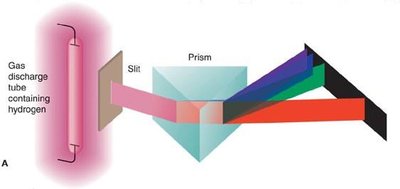
Hydrogen Emission Spectrum
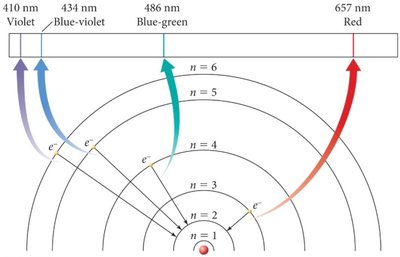
The hydrogen atom emits light at specific wavelengths when electrons transition between energy levels. These lines are observed in the visible spectrum and correspond to the Balmer series.
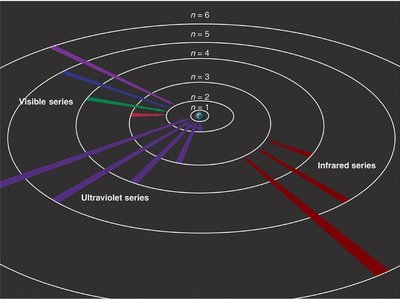
Balmer Series: Transitions from higher energy levels (n > 2) to n = 2 produce visible light.
Wavelengths: 410 nm (violet), 434 nm (blue-violet), 486 nm (blue-green), 657 nm (red).
Limitations of the Bohr Model
Why the Bohr Model Fails
The Bohr model accurately describes the hydrogen atom but fails for multi-electron atoms and cannot explain the wave-like properties of electrons. It treats electrons as particles in fixed orbits, which contradicts experimental evidence.
Cannot explain spectra of atoms with more than one electron.
Does not account for electron wave behavior.
Wave-Particle Duality and Quantum Theory
Wave-Particle Duality
Both light and electrons exhibit wave and particle properties. This duality is a fundamental concept in quantum mechanics.
Light: Behaves as both a wave (interference, diffraction) and a particle (photoelectric effect).
Electrons: Exhibit particle-like and wave-like behavior (electron diffraction).
Heisenberg Uncertainty Principle
The Heisenberg Uncertainty Principle states that it is impossible to know both the exact position and momentum of an electron simultaneously.
Mathematical Expression:
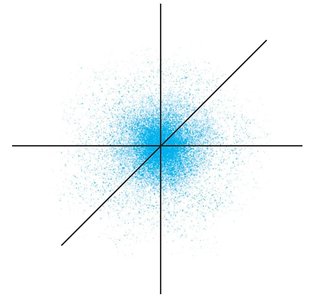
This principle leads to the concept of probability distributions for electron locations.
Quantum Mechanical Model of the Atom
Atomic Orbitals and Quantum Numbers
The quantum mechanical model describes electrons as occupying orbitals—regions in space with a high probability of finding an electron. Orbitals are defined by mathematical wave functions () and quantum numbers.
Atomic Orbital: Region in space with high probability of finding an electron.
Quantum Numbers: Describe the size, shape, and orientation of orbitals.
Schrödinger Equation: (where is the wave function).
Types and Shapes of Orbitals
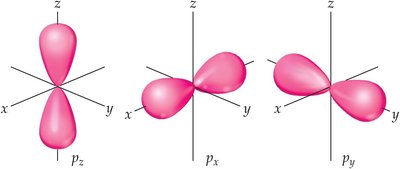
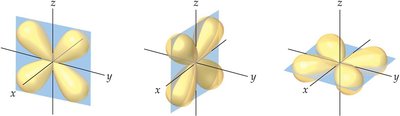
Solving the Schrödinger equation yields different types of orbitals, each with characteristic shapes and capacities:
s Orbitals: Spherical, 1 per energy level, holds 2 electrons.
p Orbitals: Dumbbell-shaped, 3 per energy level (starting from n=2), holds 6 electrons total.
d Orbitals: Cloverleaf-shaped, 5 per energy level (starting from n=3), holds 10 electrons total.
These orbitals determine the electron configuration of atoms and influence chemical properties and bonding.
Applications: Fluorescence
Fluorescence in Materials
Some materials, such as depression glass, exhibit fluorescence. When exposed to ultraviolet (UV) light, they absorb energy and re-emit it as visible light, often in bright colors.
Fluorescence: Absorption of high-energy (UV) photons followed by emission of lower-energy (visible) photons.

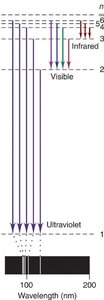
Summary Table: Hydrogen Atom Transitions
Series | Transition (n → n') | Region | Example Wavelengths (nm) |
|---|---|---|---|
Lyman | n > 1 → 1 | Ultraviolet | ~100-200 |
Balmer | n > 2 → 2 | Visible | 410, 434, 486, 657 |
Paschen | n > 3 → 3 | Infrared | ~1000+ |
Key Learning Objectives
Draw and explain atomic absorption and emission processes.
Connect the particle nature of light to the Bohr model.
Calculate energy changes for electron transitions in hydrogen.
Differentiate between the Bohr and quantum mechanical models.
Explain the Heisenberg Uncertainty Principle conceptually.
Identify and sketch s, p, and d orbital shapes.
