 Back
Quantum Numbers and Electron Configurations: Study Guide for General Chemistry
Study Guide - Smart Notes
 Tailored notes based on your materials, expanded with key definitions, examples, and context.
Quantum-Mechanical Model of the Atom
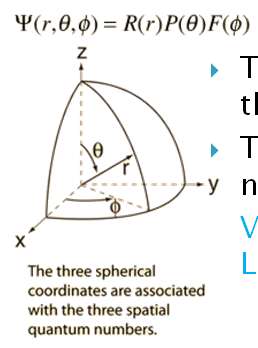
Quantum Numbers and Wave Functions
The quantum-mechanical model describes electrons in atoms using mathematical functions called wave functions. These functions are characterized by quantum numbers, which define the energy, shape, orientation, and spin of atomic orbitals.
Principal Quantum Number (n): Indicates the shell and relative size of the orbital. It is a positive integer (n = 1, 2, 3, ...).
Orbital Quantum Number (l): Defines the shape of the orbital and sub-shell. It ranges from 0 to n-1. The values correspond to letter identifiers: 0 (s), 1 (p), 2 (d), 3 (f), 4 (g).
Magnetic Quantum Number (ml): Specifies the orientation of the orbital in space. It ranges from -l to +l.
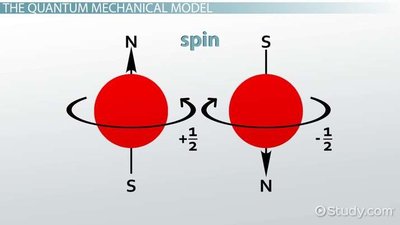
Spin Quantum Number (ms): Accounts for the two possible spin states of an electron: +1/2 or -1/2.
Example: For n = 2, l can be 0 (2s) or 1 (2p), and ml can be -1, 0, or +1 for p orbitals.
Quantum Numbers Table
The number of orbitals for each set of quantum numbers is determined by the possible values of ml for each l.
n | l | ml | # Orbitals |
|---|---|---|---|
1 | 0 | 0 | 1 |
2 | 0 | 0 | 1 |
2 | 1 | -1,0,+1 | 3 |
3 | 0 | 0 | 1 |
3 | 1 | -1,0,+1 | 3 |
3 | 2 | -2,-1,0,+1,+2 | 5 |
Electron Spin and Magnetic Properties
Spin Quantum Number and Stern-Gerlach Experiment
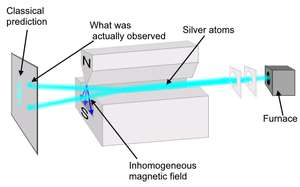
The spin quantum number (ms) describes the intrinsic angular momentum of electrons. The Stern-Gerlach experiment provided direct evidence for electron spin quantization, showing two distinct outcomes corresponding to ms = +1/2 and ms = -1/2.
Electron Spin: Not literal spinning, but a quantum property that gives electrons magnetic character.
Magnetic Behavior: Electrons behave like tiny magnets, leading to interactions with magnetic fields and explaining phenomena such as magnetism and spectral splitting.
Atomic Orbitals and Their Shapes
Probability Distributions and Radial Plots
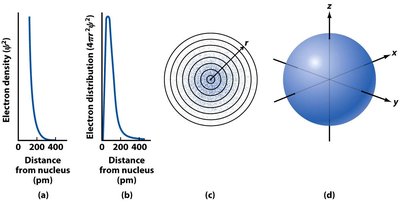
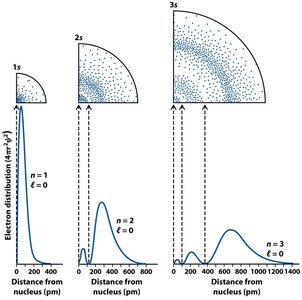
The probability of finding an electron in an atom is described by the square of the wave function, ψ². Radial distribution plots graphically represent the probability of finding an electron in a thin spherical layer near the nucleus.
1s Orbital: Spherically symmetric, highest probability near the nucleus.
Radial Distribution: Shows how electron density changes with distance from the nucleus.

Comparison of S Orbitals
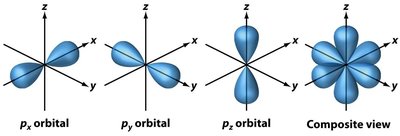
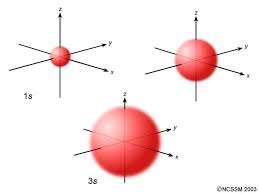
S orbitals are spherical and differ in size and electron distribution depending on the principal quantum number (n).
1s, 2s, 3s Orbitals: Higher n means larger orbitals and more nodes in the radial distribution.
P Orbitals
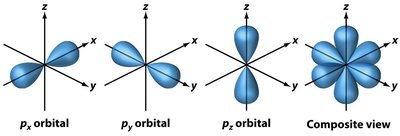
P orbitals (l = 1) have a dumbbell shape and exist in three orientations (px, py, pz), corresponding to ml = -1, 0, +1.
Shape: Each p orbital is oriented along a different axis.
Number: Three p orbitals per energy level (except n = 1).
D Orbitals
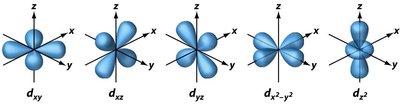
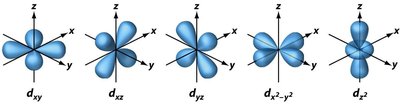
D orbitals (l = 2) have more complex shapes and exist in five orientations, corresponding to ml = -2, -1, 0, +1, +2.
Shape: Four lobes or unique shapes for each d orbital.
Number: Five d orbitals per energy level (n ≥ 3).
Summary of Orbital Types
Atomic orbitals are classified by their quantum numbers and shapes:
s orbitals: Spherical (l = 0)
p orbitals: Dumbbell-shaped (l = 1)
d orbitals: Four-lobed (l = 2)
f orbitals: Complex shapes (l = 3)

Electron Configurations
Rules for Filling Orbitals
Electrons fill atomic orbitals according to several principles:
Pauli Exclusion Principle: No two electrons in an atom can have the same set of four quantum numbers. Each orbital can hold a maximum of two electrons with opposite spins.
Aufbau Principle: Electrons occupy the lowest energy orbitals first.
Hund's Rule: Electrons fill degenerate orbitals singly before pairing up, maximizing the number of unpaired electrons.
Madelung's Rule: Orbitals fill in order of increasing n + l value; for equal n + l, lower n fills first.
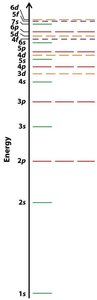

Electron Configurations and the Periodic Table
Electron configurations are reflected in the layout of the periodic table. The filling order of orbitals determines the structure of periods and groups.
Example: Ca: 1s22s22p63s23p64s2 or [Ar]4s2
Transition Metals: 3d orbitals are more compact than 4s, leading to greater electron-electron repulsion when filling d orbitals.

Useful Terms
Degenerate Orbitals: Orbitals with the same energy level.
Core Electrons: Electrons in filled inner shells, not involved in chemical reactions.
Valence Electrons: Electrons in the outermost shell, most influential in chemical behavior.
Examples of Electron Configurations
Hydrogen (H): 1s1
Helium (He): 1s2
Lithium (Li): 1s22s1
Beryllium (Be): 1s22s2
Boron (B): 1s22s22p1
Magnetic Properties of Atoms
Atoms with unpaired electrons exhibit magnetic properties:
Diamagnetic: All electrons are paired; repelled by magnetic fields.
Paramagnetic: At least one unpaired electron; attracted to magnetic fields.
Electron Configurations of Ions
To determine the electron configuration of ions, start with the neutral atom and add or remove electrons from the valence shell. Electrons with the highest n are removed first for cations.
Isoelectronic: Atoms or ions with identical numbers and configurations of electrons.
Example: I-: [Kr]5s24d105p6
Anomalous Electron Configurations
Some elements have electron configurations that deviate from the expected order due to stability considerations, such as half-filled or fully filled d or f subshells.
Chromium (Cr): [Ar]4s13d5
Copper (Cu): [Ar]4s13d10
Element | Configuration |
|---|---|
Chromium | [Ar] 3d5 4s1 |
Copper | [Ar] 3d10 4s1 |
Palladium | [Kr] 4d10 5s0 |
Gold | [Xe] 4f14 5d10 6s1 |
Electron Configuration of Transition Metal Ions
For transition metals, electrons are removed from the s orbital before the d orbital when forming cations.
Example: Scandium (Sc): Neutral: 1s22s22p63s23p63d14s2 Sc1+: 1s22s22p63s23p63d14s1 Sc2+: 1s22s22p63s23p63d1 Sc3+: 1s22s22p63s23p6
Practice Question
Select the electron configuration of 26Fe3+ (ferric ion):
A) [Ar]3d64s2
B) [Ar]3d34s2
C) [Ar]3d6
D) [Ar]3d5 Correct answer: D) [Ar]3d5
Additional info: The notes cover the quantum-mechanical model, quantum numbers, orbital shapes, electron configurations, and their relationship to the periodic table, which are core topics in General Chemistry (Ch.8, Ch.9, Ch.10).
