 Back
Quantum Numbers and Orbital Identification
Study Guide - Smart Notes
 Tailored notes based on your materials, expanded with key definitions, examples, and context.
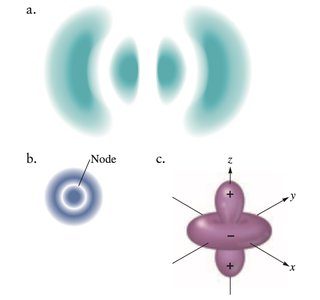
Q14. Identify the n and l quantum numbers and the name (e.g., 1s) for each of the orbitals pictured below:
Background
Topic: Atomic Orbitals and Quantum Numbers
This question tests your ability to interpret orbital diagrams and relate them to quantum numbers (n and l), as well as to name the orbitals using spectroscopic notation (e.g., 2p, 3d).
Key Terms and Formulas:
Principal quantum number (n): Indicates the energy level and size of the orbital.
Angular momentum quantum number (l): Determines the shape of the orbital. Values: 0 (s), 1 (p), 2 (d), 3 (f).
Spectroscopic notation: Combines n and l (e.g., 2p means n=2, l=1).
Radial nodes: Number of spherical regions where the probability of finding an electron is zero. Formula:
Orbital shapes: s = spherical, p = dumbbell, d = cloverleaf/multi-lobed.
Step-by-Step Guidance
Examine each diagram and identify the general shape. For example, multi-lobed shapes often indicate d orbitals, while concentric rings with nodes suggest s orbitals.
Recall the correspondence between l values and orbital types: s (l=0), p (l=1), d (l=2), f (l=3).
For each diagram, count the number of radial nodes (spherical regions with zero probability) and use the formula to estimate n and l.
Assign the correct spectroscopic notation (e.g., 3d, 2s, 2p) based on your analysis of n and l for each orbital.
For the final step, use the information above to write the full name (e.g., 3d) for each orbital, but stop before stating the exact answer for each diagram.
Try solving on your own before revealing the answer!
Final Answer:
a. This is a 3d orbital: n = 3, l = 2. The multi-lobed shape is characteristic of d orbitals.
b. This is a 2s orbital: n = 2, l = 0. The concentric rings and node indicate an s orbital with one radial node.
c. This is a 2p orbital: n = 2, l = 1. The dumbbell shape with axes is typical of p orbitals.
Each orbital's quantum numbers and name are determined by analyzing the shape and node structure in the diagram.
