 Back
Quantum Theory and Atomic Structure: Study Notes for General Chemistry
Study Guide - Smart Notes
 Tailored notes based on your materials, expanded with key definitions, examples, and context.
Quantum Theory and Atomic Structure
Electromagnetic Radiation and Photons
Electromagnetic radiation is a form of energy that travels through space as waves. It is characterized by its wavelength (λ) and frequency (ν), which are inversely related. The visible spectrum is only a small part of the electromagnetic spectrum, which includes gamma rays, X-rays, ultraviolet, infrared, microwaves, and radio waves.
Wavelength (λ): The distance between equivalent points on adjacent waves.
Frequency (ν): The number of cycles passing a point per second. Measured in hertz (Hz).
Amplitude: The maximum displacement from equilibrium; intensity increases with amplitude squared.
Speed of light (c):
Relationship:
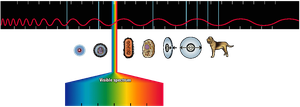
Example: To find the frequency of yellow light (589 nm):
Convert wavelength to meters:
Calculate frequency:
Wave and Particle Behavior
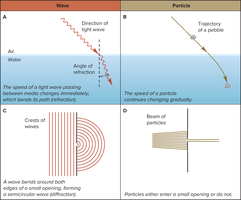
Light and matter exhibit both wave-like and particle-like properties. Waves can refract and diffract, while particles follow defined trajectories.
Refraction: Bending of waves as they pass between media.
Diffraction: Bending of waves around obstacles or through openings.
Particles: Move in straight lines unless acted upon by forces.
Blackbody Radiation and Planck's Quantum Theory
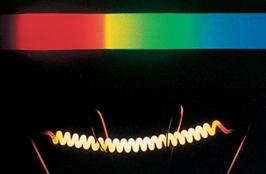
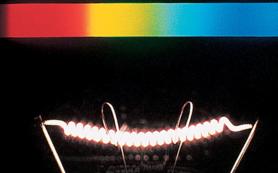
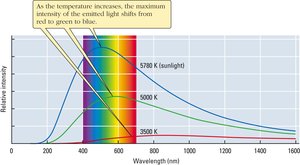
Hot objects emit a continuous spectrum of light, known as blackbody radiation. Classical physics could not explain the observed spectrum, leading to the development of quantum theory.
Planck's Proposal: Energy is emitted or absorbed in discrete packets called quanta.
Energy of a quantum:
Planck's constant:
Higher temperature shifts the peak wavelength to shorter values and increases total emission.
Quantized Energy and Photons
Energy is exchanged in integer multiples of . Each photon carries energy proportional to its frequency.
Photon energy:
Higher frequency means greater photon energy; longer wavelength means lower photon energy.
At fixed frequency, greater intensity means more photons, each with the same energy.
Example: Energy of a photon with wavelength 640 nm:
Convert wavelength:
Calculate energy:
Atomic Spectra and the Bohr Model
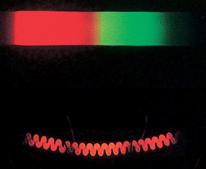
Heated solids emit continuous spectra, while excited atoms emit line spectra. Each element has a unique pattern of spectral lines, corresponding to quantized energy levels.
Line spectra: Each line corresponds to a photon energy matching an allowed atomic energy gap:
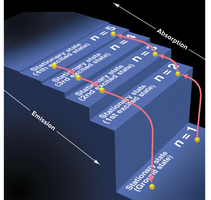
Bohr Model: Electrons occupy only certain allowed energy states, labeled by principal quantum number n.
Energy of hydrogen atom: , where
Ionization occurs as ,
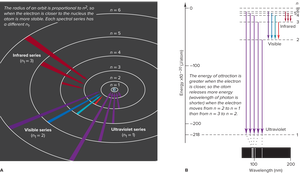
Emission Spectra and Electronic Transitions
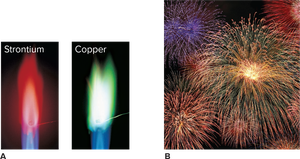
Excited atoms emit characteristic wavelengths as electrons move to lower-energy states. These spectral lines produce distinct colors in lamps, flames, and fireworks.
Absorption: , electron moves to higher n
Emission: , electron moves to lower n
Visible Balmer lines terminate at
Matter Waves and Quantum Mechanics
According to de Broglie, every moving object has a wavelength. Wave behavior is observable for electrons, as demonstrated by electron diffraction experiments.
de Broglie relation:
Large mass or high speed gives a very short wavelength.
Electron diffraction is direct evidence for the wave character of matter.

Wave-Particle Duality and Quantum Theory
Quantum theory describes energy and matter as displaying both wave-like and particle-like behavior. Key evidence includes blackbody radiation, atomic line spectra, and electron diffraction.
Energy is exchanged in discrete quanta.
Atoms have discrete electronic energy levels.
Moving matter can produce wave interference.
Heisenberg Uncertainty Principle
The uncertainty principle states that position and momentum cannot both be known precisely at the same time. This is an intrinsic quantum limit.
Localizing an electron increases momentum uncertainty, and vice versa.
The Schrödinger Quantum-Mechanical Model
The Schrödinger equation describes electron states with wavefunctions (ψ). Allowed wavefunctions form standing-wave patterns, providing allowed energies and orbitals for atoms and molecules.
Electrons are not classical particles traveling in fixed orbits.
Wavefunction probability density orbital
Quantum mechanics predicts probabilities, not classical paths.
Atomic Orbitals and Boundary Surfaces
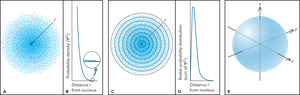
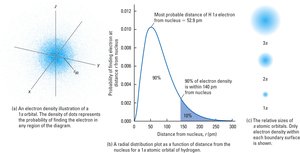
An atomic orbital is a one-electron wavefunction with an associated energy. A boundary surface encloses a chosen probability, often 90%.
Orbitals with the same energy are called degenerate.
No finite boundary encloses 100% of a bound atomic orbital's probability.
Orbital is a probability distribution, not a track.
Quantum Numbers and Orbital Shapes
Three quantum numbers specify an orbital: principal (n), angular momentum (ℓ), and magnetic (mℓ). An individual electron also requires a spin quantum number (ms).
Principal quantum number (n): Positive integers; determines shell and energy.
Angular momentum quantum number (ℓ): Integer from 0 to n−1; determines subshell shape.
Magnetic quantum number (mℓ): Integer from −ℓ to +ℓ; determines orbital orientation.
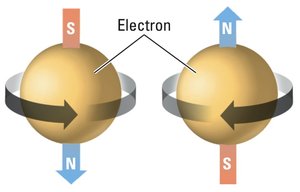
Spin quantum number (ms): +½ or −½; intrinsic property of electrons.
Shell and Subshell Capacities
s: 1 orbital / 2 electrons
p: 3 orbitals / 6 electrons
d: 5 orbitals / 10 electrons
f: 7 orbitals / 14 electrons
Pauli Exclusion Principle
No two electrons in an atom can share the same four quantum numbers.
Each orbital holds at most two electrons with opposite spins.
Atomic Orbital Shapes
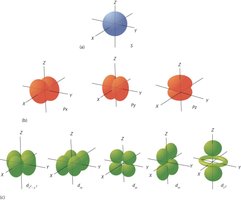
Orbitals have characteristic shapes depending on their quantum numbers.
s orbitals (ℓ = 0): Spherically symmetric; higher n means larger size and more radial nodes.
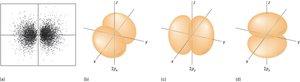
p orbitals (ℓ = 1): Three orientations (x, y, z); two lobes separated by a nodal plane.
d orbitals (ℓ = 2): Five orientations; four have four lobes, one has two lobes and a ring.
f orbitals (ℓ = 3): Seven orientations; complex shapes.
Additional info: The notes above expand on brief points with academic context, definitions, and examples to ensure completeness and clarity for exam preparation.
