 Back
BackRadioactivity and Nuclear Chemistry: Principles, Applications, and Calculations
Study Guide - Smart Notes
 Tailored notes based on your materials, expanded with key definitions, examples, and context.
Radioactivity and Nuclear Chemistry
Introduction to Radioactivity
Radioactivity is the spontaneous emission of subatomic particles or high-energy electromagnetic radiation from the nuclei of certain atoms. Atoms that emit such radiation are termed radioactive. This phenomenon is central to nuclear chemistry and has significant implications in medicine, dating techniques, and energy production.
Discovery of Radioactivity
Antoine-Henri Becquerel discovered that uranium-containing minerals emitted rays capable of penetrating matter, independent of exposure to external energy sources.
Marie Curie extended this work, identifying that these rays were emitted from specific elements, leading to the discovery of new elements such as radium and polonium. She coined the term radioactivity.


Types of Radioactive Decay
Radioactive decay occurs in several forms, each with distinct characteristics and effects on the nucleus:
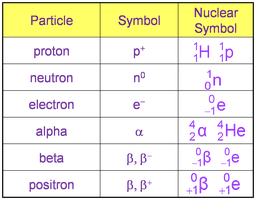
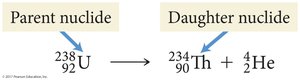
Alpha (α) Decay: Emission of a particle with 2 protons and 2 neutrons (a helium nucleus). Decreases atomic number by 2 and mass number by 4. Most ionizing, least penetrating.
Beta (β) Decay: Emission of an electron from the nucleus. Increases atomic number by 1, mass number unchanged. More penetrating than α, less ionizing.
Gamma (γ) Emission: Emission of high-energy photons. No change in atomic or mass number. Most penetrating, least ionizing.
Positron Emission: Emission of a positron (antiparticle of the electron). Decreases atomic number by 1, mass number unchanged.
Electron Capture: An inner electron is captured by the nucleus, converting a proton to a neutron. Decreases atomic number by 1, mass number unchanged.

Isotopic Notation and Nuclear Equations
Isotopes are atoms of the same element with different numbers of neutrons. Nuclear equations describe radioactive processes, conserving both atomic and mass numbers.
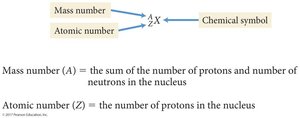
Isotopic Notation: where A is the mass number (protons + neutrons), Z is the atomic number (protons), and X is the chemical symbol.
Example: Alpha Decay Equation
When uranium-238 undergoes alpha decay:

Penetrating Ability of Radioactive Rays
Alpha particles are stopped by paper or skin, beta particles by thin metal, and gamma rays require thick lead or concrete for shielding.
Stability of Nuclei: N/Z Ratio and Magic Numbers
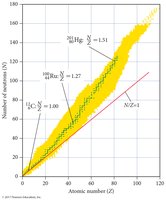
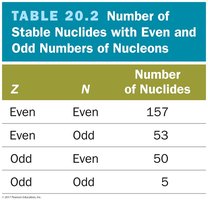
The stability of a nucleus depends on the neutron-to-proton (N/Z) ratio and the presence of certain 'magic numbers' of nucleons.
For Z = 1–20, stable N/Z ≈ 1.
For Z = 20–40, stable N/Z approaches 1.25.
For Z = 40–80, stable N/Z approaches 1.5.
No stable nuclei for Z > 83.
Magic numbers (2, 8, 20, 28, 50, 82, 126) confer extra stability.
Decay Series
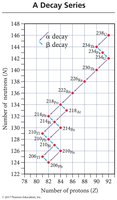
Heavy radioactive elements (Z > 83) decay through a series of steps until a stable nuclide is formed.
Detecting Radioactivity
Thermoluminescent dosimeters: Crystals emit light when heated after exposure to radiation.
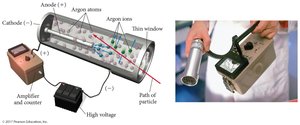
Geiger-Müller counters: Detect ionizing radiation by counting ionized argon atoms.
Scintillation counters: Measure flashes of light produced by radioactive rays striking certain chemicals.

Kinetics of Radioactive Decay
Radioactive Decay Law and Half-Life
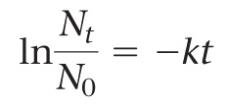
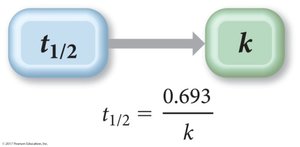
Radioactive decay follows first-order kinetics, characterized by a constant half-life () for each radionuclide. The rate of decay is independent of temperature.
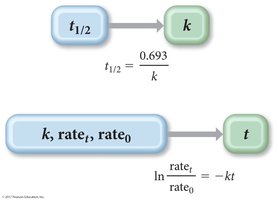
Integrated Rate Law:
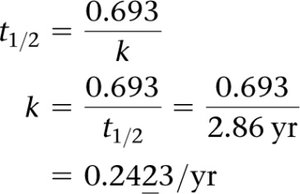
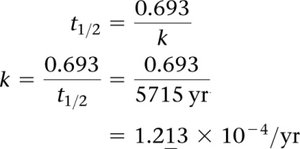
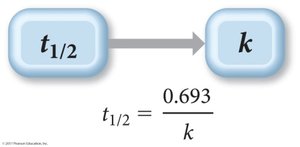
Half-Life Equation:
Example Calculation: Decay of Pu-236
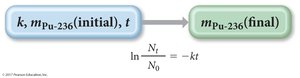
Given an initial mass and half-life, the remaining mass after a certain time can be calculated using the integrated rate law.
Radiometric Dating
Radiocarbon Dating: Uses the decay of C-14 (half-life ≈ 5730 years) to date formerly living materials up to ~50,000 years old.
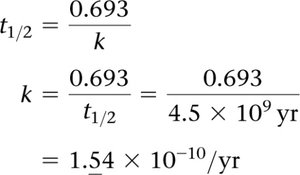
Uranium-Lead Dating: Compares ratios of U-238 to Pb-206 to estimate the age of rocks and the Earth (half-life ≈ 4.5 × 10⁹ years).


Nuclear Fission and Fusion
Nuclear Fission
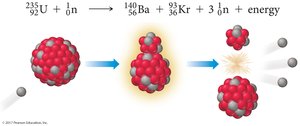
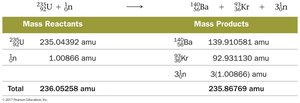
Fission is the splitting of a large nucleus into smaller nuclei, releasing energy. It is the basis for nuclear reactors and atomic bombs.
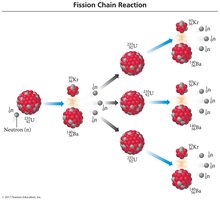
Chain Reaction: Neutrons produced in fission can induce further fission events, leading to a self-sustaining reaction if the critical mass is reached.
Nuclear Power Plants
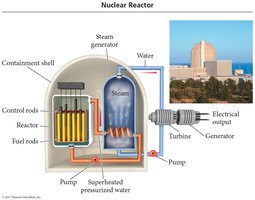
Nuclear reactors use controlled fission to generate electricity. Fuel rods contain fissionable material, while control rods absorb neutrons to regulate the reaction. Water acts as a moderator and coolant.
Problems with Nuclear Power
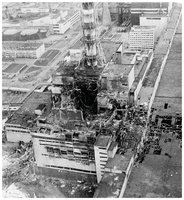
Core meltdowns (e.g., Chernobyl, Fukushima)
Radioactive waste disposal
Mass Defect and Nuclear Binding Energy
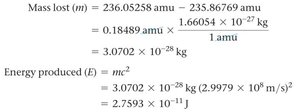
When nucleons combine to form a nucleus, some mass is converted to energy (binding energy). The mass defect is the difference between the mass of the separated nucleons and the nucleus.
Binding Energy Equation:
1 amu of mass defect = 931.5 MeV
Nuclear Fusion
Fusion is the combination of light nuclei to form a heavier nucleus, releasing even more energy per gram than fission. It powers stars and hydrogen bombs but requires extremely high temperatures to overcome nuclear repulsion.
Applications and Effects of Radioactivity
Medical and Industrial Uses
Radiotracers: Radioactive isotopes used to track chemical processes in the body.
Radiotherapy: Targeted radiation to kill cancer cells.
Nonmedical Uses: Smoke detectors, food preservation, insect control, and chemical analysis.
Biological Effects of Radiation
Acute Effects: High doses can kill cells, weaken the immune system, and cause death.
Chronic Effects: Increased cancer risk and potential genetic defects.
Measuring Radiation Exposure
Curie (Ci): 3.7 × 10¹⁰ decay events per second.
Gray (Gy): 1 J/kg of tissue.
Rad: 0.01 Gy.
Rem: Dose in rads × relative biological effectiveness (RBE).
Summary Table: Modes of Radioactive Decay
Decay Mode | Process | Change in Z | Example |
|---|---|---|---|
Alpha decay | Emission of α particle | -2 | |
Beta decay | Neutron becomes proton, emission of β particle | +1 | |
Gamma emission | Emission of γ photon | 0 | Excited nucleus → Stable nucleus + γ |
Positron emission | Proton becomes neutron, emission of positron | -1 | |
Electron capture | Proton + electron → neutron | -1 |
