 Back
BackL22 Reaction Mechanisms and Catalysis: Study Notes for General Chemistry
Study Guide - Smart Notes
 Tailored notes based on your materials, expanded with key definitions, examples, and context.
Reaction Mechanisms and Catalysis
Collision Theory and Reaction Rate
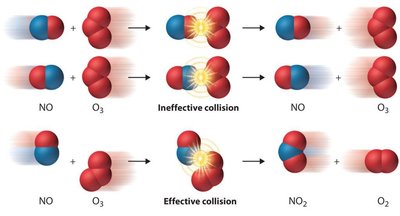
Chemical reactions occur when reactant molecules collide with sufficient energy and proper orientation. The collision theory explains how these factors influence the rate of a reaction.
Reaction rate is proportional to the frequency of collisions between reactant molecules.
Orientation of molecules during collision affects whether a reaction will occur (only certain alignments are effective).
Kinetic energy must be high enough to overcome the activation energy barrier for a reaction to proceed.
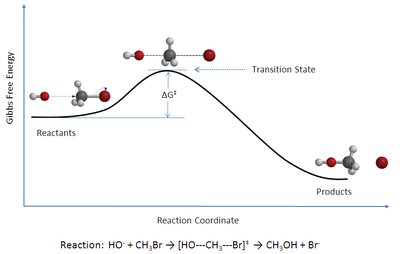
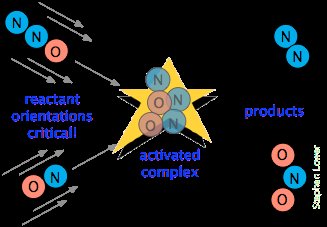
Transition state (or activated complex) is a high-energy, unstable arrangement of atoms that exists momentarily as reactants are converted to products.
Activation Energy and Reaction Energetics
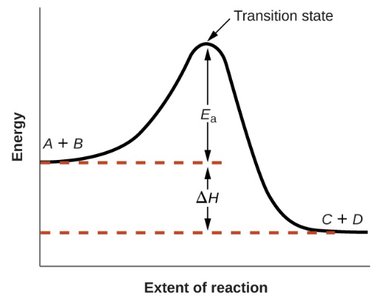
The activation energy (Ea) is the minimum energy required for a reaction to occur. It represents the energy barrier that must be overcome for reactants to form products. The difference in energy between reactants and products is the heat of reaction (ΔHrxn).
Energy diagrams illustrate the energy changes during a reaction, including the transition state and activation energy.
Multi-step reactions have multiple activation energies and transition states.
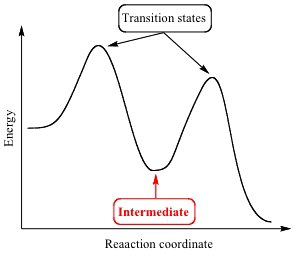
Intermediates are formed and consumed during the reaction sequence.
Arrhenius Equation
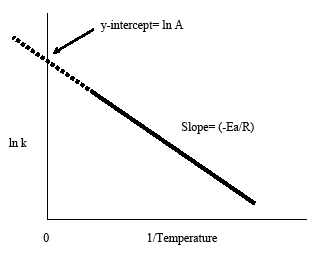
The Arrhenius equation relates the rate constant (k) of a reaction to temperature (T) and activation energy (Ea):
General form:
Linear form:
Two-point form:
Elementary Steps and Types
Reactions often proceed through a series of elementary steps, each representing a single collision or decay event. The rate law for each step can be written directly from its stoichiometry.
Unimolecular decay: products, rate =
Bimolecular collision (same molecule): products, rate =
Bimolecular collision (different molecules): products, rate =
Termolecular collisions: involve three reactant molecules, rate laws depend on stoichiometry
Reaction Mechanism
A reaction mechanism is a proposed sequence of elementary steps that describes how reactants are converted to products. The mechanism must match the overall reaction stoichiometry and can be tested by comparing predicted and observed rate laws.
Intermediates: formed in one step and consumed in another; not present in the overall equation.
Catalysts: consumed in an early step and regenerated in a later step; appear in the mechanism but not in the net reaction.
Transition State and Activated Complex
The transition state is the highest energy point along the reaction pathway. It is transient and difficult to observe directly, but it is crucial for understanding reaction energetics.
Multi-Step Reaction Energy Diagrams
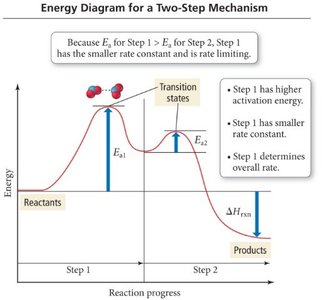
Multi-step reactions have energy diagrams with multiple peaks (transition states) and valleys (intermediates). The step with the highest activation energy is the rate-limiting step.
Rate-Limiting Step
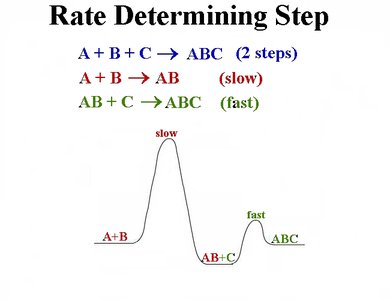
The rate-limiting step (or rate-determining step) is the slowest step in a multi-step reaction. It controls the overall reaction rate and determines the observed rate law.
To derive the overall rate law, start with the rate law for the rate-limiting step.
Energy diagrams can help identify the rate-limiting step by showing which step has the highest activation energy.
Fast Pre-Equilibrium Steps
When a fast step precedes a slow step, the fast step can reach a pre-equilibrium. The concentration of intermediates is determined by the equilibrium of the fast step, and the rate law for the slow step must be expressed in terms of measurable reactant concentrations.
Dynamic equilibrium: forward and reverse rates are equal, concentrations remain constant.
Intermediate concentrations can be solved using equilibrium expressions and substituted into the rate law.
Deriving Rate Laws from Mechanisms
To derive a rate law from a proposed mechanism:
Identify the slowest (rate-limiting) step.
Write the rate law for each elementary step.
If intermediates appear in the rate law, use equilibrium relationships to express them in terms of reactants.
Compare the derived rate law to experimental data to validate or disprove the mechanism.
Catalysis
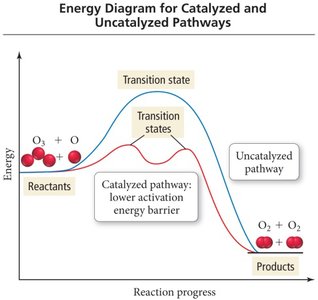
Catalysts are substances that increase the rate of a reaction without being consumed. They work by providing an alternative pathway with a lower activation energy.
Catalysts are consumed in one step and regenerated in another.
Intermediates are produced and then consumed during the reaction.
Catalysts fundamentally alter the reaction mechanism.
Homogeneous and Heterogeneous Catalysis
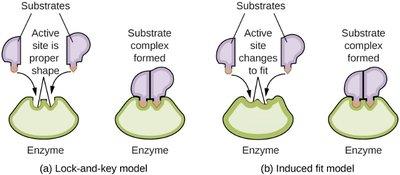
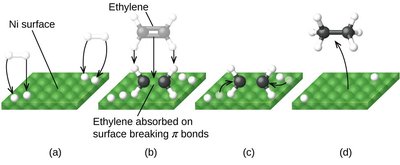
Homogeneous catalysis occurs when the catalyst and reactants are in the same phase (e.g., gas or solution). Heterogeneous catalysis involves a catalyst in a different phase, often a solid surface.
Homogeneous: catalyst is dissolved or gaseous; enzymes are examples.
Heterogeneous: catalyst is a solid; reactants adsorb to the surface, react, and then desorb as products.
Energy Diagrams for Catalyzed and Uncatalyzed Pathways
Catalysts lower the activation energy, resulting in a faster reaction. Energy diagrams show the difference between catalyzed and uncatalyzed pathways.
Summary Table: Types of Elementary Steps
Type | General Reaction | Rate Law |
|---|---|---|
Unimolecular | A → products | rate = k[A] |
Bimolecular (same) | A + A → products | rate = k[A]^2 |
Bimolecular (different) | A + B → products | rate = k[A][B] |
Termolecular (same) | A + A + A → products | rate = k[A]^3 |
Termolecular (two different) | A + A + B → products | rate = k[A]^2[B] |
Termolecular (three different) | A + B + C → products | rate = k[A][B][C] |
Key Equations
Arrhenius Equation:
Linear Arrhenius:
Two-point Arrhenius:
Additional info:
Modern techniques such as electron microscopy and ultrafast spectroscopy can sometimes directly observe reaction mechanisms, but kinetic analysis remains the standard method for most reactions.
Comparing predicted and observed rate laws is a powerful tool for disproving incorrect mechanisms, but agreement does not prove a mechanism is correct.
