 Back
BackReaction Rates and Factors Affecting Chemical Reactions
Study Guide - Smart Notes
 Tailored notes based on your materials, expanded with key definitions, examples, and context.
Reaction Rates and Equilibrium
Rates of Reaction
The rate of a chemical reaction describes how quickly reactants are converted into products. Understanding reaction rates is essential for controlling chemical processes in both laboratory and industrial settings.
Reaction Rate: The change in the amount of reactant or product per unit time. It is commonly measured in units such as mol/L·s.
Examples: Striking a match results in a rapid reaction, while the formation of coal from buried plants takes millions of years.
Definition: Rate describes the speed of change over an interval of time.
Collision Theory
Collision theory explains how chemical reactions occur and why reaction rates vary. It relates particle properties to the rates of chemical reactions.
Key Principle: Atoms, ions, and molecules can react to form products when they collide, provided they have enough kinetic energy.
Ineffective Collisions: If particles lack sufficient energy, they bounce apart unchanged.
Activation Energy: The minimum energy that colliding particles must have to react. It acts as a barrier that must be overcome for a reaction to proceed.
Activated Complex and Transition State
When two reactant particles collide with sufficient energy and proper orientation, they may form an activated complex, also known as the transition state.
Activated Complex: An unstable arrangement of atoms that exists momentarily at the peak of the activation-energy barrier.
Lifetime: Typically about seconds; it may revert to reactants or proceed to products.
Transition State: Another term for the activated complex.
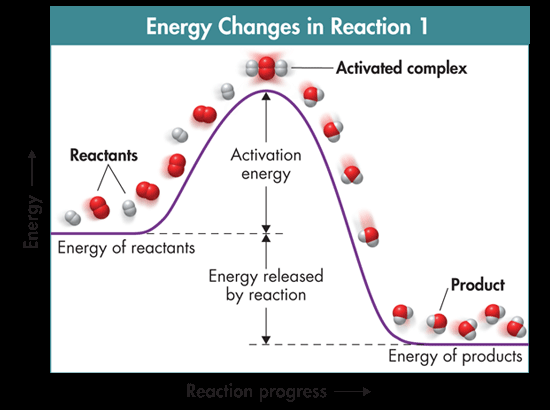
Endothermic vs. Exothermic Reactions
Reactions can either absorb or release heat, affecting the energy profile of the reaction.
Endothermic Reaction: Absorbs heat; products have higher energy than reactants.
Exothermic Reaction: Releases heat; products have lower energy than reactants.
Factors Affecting Reaction Rates
The rate of a chemical reaction can be influenced by several factors. By varying these conditions, chemists can modify the rate of almost any reaction.
Temperature: Raising the temperature increases the frequency of collisions and the percentage of particles with enough energy to overcome the activation-energy barrier, thus speeding up the reaction.
Concentration: Increasing the concentration of reactants increases the frequency of collisions, leading to a higher reaction rate.
Particle Size: Smaller particle size increases the surface area available for reaction, resulting in more frequent collisions and a faster reaction rate.
Catalyst: A catalyst increases the rate of a reaction by lowering the activation energy, without being consumed in the reaction.
Temperature
Higher temperatures cause particles to move faster, increasing collision frequency and energy.
Lower temperatures slow down reactions.
Concentration
More particles in a fixed volume increases collision frequency.
Example: Combustion is faster in pure oxygen than in air due to higher oxygen concentration.
Particle Size
Smaller particles provide greater surface area for a given mass, increasing collision frequency.
Grinding solids into fine powders or dissolving them increases surface area.
Example: Fine sugar dust reacts explosively with oxygen due to its tiny particle size.
Catalysts and Inhibitors
Catalyst: Substance that increases reaction rate by providing a lower energy pathway; not consumed in the reaction.
Enzymes: Biological catalysts that speed up reactions in living organisms.
Inhibitor: Substance that interferes with the action of a catalyst, often by "poisoning" the catalyst.
Summary Table: Factors Affecting Reaction Rates
Factor | Effect on Reaction Rate | Example/Application |
|---|---|---|
Temperature | Increase speeds up, decrease slows down | Heating increases reaction speed |
Concentration | Higher concentration increases rate | Combustion in pure oxygen vs. air |
Particle Size | Smaller size increases rate | Sugar dust explosion |
Catalyst | Lowers activation energy, increases rate | Platinum in hydrogen-oxygen reaction |
Inhibitor | Decreases rate by interfering with catalyst | Catalyst poisoning |
Key Concepts and Glossary
Rate: Describes the speed of change over an interval of time.
Collision Theory: Atoms, ions, and molecules can react to form products when they collide, provided that the particles have enough kinetic energy.
Activation Energy: The minimum energy colliding particles must have in order to react.
Activated Complex: An unstable arrangement of atoms that exists momentarily at the peak of the activation-energy barrier.
Inhibitor: A substance that interferes with the action of a catalyst.
Big Idea
The rate of a chemical reaction can be controlled by adjusting temperature, concentration, or particle size.
Adding a catalyst speeds up a reaction by lowering the activation energy.
