 Back
Real Gases: Kinetic Molecular Theory, Heat Capacity, and Deviations from Ideal Behavior
Study Guide - Smart Notes
 Tailored notes based on your materials, expanded with key definitions, examples, and context.
Real Gases and the Kinetic Molecular Theory (KMT)
Assumptions of the Kinetic Molecular Theory
The Kinetic Molecular Theory (KMT) provides a model for the behavior of ideal gases, based on several key assumptions:
Gas molecules are point masses: They have mass but negligible volume.
No intermolecular forces (IMF): Gas molecules neither attract nor repel each other except during collisions.
Elastic collisions: Gas molecules do not lose energy when they collide.
Distribution of speeds: At a given temperature, molecules have a range of speeds, not all the same.
These assumptions are valid for ideal gases, but real gases deviate from this behavior under certain conditions.
Kinetic Energy, Temperature, and Molecular Motion
Kinetic Energy and Temperature
The kinetic energy of a gas molecule is directly related to its temperature. The average kinetic energy per molecule is given by:
$ KE_{avg} = \frac{1}{2} m v^2 $
For a mole of gas, the relationship is:
$ KE_{avg} = \frac{3}{2} RT $
where R is the gas constant and T is the absolute temperature.
Degrees of Freedom
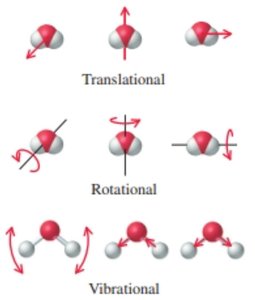
Degrees of freedom refer to the independent ways a molecule can move or store energy. For gases, these include:
Translational: Movement in three spatial directions (x, y, z).
Rotational: Rotation about axes through the center of mass.
Vibrational: Oscillation of atoms within a molecule.
Monoatomic gases (e.g., He, Ar) have only translational degrees of freedom, while diatomic and polyatomic gases have additional rotational and vibrational modes.
Principle of Equipartition of Energy
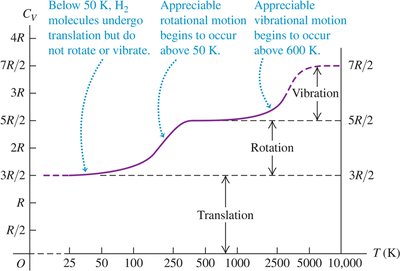
The principle of equipartition of energy states that, at equilibrium, energy is distributed equally among all active degrees of freedom. The molar heat capacity at constant volume (Cv) is:
$ C_v = \frac{d}{2} R $
where d is the number of degrees of freedom.
Heat Capacity of Gases
Molar Heat Capacities
The heat capacity of a gas depends on its molecular structure:
Monoatomic gases: Only translational motion (d = 3).
Diatomic gases: Translational and rotational motion (d = 5 at room temperature; vibrational modes may be active at higher temperatures).
Polyatomic gases: More degrees of freedom due to additional atoms.
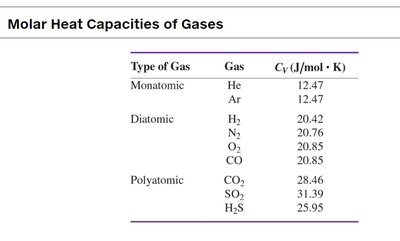
Typical values for molar heat capacities are shown below:
Type of Gas | Gas | Cv (J/mol·K) |
|---|---|---|
Monoatomic | He | 12.47 |
Monoatomic | Ar | 12.47 |
Diatomic | H2 | 20.42 |
Diatomic | N2 | 20.76 |
Diatomic | O2 | 20.85 |
Diatomic | CO | 20.85 |
Polyatomic | CO2 | 28.46 |
Polyatomic | SO2 | 31.39 |
Polyatomic | H2S | 25.95 |
Temperature Dependence of Heat Capacity
As temperature increases, more degrees of freedom become active, increasing the heat capacity. For example, vibrational modes in diatomic molecules become significant at higher temperatures.
State Variables and Equations of State
State Variables
State variables describe the condition of a gas:
Pressure (P)
Volume (V)
Temperature (T)
Amount of substance (n)
The relationship among these variables is given by an equation of state.
Ideal Gas Law
The ideal gas law is:
$ PV = nRT $
This law assumes point masses and no intermolecular forces.
Deviations from Ideal Gas Behavior
Compressibility Factor (Z)
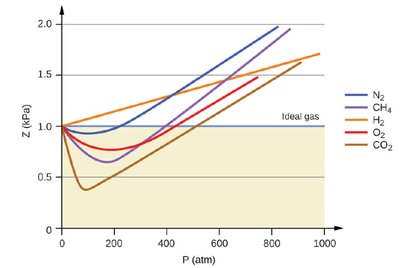
The compressibility factor (Z) quantifies deviations from ideal gas behavior:
$ Z = \frac{PV}{nRT} $
Z = 1: Ideal gas behavior
Z > 1: Volume effects dominate (finite molecular size)
Z < 1: Intermolecular forces dominate (attractive forces)
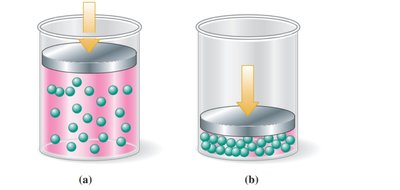
Effect of Finite Molecular Size
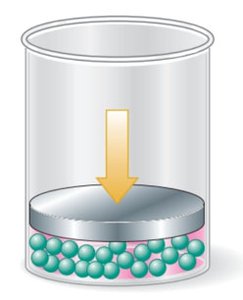
At high pressures, gas molecules are forced close together, and their finite size becomes significant. The volume cannot decrease indefinitely because molecules occupy space.
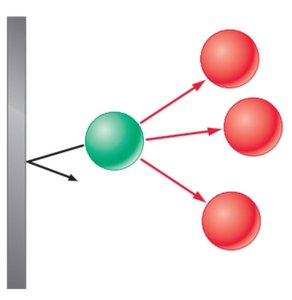
Effect of Intermolecular Forces
At low temperatures and high pressures, attractive intermolecular forces reduce the pressure exerted by the gas compared to the ideal gas prediction.
Van der Waals Equation for Real Gases
Van der Waals Equation
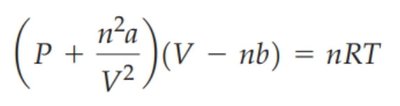
The Van der Waals equation modifies the ideal gas law to account for molecular size and intermolecular forces:
$ \left( P + \frac{n^2 a}{V^2} \right) (V - nb) = nRT $
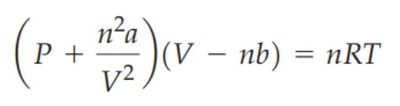
Where:
a: Measures the strength of intermolecular attractions (pressure correction).
b: Represents the excluded volume per mole (volume correction).
For an ideal gas, a = 0 and b = 0.
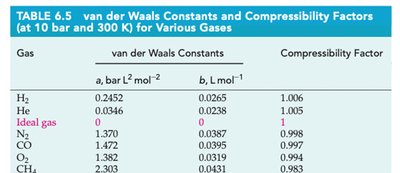
Van der Waals Constants and Compressibility Factors
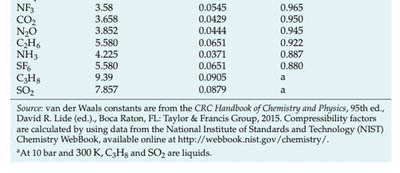
Different gases have different values for a and b, reflecting their molecular properties. Typical values are shown below:
Gas | a (bar L2 mol-2) | b (L mol-1) | Compressibility Factor |
|---|---|---|---|
H2 | 0.2452 | 0.0265 | 1.006 |
He | 0.0346 | 0.0238 | 1.005 |
Ideal gas | 0 | 0 | 1 |
N2 | 1.370 | 0.0387 | 0.997 |
CO2 | 1.472 | 0.0395 | 0.997 |
O2 | 1.382 | 0.0319 | 0.994 |
CH4 | 2.203 | 0.0431 | 0.983 |
Physical Meaning of Parameters a and b
a (Pressure correction): Accounts for intermolecular attractions, which reduce the observed pressure.
b (Volume correction): Accounts for the finite size of molecules, reducing the available volume for molecular motion.
Summary Table: Ideal vs Real Gas Behavior
Condition | Ideal Gas | Real Gas |
|---|---|---|
Low pressure, high temperature | Behaves ideally | Behaves nearly ideally |
High pressure, low temperature | Deviations negligible | Significant deviations (IMF and finite size) |
Near phase change | Not applicable | Large deviations |
Example Calculation: Van der Waals Equation
Example: Chlorine Gas
Calculate the pressure exerted by 1.00 mole of Cl2 (g) confined to a volume of 2.00 L at 273 K using the Van der Waals equation. Compare with the ideal gas law.
Given: a = 6.34 bar L2 mol-2, b = 0.0542 L mol-1
Van der Waals equation:
$ \left( P + \frac{n^2 a}{V^2} \right) (V - nb) = nRT $
Plug in values to solve for P.
Result: Preal < Pideal due to intermolecular forces.
Key Takeaways
Real gases deviate from ideal behavior due to finite molecular size and intermolecular forces.
The Van der Waals equation provides a more accurate model for real gases.
Heat capacity and degrees of freedom depend on molecular structure and temperature.
Compressibility factor (Z) is a useful indicator of ideal vs real gas behavior.
