 Back
Saturated Solutions, Solubility, and Factors Affecting Solubility
Study Guide - Smart Notes
 Tailored notes based on your materials, expanded with key definitions, examples, and context.
Saturated Solutions and Solubility
Definition of Solubility and Saturated Solutions
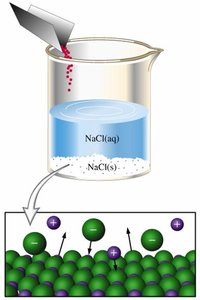
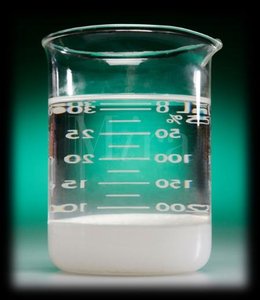
Solubility is defined as the maximum amount of a solute that can dissolve in a given quantity of solvent at a specific temperature, resulting in a saturated solution. In a saturated solution, the dissolved solute is in dynamic equilibrium with the undissolved solute, meaning the rate of dissolution equals the rate of precipitation.
Saturated Solution: Contains the maximum amount of dissolved solute at equilibrium.
Dynamic Equilibrium: The process of solute dissolving and precipitating occurs at equal rates.
Example: The solubility of NaCl in water at 25 °C is approximately 35 g per 100 mL of water.
Measuring Solubility
Solubility is determined by measuring the concentration of dissolved solute in a saturated solution under equilibrium conditions. Changes in temperature or solvent can alter solubility.
Simulations of Saturated Solutions
Atomic-scale simulations can help visualize the dynamic equilibrium in saturated solutions, showing the continuous exchange of solute particles between the solid and dissolved states.

Unsaturated and Supersaturated Solutions
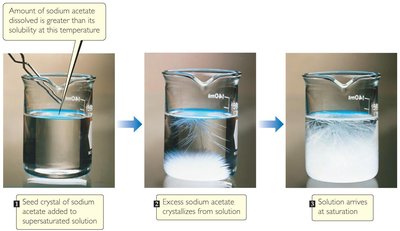
If the amount of dissolved solute is less than the solubility, the solution is unsaturated. If the amount of dissolved solute exceeds the solubility, the solution is supersaturated. Supersaturated solutions are unstable and can precipitate excess solute upon disturbance or seeding.
Unsaturated Solution: More solute can dissolve.
Supersaturated Solution: Contains more dissolved solute than is stable at that temperature.
Factors Affecting Solubility
Polarity and the Principle of 'Like Dissolves Like'
The solubility of substances depends largely on the polarity of the solute and solvent. Polar solutes dissolve well in polar solvents due to dipole-dipole or ion-dipole interactions, while nonpolar solutes dissolve in nonpolar solvents due to London dispersion forces.
Polar in Polar: Ethanol (CH3CH2OH) in water.
Ionic in Polar: NaCl in water (ion-dipole forces).
Nonpolar in Nonpolar: I2 in CCl4, pentane in hexane.
Miscibility of Liquids
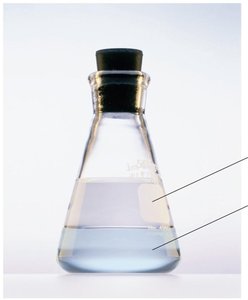
Liquids that mix in all proportions are called miscible. Liquids that do not dissolve in each other are immiscible. The miscibility depends on the similarity of intermolecular forces between the two liquids.
Examples: Alcohols and Water
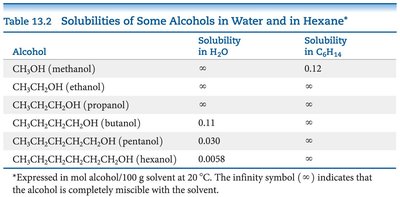
Alcohols with shorter hydrocarbon chains (e.g., methanol, ethanol) are highly soluble in water due to their ability to form hydrogen bonds. As the hydrocarbon chain length increases, solubility in water decreases and solubility in nonpolar solvents increases.
1-Butanol (C4H9OH): Moderately soluble in water.
Hexane (C6H14): Insoluble in water, soluble in nonpolar solvents.
Ethanol (C2H5OH): Completely miscible with water.
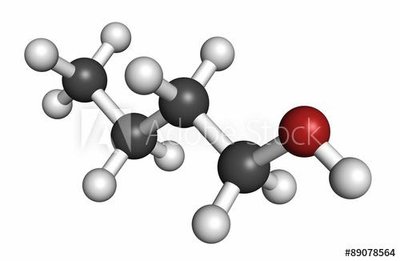
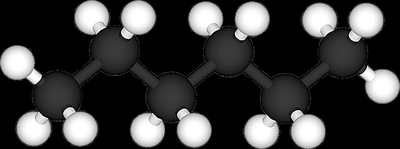
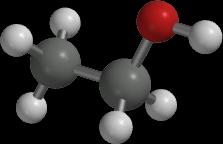
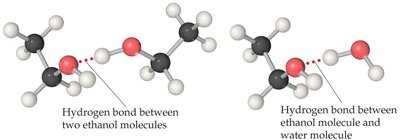
Table: Solubilities of Alcohols in Water and Hexane
The table below compares the solubility of various alcohols in water and hexane, illustrating the effect of increasing hydrocarbon chain length on solubility.
Alcohol | Solubility in H2O | Solubility in C6H14 |
|---|---|---|
CH3OH (methanol) | ∞ | 0.12 |
CH3CH2OH (ethanol) | ∞ | ∞ |
CH3CH2CH2OH (propanol) | ∞ | ∞ |
CH3CH2CH2CH2OH (butanol) | 0.11 | ∞ |
CH3CH2CH2CH2CH2OH (pentanol) | 0.030 | ∞ |
CH3CH2CH2CH2CH2CH2OH (hexanol) | 0.0058 | ∞ |
Solubility of Vitamins
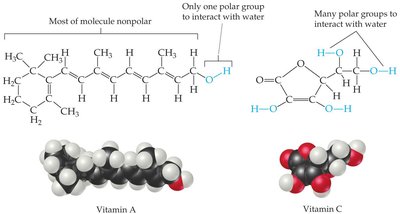
Vitamins can be classified based on their solubility. Fat-soluble vitamins (A, D, E, K) are nonpolar and dissolve in nonpolar solvents and fatty tissues, while water-soluble vitamins (B, C) are polar and dissolve in water.
Solubility of Gases and Temperature Effects
Henry's Law
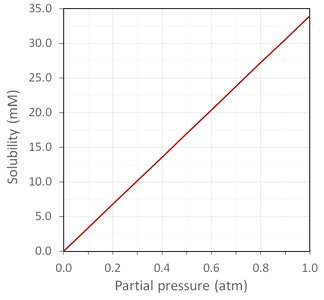
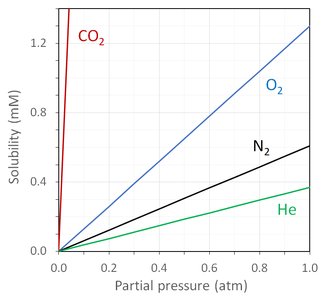
The solubility of a gas in a liquid is directly proportional to the partial pressure of the gas above the solution. This relationship is described by Henry's Law:
Henry's Law Equation:
Sg: Solubility of the gas (mol/L)
k: Henry's Law constant (mol/L·atm)
Pg: Partial pressure of the gas (atm)
Solubility Constants for Common Gases
Gas | Mole Fraction | Henry's Law Constant, k (mol/L·atm) |
|---|---|---|
Nitrogen, N2 | 0.78084 | 6.9 × 10⁻⁴ |
Oxygen, O2 | 0.20946 | 1.4 × 10⁻³ |
Argon, Ar | 0.00934 | 1.5 × 10⁻³ |
Carbon dioxide, CO2 | 0.000415 | 3.7 × 10⁻² |
Effect of Pressure on Gas Solubility
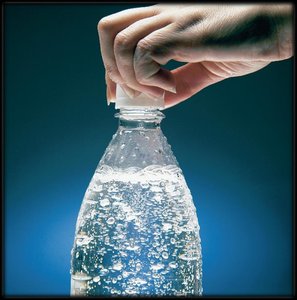
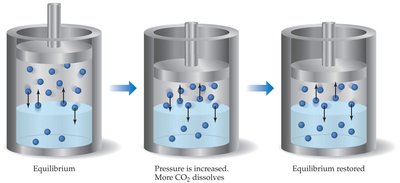
Increasing the pressure of a gas above a liquid increases the solubility of the gas in the liquid. This is because more gas molecules collide with the surface and dissolve until equilibrium is re-established.
Effect of Temperature on Solubility
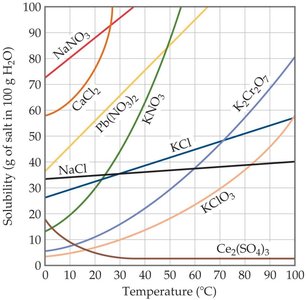
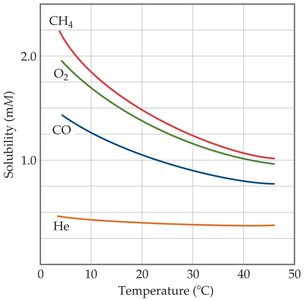
The solubility of most solid solutes in water increases with temperature, while the solubility of gases decreases with increasing temperature. This is due to the higher entropy of gases and the exothermic nature of gas dissolution.
Solids: Solubility generally increases with temperature.
Gases: Solubility decreases with temperature.

Applications: Henry's Law and Everyday Life
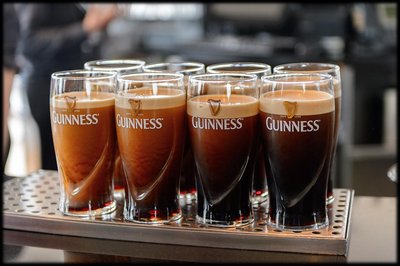
Henry's Law explains phenomena such as the fizz in carbonated beverages and the special pouring technique for Guinness beer, which uses a mixture of nitrogen and carbon dioxide to achieve its characteristic head.
Additional info: The entropy relationship (Entropy (Solid) < Entropy (Solution) < Entropy (Gas)) explains why gases become less soluble at higher temperatures: the increased disorder (entropy) of the gas phase is favored as temperature rises.
