 Back
Single, Double, and Triple Bonds: Structure, Properties, and Reactivity
Study Guide - Smart Notes
 Tailored notes based on your materials, expanded with key definitions, examples, and context.
Basic Concepts of Chemical Bonding
Types of Covalent Bonds
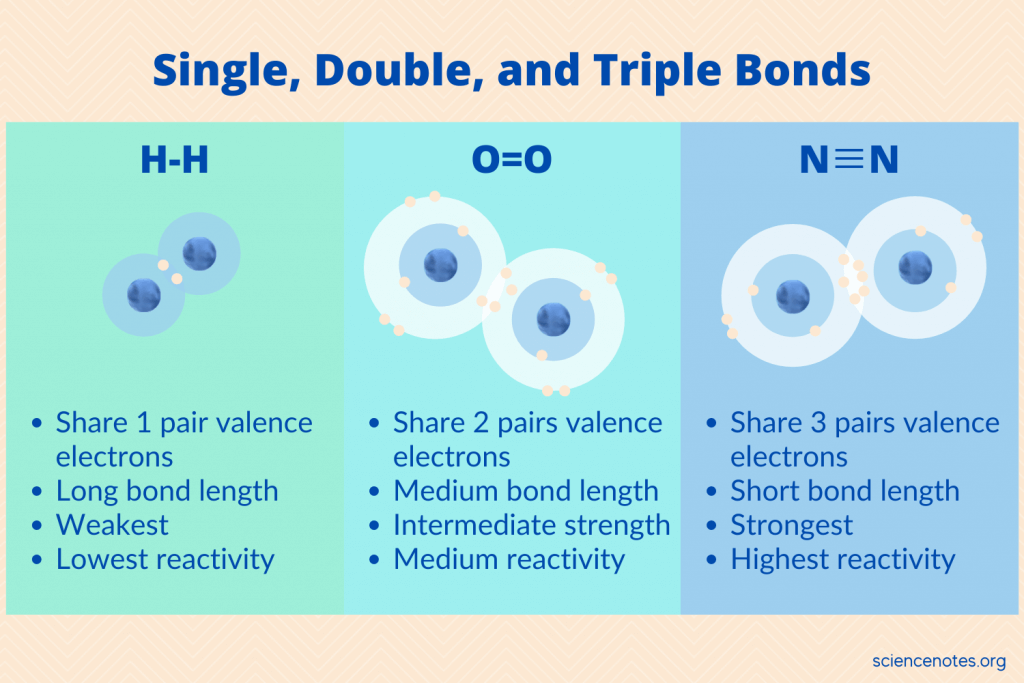
Covalent bonds are formed when atoms share pairs of valence electrons. The number of shared electron pairs determines whether the bond is single, double, or triple, each with distinct properties and reactivity. Understanding these bond types is fundamental to predicting molecular structure and behavior.
Single Bond: Involves the sharing of one pair of valence electrons between two atoms. Example: H-H (hydrogen molecule).
Double Bond: Involves the sharing of two pairs of valence electrons. Example: O=O (oxygen molecule).
Triple Bond: Involves the sharing of three pairs of valence electrons. Example: N≡N (nitrogen molecule).
Bond Length, Strength, and Reactivity
The number of shared electron pairs affects the bond length, strength, and chemical reactivity:
Single Bonds:
Longest bond length
Weakest bond strength
Lowest chemical reactivity
Double Bonds:
Intermediate bond length
Intermediate bond strength
Medium chemical reactivity
Triple Bonds:
Shortest bond length
Strongest bond strength
Highest chemical reactivity
Bond Representation and Examples
Covalent bonds are often represented using lines or symbols:
Single bond: H–H or H2
Double bond: O=O or O2
Triple bond: N≡N or N2
Bond Energy and Stability
Bond energy is the amount of energy required to break a bond. Generally, the more electron pairs shared, the higher the bond energy and the greater the stability:
Single bond: Lowest bond energy
Double bond: Intermediate bond energy
Triple bond: Highest bond energy
Formulas and Equations
The relationship between bond order and bond length/strength can be summarized as:
Bond Order: Number of shared electron pairs between two atoms.
Bond Length:
Bond Strength:
Summary Table: Properties of Single, Double, and Triple Bonds
Bond Type | Electron Pairs Shared | Bond Length | Bond Strength | Reactivity |
|---|---|---|---|---|
Single | 1 | Longest | Weakest | Lowest |
Double | 2 | Medium | Intermediate | Medium |
Triple | 3 | Shortest | Strongest | Highest |
Example: The nitrogen molecule (N2) has a triple bond, making it very stable and unreactive under normal conditions, while the hydrogen molecule (H2) has a single bond and is more reactive.
Key Take aways:
Covalent bonds form when atoms share valence electron pairs.
Bond order = number of shared electron pairs:
Single bond: 1 shared pair (e.g., H–H in H2)
Double bond: 2 shared pairs (e.g., O=O in O2)
Triple bond: 3 shared pairs (e.g., N≡N in N2)
As bond order increases (single → double → triple):
Bond length decreases (single = longest, triple = shortest)
Bond strength increases (single = weakest, triple = strongest)
Bond energy increases (more energy required to break the bond)
Reactivity increases (single = lowest, triple = highest)
Helpful relationships:
∝ = “ is proportional to ”
Bond Length proportionality: Bond Length ∝ 1/(Bond Order)
Bond Strength proportionality: Bond Strength ∝ Bond Order
Bond Strength ∝ Bond Order means: as bond order increases, bond strength increases (direct relationship).
Optional (if you want a one-line summary at the end)derived from the study notes:
Higher bond order → shorter, stronger, higher-energy bonds (and typically higher reactivity).
Exam-prep questions related to this:
Exam Prep Questions Related to Bond Order (Single/Double/Triple) 🔎based on the study notes, the Exam Prep questions that match what you listed are the ones that ask you to do any of the following:
Identify bond type from a drawing/formula
Recognize single (e.g., H–H), double (e.g., O=O), and triple (e.g., N≡N) bonds.
Connect bond order to “number of shared electron pairs” (1, 2, or 3).
Rank/compare bond lengths
Questions that say “Which bond is shortest/longest?” for single vs double vs triple.
Use the proportionality: Plain text: Bond Length ∝ 1/(Bond Order)
Rank/compare bond strengths and bond energies
“Which bond is strongest/weakest?” and “Which requires the most/least energy to break?”
Use the proportionality: Plain text: Bond Strength ∝ Bond Order
From the notes: single = lowest bond energy, double = intermediate, triple = highest.
Predict relative reactivity from bond order
Questions that ask which is most/least reactive among single, double, triple bonds (notes: single lowest → triple highest).
Interpret or complete summary tables
Fill-in/choose-the-correct-row style questions using the notes’ table trends: single (longest/weakest/lowest), double (middle), triple (shortest/strongest/highest).
One-line wrap-up 🧾derived from the study notes: higher bond order → shorter bond length and stronger, higher-energy bonds (and higher reactivity per the notes).
Chapter: Ch. 8 — Basic Concepts of Chemical Bonding
Sections/topics within that chapter:
Bond Energy (covers the “more energy required to break a bond” idea)
Average Bond Order (covers bond order as a way to describe multiple bonding / shared electron pairs)
Lewis Dot Structures: Sigma & Pi Bonds (connects single/double/triple bonds to how electrons are shared)
