 Back
BackSolids, Liquids, and Intermolecular Forces: Study Guide
Study Guide - Smart Notes
 Tailored notes based on your materials, expanded with key definitions, examples, and context.
Solids, Liquids, and Intermolecular Forces
Difference Between Intermolecular and Intramolecular Forces
Understanding the distinction between intermolecular and intramolecular forces is fundamental in chemistry. Intramolecular forces are the chemical bonds (such as covalent, ionic, or metallic bonds) that hold atoms together within a molecule. Intermolecular forces are the forces of attraction or repulsion between neighboring molecules, affecting physical properties like boiling point, melting point, and solubility.
Intramolecular forces: Strong, responsible for molecule formation (e.g., O-H bond in water).
Intermolecular forces: Weaker, responsible for interactions between molecules (e.g., hydrogen bonding between water molecules).
Example: Water's O-H bond is intramolecular; hydrogen bonds between water molecules are intermolecular.
Types of Intermolecular Forces
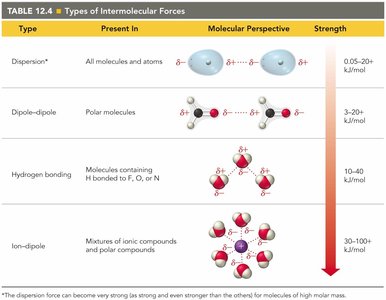
There are four main types of intermolecular forces, each with distinct characteristics and effects on physical properties.
London Dispersion Forces (LDFs): Present in all molecules and atoms; arise from temporary dipoles due to electron movement. Strength increases with molecular weight.
Dipole-Dipole Forces: Occur in polar molecules; strength depends on the dipole moment.
Hydrogen Bonding: Special type of dipole-dipole interaction; occurs when H is bonded to F, O, or N. Stronger than LDFs and dipole-dipole forces.
Ion-Dipole Forces: Occur between ions and polar molecules; important in solutions of ionic compounds.
Hydrogen Bonding
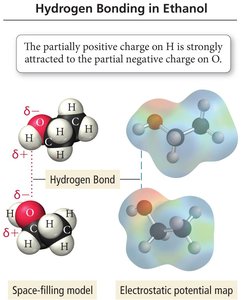
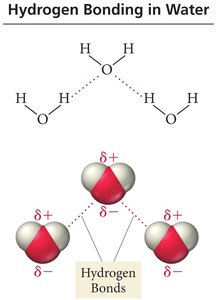
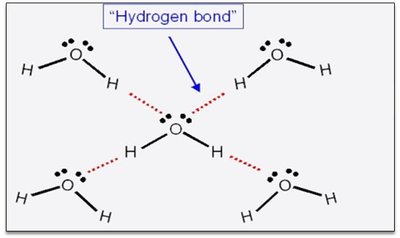
Hydrogen bonding is an attractive force between a hydrogen atom bonded to a highly electronegative atom (F, O, or N) and the F, O, or N atom of another molecule. It is responsible for many unique properties of substances like water and ethanol.
Atoms involved: H, F, O, N only.
Examples: HF, H2O, NH3, ethanol.
Average energy: 40 kJ/mol.
Cause: Highly electronegative atom pulls electron density from H, leaving H nucleus unshielded and highly positive, which is attracted to lone pairs on neighboring molecules.
Example: Hydrogen bonding in ethanol and water.
Unique Properties of Water
Water exhibits several unique properties due to hydrogen bonding:
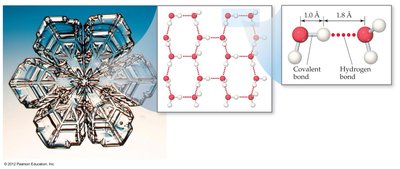
Expands upon freezing; ice is less dense than liquid water due to open hydrogen-bonded structure.
Each water molecule can form four hydrogen bonds, leading to a high boiling point for its low molar mass.
Other Molecules with Hydrogen Bonding
Ammonia (NH3)
Hydrogen fluoride (HF)
Hydrogen peroxide (H2O2)
Methanol (CH3OH)
Acetic acid (CH3COOH)
Methylamine (CH3NH2)
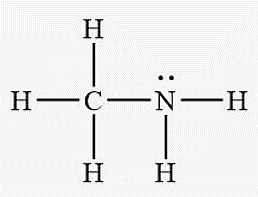
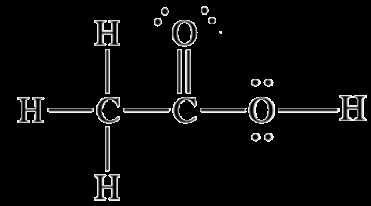

Effect of Hydrogen Bonding on Physical Properties
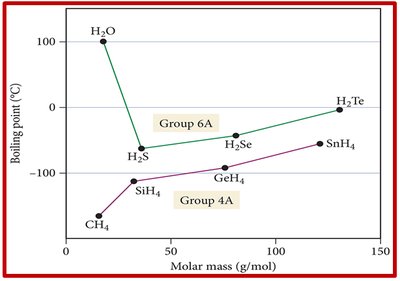
Hydrogen bonding significantly increases melting and boiling points compared to substances without hydrogen bonding.
Hydrides of Group 6A (e.g., H2O) have higher boiling points than Group 4A hydrides due to hydrogen bonding.
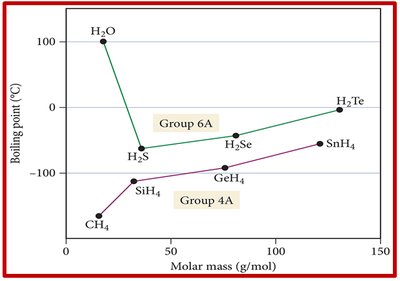
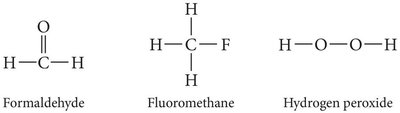
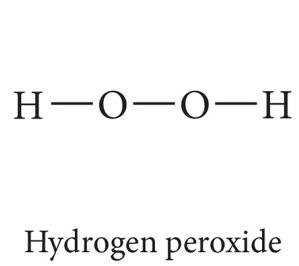
Example: Among formaldehyde, fluoromethane, and hydrogen peroxide, only hydrogen peroxide exhibits hydrogen bonding and is liquid at room temperature.
Hydrogen Bonding in DNA
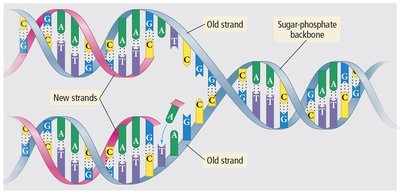
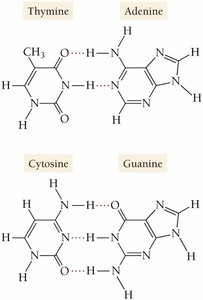
Hydrogen bonds are crucial for the structure of DNA, holding the base pairs together.
Important Distinction
Hydrogen bonding is an intermolecular force, not a chemical bond.
Chemical bonds occur within molecules; hydrogen bonds occur between molecules.
Ion-Dipole Forces
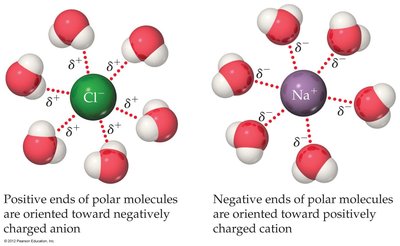
Ion-dipole interactions are Coulombic attractions between ions and polar molecules, especially important in aqueous solutions.
Strength depends on ion size, charge, and dipole moment.
Cations interact more strongly with dipoles than anions of the same charge due to smaller size.
Example: Sodium chloride dissolved in water.
Summary of Intermolecular Forces
Type | Present In | Molecular Perspective | Strength (kJ/mol) |
|---|---|---|---|
Dispersion | All molecules and atoms | Temporary dipoles | 0.05–20 |
Dipole-dipole | Polar molecules | Permanent dipoles | 3–20 |
Hydrogen bonding | H bonded to F, O, or N | Special dipole-dipole | 10–40 |
Ion-dipole | Ions and polar molecules | Ion and dipole | 30–100+ |
Comparison of Intermolecular Forces
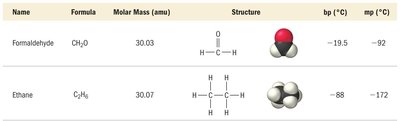
For substances with similar molar mass and shape, LDFs are similar; differences arise from dipole-dipole and hydrogen bonding.
Hydrogen bonding leads to stronger intermolecular attractions.
For substances with very different molar mass and similar shape, LDFs dominate if no hydrogen bonding is present.
Example: Formaldehyde has higher boiling and melting points than ethane due to dipole-dipole forces.
Practice: Identifying Intermolecular Forces
Compound | LDF | D-D | HB |
|---|---|---|---|
PCl3 | yes | yes | no |
CH3F | yes | yes | no |
I2 | yes | no | no |
HF | yes | yes | yes |
HCl | yes | yes | no |
CH2O | yes | yes | no |
CH3OH | yes | yes | yes |
BF3 | yes | no | no |
Intermolecular Forces and Physical Properties
Surface Tension, Viscosity, and Capillary Action
Surface Tension
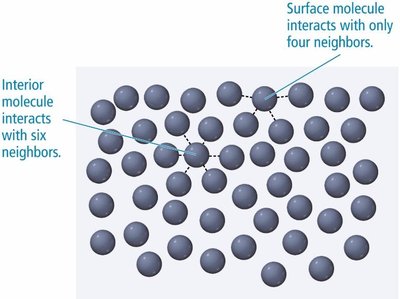
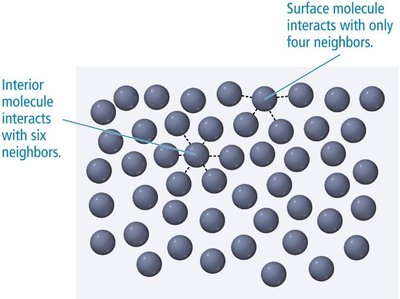
Surface tension is the net inward pull experienced by molecules at the surface of a liquid, causing the surface to tighten like an elastic film and reducing its surface area.
Measured as the energy required to increase the surface area by a unit amount.
Stronger intermolecular forces lead to higher surface tension.
Surface tension decreases with increasing temperature due to increased molecular motion.
Example: Water has much higher surface tension than ethanol due to extensive hydrogen bonding.
Substance | Surface Tension (J/m2) |
|---|---|
Water (H2O) | 7.3×10‒2 |
Ethanol (C2H5OH) | 2.3×10‒2 |
Viscosity
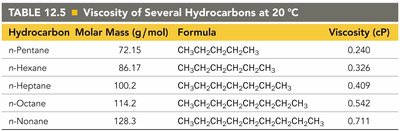
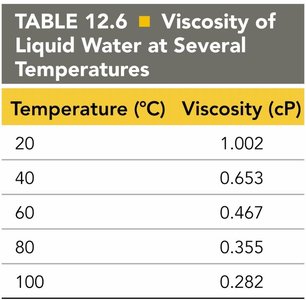
Viscosity is the resistance to flow exhibited by liquids and gases. It is influenced by intermolecular forces and temperature.
Higher viscosity means slower flow.
Measured in kg/m·s or poise (P).
Strong IMFs and higher molar mass increase viscosity.
Viscosity decreases with increasing temperature.
Hydrocarbon | Molar Mass (g/mol) | Formula | Viscosity (cP) |
|---|---|---|---|
n-Pentane | 72.15 | CH3CH2CH2CH2CH3 | 0.240 |
n-Hexane | 86.17 | CH3CH2CH2CH2CH2CH3 | 0.326 |
n-Heptane | 100.2 | CH3CH2CH2CH2CH2CH2CH3 | 0.409 |
n-Octane | 114.2 | CH3CH2CH2CH2CH2CH2CH2CH3 | 0.542 |
n-Nonane | 128.3 | CH3CH2CH2CH2CH2CH2CH2CH2CH3 | 0.711 |
Temperature (°C) | Viscosity (cP) |
|---|---|
20 | 1.002 |
40 | 0.653 |
60 | 0.467 |
80 | 0.355 |
100 | 0.282 |
Capillary Action
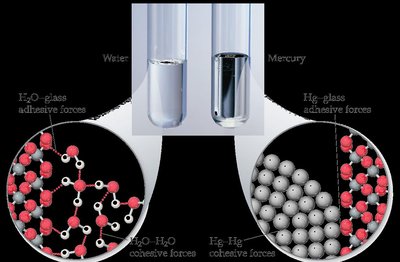
Capillary action is the rising of a liquid through a narrow tube against gravity, resulting from the competition between cohesive and adhesive forces.
Cohesive forces: IMFs between molecules of the same substance.
Adhesive forces: Forces between molecules and a surface.
If adhesive forces > cohesive forces, liquid rises (concave meniscus, e.g., water).
If cohesive forces > adhesive forces, liquid does not rise (convex meniscus, e.g., mercury).
Key Equations
Clausius-Clapeyron Equation: Used to relate vapor pressure and temperature for phase changes.
Summary Table: Types of Intermolecular Forces
Type | Present In | Strength (kJ/mol) |
|---|---|---|
London Dispersion | All molecules/atoms | 0.05–20 |
Dipole-Dipole | Polar molecules | 3–20 |
Hydrogen Bonding | H bonded to F, O, N | 10–40 |
Ion-Dipole | Ions and polar molecules | 30–100+ |
Additional info: The notes have been expanded with academic context and examples to ensure completeness and clarity for exam preparation.
