 Back
BackSolubility and Lewis Structures in General Chemistry
Study Guide - Smart Notes
 Tailored notes based on your materials, expanded with key definitions, examples, and context.
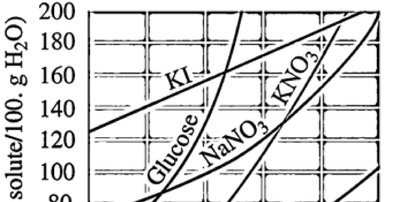
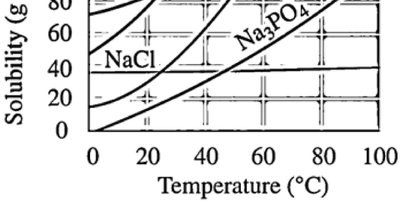
Q23. At 40 °C, 105 g of glucose are added to 100 g of water. Is the solution saturated?
Background
Topic: Solubility and Saturated Solutions
This question tests your ability to interpret solubility curves and determine whether a solution is saturated, unsaturated, or supersaturated based on the amount of solute added and the temperature.
Key Terms and Concepts:
Saturated solution: A solution in which no more solute can dissolve at a given temperature.
Solubility curve: A graph showing how the solubility of a substance changes with temperature.
Step-by-Step Guidance
Locate the solubility curve for glucose on the provided graph.
Find the point corresponding to 40 °C on the x-axis (temperature).
Read the solubility value for glucose at 40 °C (in grams per 100 g of water).
Compare the amount of glucose added (105 g) to the solubility value at 40 °C.
Try solving on your own before revealing the answer!
Final Answer: The solution is saturated.
At 40 °C, the solubility of glucose is approximately 105 g per 100 g of water, so adding 105 g results in a saturated solution.
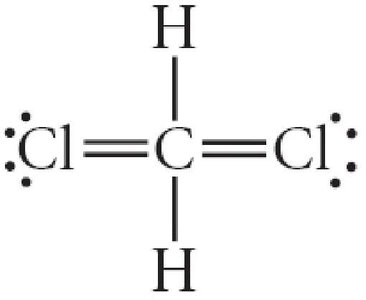
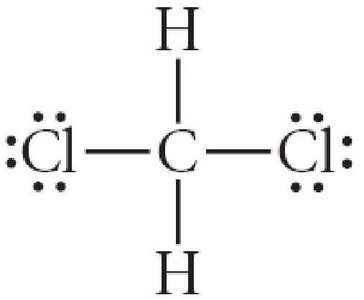
Q26. Choose the most complete Lewis structure for CH2Cl2.
Background
Topic: Lewis Structures and Molecular Geometry
This question tests your ability to draw and identify the correct Lewis structure for a molecule, including proper placement of bonds and lone pairs.
Key Terms and Concepts:
Lewis structure: A diagram showing the arrangement of atoms, bonds, and lone pairs in a molecule.
Valence electrons: Electrons in the outermost shell of an atom, used in bonding.


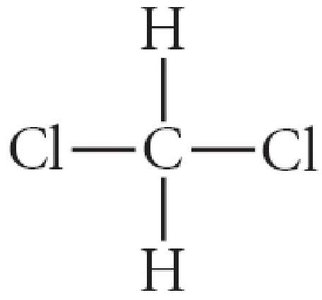
Step-by-Step Guidance
Count the total number of valence electrons for CH2Cl2: C (4), H (1 each), Cl (7 each).
Arrange the atoms: Carbon is the central atom, with two hydrogens and two chlorines attached.
Draw single bonds from carbon to each hydrogen and chlorine.
Place remaining electrons as lone pairs on the chlorine atoms.
Try solving on your own before revealing the answer!
Final Answer: The most complete Lewis structure is option E.
Option E shows carbon with four single bonds (two to H, two to Cl), and each Cl has three lone pairs.
Q29. Which orbital electron configurations are incorrect for ground-state atoms?
Background
Topic: Electron Configurations and Orbital Diagrams
This question tests your understanding of the rules for filling electron orbitals (Aufbau principle, Pauli exclusion principle, Hund's rule) and identifying incorrect configurations.
Key Terms and Concepts:
Orbital diagram: Visual representation of electron arrangement in orbitals.
Hund's rule: Electrons fill degenerate orbitals singly before pairing.
Pauli exclusion principle: No two electrons in an atom can have the same set of quantum numbers.
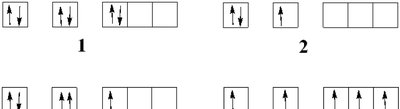
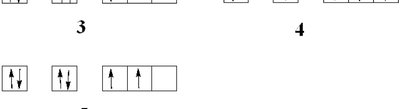
Step-by-Step Guidance
Examine each orbital diagram for violations of Hund's rule or the Pauli exclusion principle.
Check if electrons are paired correctly and if orbitals are filled in the proper order.
Identify any diagrams where electrons are incorrectly paired or where orbitals are not filled according to the rules.
Try solving on your own before revealing the answer!
Final Answer: Orbital electron configurations 3 and 4 are incorrect.
These diagrams violate Hund's rule or the Pauli exclusion principle.
