 Back
Solubility, Ionic & Molecular Compounds in Aqueous Solutions, and Precipitation Reactions
Study Guide - Smart Notes
 Tailored notes based on your materials, expanded with key definitions, examples, and context.
Solubility and Dissolution
Definitions and Quantitative Characterization
Solubility is a fundamental property describing the ability of a substance (solute) to dissolve in a solvent, forming a homogeneous solution. The process of dissolving is called dissolution. Solubility can be expressed in various units, such as grams of solute per 100 g of solvent or moles of solute per liter of solution.
Saturated Solution: A solution in which no more solute can dissolve at a given temperature; any additional solute will remain undissolved.
Soluble Substance: Solubility > 1.0 g per 100 g solvent (e.g., NaCl in water: 36 g/100 g at 20°C).
Slightly Soluble: Solubility between 0.010 g and 1.0 g per 100 g solvent (e.g., CaSO4: 0.200 g/100 g at 20°C).
Practically Insoluble: Solubility ≤ 0.010 g per 100 g solvent (e.g., AgCl: 0.00014 g/100 g at 20°C).
Example: NaCl is highly soluble in water, while AgCl is practically insoluble.
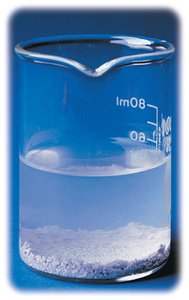
Solubility of Poorly Water-Soluble Ionic Compounds
Many ionic compounds exhibit low solubility in water. Their solubility is often tabulated for reference.
Compound | Solubility (g/100 g H2O) |
|---|---|
CaSO4 | 0.20 |
SrSO4 | 0.013 |
BaSO4 | 0.0002 |
AgCl | 1.4×10⁻⁴ |
PbCl2 | 0.98 |
PbSO4 | 0.004 |
CaCO3 | 5.7×10⁻⁴ |
Poorly Soluble Ionic Compounds in Nature
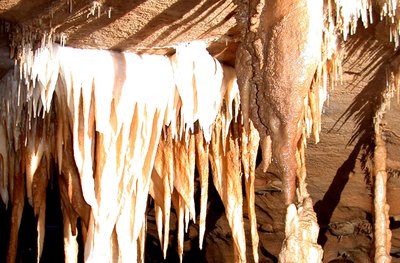
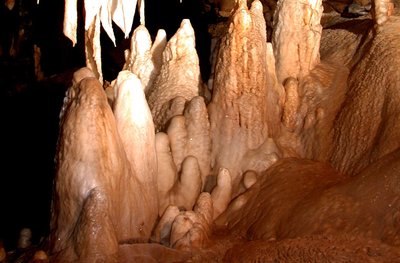
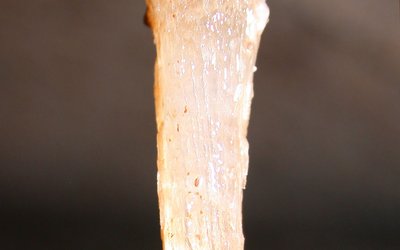
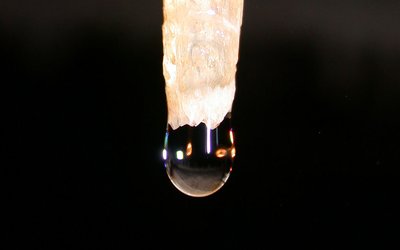
Compounds like CaCO3 and CaSO4 are responsible for the formation of geological features such as stalactites and stalagmites in caves, resulting from precipitation reactions.
Dissolution of Ionic Compounds in Water
Process and Energetics
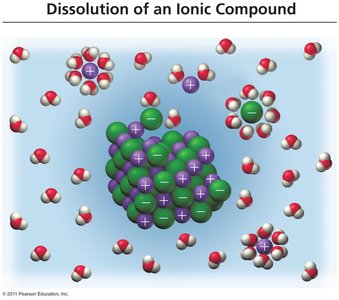
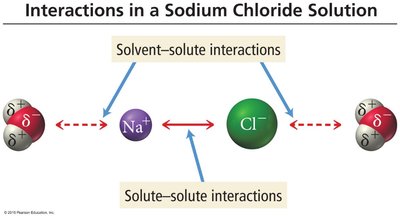
When ionic compounds dissolve in water, they dissociate into their constituent ions, which become surrounded by water molecules, forming hydrated ions. The dissolution occurs if the total hydration energy of the ions is comparable to or greater than the lattice energy of the ionic solid.
Dissociation Example: NaCl(s) → Na+(aq) + Cl-(aq)
Hydrated Ion Example: Na+ forms Na(H2O)6+
Energetic Criterion:
Energetics of Dissolution
The solubility of an ionic compound depends on the balance between lattice energy and hydration energy:
NaCl: , → NaCl is soluble.
AgCl: , → AgCl is insoluble.
Solubility Rules for Ionic Compounds
General Rules and Exceptions
Solubility rules help predict whether an ionic compound will dissolve in water:
Generally Soluble: Compounds containing Li+, Na+, K+, Rb+, Cs+, NH4+, NO3-, C2H3O2-
Generally Insoluble: Compounds containing CO32-, PO43-, S2-, OH- (except with alkali metals and NH4+)
Exceptions: Some compounds with Ag+, Pb2+, Hg22+ are insoluble.
Molecular Compounds in Aqueous Solutions
Ionization and Types of Molecular Compounds
Molecular compounds may either remain unchanged or ionize when dissolved in water. The extent of ionization varies:
Non-ionizing: SF6, acetone, benzene
Ionizing: Al2Br6 (near 100%), HCl (near 100%), HC2H3O2 (~0.4%), HgCl2 (2×10⁻⁵%)
Acids: Strong and Weak
Acids are compounds that ionize in water to produce H+(aq). The degree of ionization distinguishes strong acids from weak acids:
Strong Acids: >90% ionization in 1M solution (e.g., HCl, HBr, HI, HNO3, H2SO4, HClO4)
Weak Acids: <10% ionization in 1M solution (e.g., HF, H3PO4, CH3COOH, H2SO3, H2CO3, HNO2, H2S)
Energetics of Ionization
The extent of ionization depends on the balance between the energy required to break chemical bonds and the hydration energy of the resulting ions:
Criterion:
Example: HCl(aq): , → HCl is fully ionized.
Example: HC2H3O2(aq): , → Only slightly ionized.
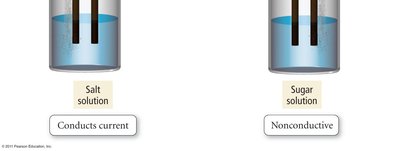
Electrolytes and Nonelectrolytes
Definitions and Conductivity
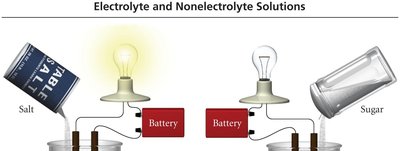
Electrolytes are substances that produce ions in solution and enhance electrical conductivity. Nonelectrolytes do not produce ions and do not affect conductivity.
Strong Electrolytes: Dissociate/ionize almost completely (e.g., NaCl, HCl)
Weak Electrolytes: Ionize only partially (e.g., acetic acid)
Nonelectrolytes: Do not ionize (e.g., benzene, sucrose)
Precipitation Reactions
Definition and Industrial Applications
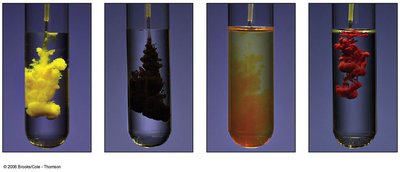
Precipitation reactions occur when two soluble substances react to form an insoluble solid (precipitate). These reactions are important in water purification and chemical manufacturing.
Example: Cd(NO3)2(aq) + K2S(aq) → CdS(s) + 2KNO3(aq)
Precipitate: The insoluble product formed (e.g., CdS)
Spectator Ions: Ions that remain in solution and do not participate in the formation of the precipitate
How Precipitation Works
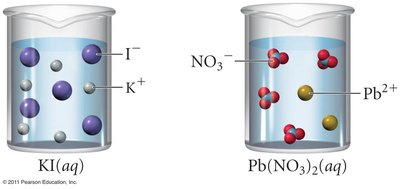
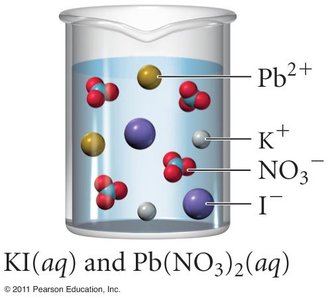
When two solutions containing ions are mixed, new combinations of ions may form insoluble products, resulting in precipitation.
Step 1: Dissociation of ionic compounds in water
Step 2: Mixing brings ions into contact
Step 3: Formation of a strong ionic crystal lattice (precipitate)
Step 4: Spectator ions remain in solution
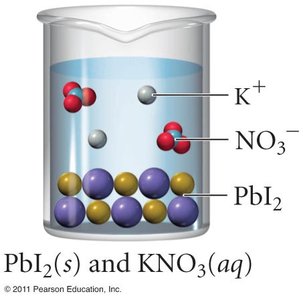
Ionic and Net Ionic Equations
Precipitation reactions can be written as complete ionic equations (showing all ions) or net ionic equations (showing only the ions involved in forming the precipitate).
Complete Ionic Equation: Cd2+(aq) + 2NO3-(aq) + 2K+(aq) + S2-(aq) → CdS(s) + 2K+(aq) + 2NO3-(aq)
Net Ionic Equation: Cd2+(aq) + S2-(aq) → CdS(s)
Determining Products of Precipitation Reactions
To predict the outcome of mixing two solutions:
Identify ions present in each solution.
Consider all possible combinations of ions of opposite charge.
Use solubility rules to determine if any combination forms an insoluble product.
Write the formula of the precipitate and indicate its state.
If no insoluble product forms, write "No Reaction".
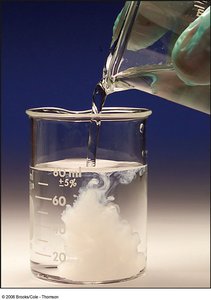
Example: Mixing BaCl2(aq) and Na2SO4(aq) forms BaSO4(s) as a precipitate. Mixing K2SO4(aq) and MgCl2(aq) results in no reaction, as all possible products are soluble.
