 Back
BackSolubility Product Constant (Ksp), Molar Solubility, and the Common Ion Effect
Study Guide - Smart Notes
 Tailored notes based on your materials, expanded with key definitions, examples, and context.
Solubility Equilibria and the Solubility Product Constant (Ksp)
Introduction to Solubility Equilibria
The solubility of ionic compounds in water is governed by equilibrium principles. Even compounds considered 'insoluble' dissolve to a small extent, and this dissolution can be described quantitatively using the solubility product constant (Ksp).
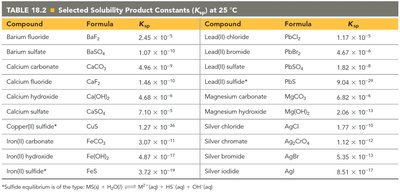
Solubility Product Constant (Ksp): The equilibrium constant for the dissolution of a sparingly soluble ionic solid in water. It is defined as the product of the equilibrium concentrations of the ions, each raised to the power of its stoichiometric coefficient. The solid is omitted from the expression.
Molar Solubility (S): The number of moles of solute that dissolve per liter of solution to form a saturated solution.
Saturated Solution: Contains the maximum amount of dissolved ions; the solution is at equilibrium (Q = Ksp).
Unsaturated Solution: Contains less dissolved solute than the equilibrium amount (Q < Ksp); more solid can dissolve.
Supersaturated Solution: Contains more dissolved solute than equilibrium allows (Q > Ksp); excess solute will precipitate.
Writing Ksp Expressions
To write a Ksp expression, use the balanced dissolution equation and include only the ions in solution:
General Rule: product of ion concentrations, each raised to the power of its coefficient in the balanced equation.
Solids are omitted (activity = 1).
Examples:
AgCl(s) ↔ Ag+(aq) + Cl-(aq) →
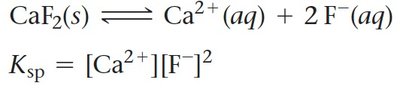
CaF2(s) ↔ Ca2+(aq) + 2 F-(aq) →
PbCl2(s) ↔ Pb2+(aq) + 2 Cl-(aq) →
Calculating Molar Solubility from Ksp
The ICE Table Method
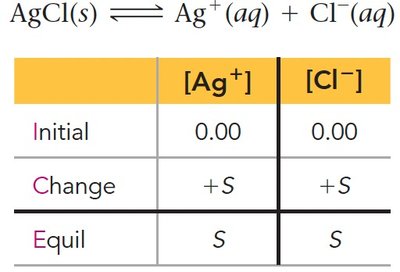
To relate Ksp to molar solubility, set up an ICE (Initial, Change, Equilibrium) table based on the dissolution stoichiometry.
Let S = molar solubility (mol/L dissolved).
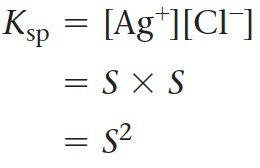
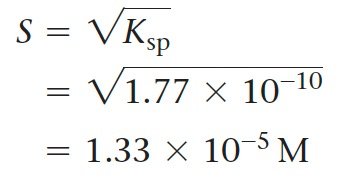
For 1:1 salts (e.g., AgCl):
For 1:2 salts (e.g., CaF2):
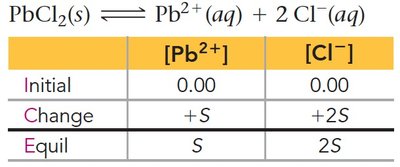
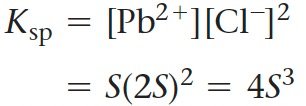
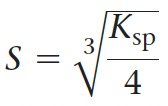
Example: PbCl2
PbCl2(s) ↔ Pb2+(aq) + 2 Cl-(aq)

Calculating Ksp from Molar Solubility
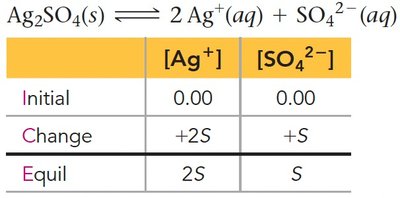
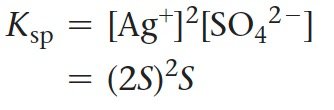
Given the molar solubility, you can calculate Ksp by reversing the ICE table process.
For Ag2SO4:

Comparing Ksp and Relative Solubility
When Can You Compare Ksp Directly?
Ksp values can only be directly compared for compounds with the same dissolution stoichiometry. For different stoichiometries, calculate the actual molar solubility (S) for each compound.
For salts with the same stoichiometry, a larger Ksp means higher molar solubility.
For salts with different stoichiometries, always calculate S to compare solubility.
The Common Ion Effect on Solubility
Le Châtelier's Principle Applied
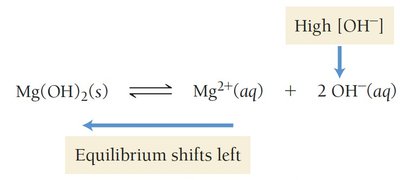
The solubility of an ionic compound is reduced when dissolved in a solution already containing one of its ions (the common ion). This is an application of Le Châtelier's principle: adding a common ion shifts the dissolution equilibrium to the left, decreasing solubility.
Example: Adding NaCl to AgCl(s) ↔ Ag+(aq) + Cl-(aq) decreases AgCl solubility because Cl- is the common ion.
Only ions that appear in the Ksp expression are considered common ions.
The Effect of pH on Solubility
pH Effects on Solubility
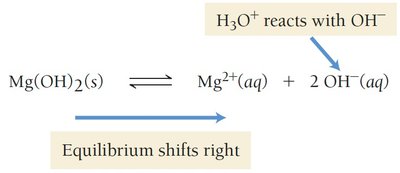
The solubility of ionic compounds containing basic anions increases as pH decreases (solution becomes more acidic). This is because H3O+ reacts with the basic anion, removing it from solution and shifting the equilibrium to the right.
Basic anions: OH-, F-, CO32-, S2-, PO43-
pH-neutral anions (Cl-, Br-, I-, NO3-) are not affected by pH because they are conjugate bases of strong acids.

Key Takeaways
Ksp is the equilibrium constant for dissolution; solids are excluded from the expression.
Molar solubility (S) is found using an ICE table and the Ksp expression.
Direct Ksp comparison is only valid for compounds with the same stoichiometry; otherwise, calculate S.
The common ion effect reduces solubility by shifting equilibrium left.
Acidic conditions increase the solubility of compounds with basic anions.
pH-neutral anions are unaffected by pH changes.
