 Back
Solutions and Aqueous Reactions: Concentration, Solubility, and Types of Reactions
Study Guide - Smart Notes
 Tailored notes based on your materials, expanded with key definitions, examples, and context.
Solution Concentration and Solution Stoichiometry
Definitions and Properties of Solutions
Solutions are homogeneous mixtures composed of two or more substances. The substance that changes state is called the solute, while the substance that retains its state is the solvent. If both components are in the same state, the major component is considered the solvent. The composition of solutions can vary, unlike pure substances which have constant composition.
Quantitative Description of Solution Concentration
Solutions are often described as dilute or concentrated based on the relative amount of solute to solvent. A dilute solution contains a small amount of solute, while a concentrated solution contains a large amount of solute.
Dilute Solution: Low solute concentration
Concentrated Solution: High solute concentration
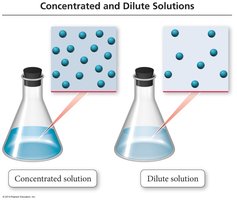
Molarity: Measuring Solution Concentration
Molarity (M) is a common unit for expressing solution concentration, defined as the number of moles of solute per liter of solution:
Formula:
Preparing Solutions of Specified Concentration
To prepare a solution of a specific molarity, weigh the required amount of solute, dissolve it in water, and dilute to the desired final volume.
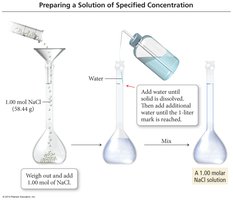
Using Molarity in Calculations
Molarity serves as a conversion factor between moles of solute and liters of solution. For example, a 0.500 M NaCl solution contains 0.500 mol NaCl per liter.
Conversion from volume to moles:
Conversion from moles to volume:


Solution Dilution
Stock solutions are often diluted to prepare solutions of lower concentration. The amount of solute remains constant, but the volume increases. The relationship is given by:
Formula:
Where and are the molarity and volume of the stock solution, and and are those of the diluted solution.
Stoichiometric Calculations with Solutions
Molarity allows conversion between the volume of reactants/products and their amount in moles, facilitating stoichiometric calculations in chemical reactions.

Types of Aqueous Solutions and Solubility
Solubility and Dissolution
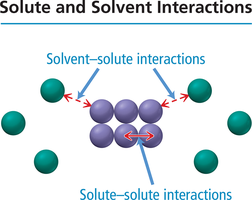
Solubility refers to the ability of a substance to dissolve in a solvent. When a solute dissolves, attractive forces between solute and solvent must overcome those between solute particles and between solvent molecules.
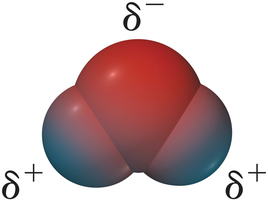
Charge Distribution in Water Molecules
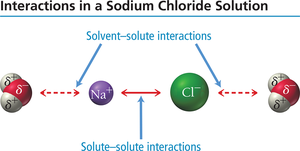
Water molecules have an uneven distribution of electrons, resulting in a partial negative charge (δ−) on the oxygen atom and partial positive charges (δ+) on the hydrogen atoms. This polarity is crucial for dissolving ionic and polar substances.
Solute and Solvent Interactions in Sodium Chloride Solution
When NaCl dissolves in water, the attraction between Na+ and Cl− ions and water molecules competes with the attraction between the ions themselves. Water molecules surround and insulate the ions, allowing them to move freely.
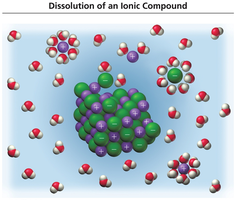
Dissolution of Ionic Compounds
Ionic compounds dissolve in water when the ions are pulled away from the crystal lattice and surrounded by water molecules. This process results in a solution with free-moving ions that can conduct electricity.
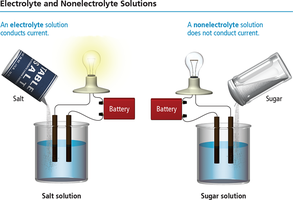
Electrolyte and Nonelectrolyte Solutions
Definitions and Properties
Electrolytes are substances that dissolve in water to produce ions, enabling the solution to conduct electricity. Nonelectrolytes dissolve without forming ions and do not conduct electricity.
Electrolyte: Conducts electricity (e.g., NaCl)
Nonelectrolyte: Does not conduct electricity (e.g., sugar)
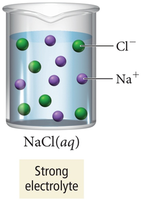
Strong and Weak Electrolytes
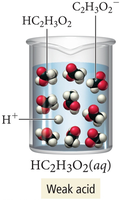
Strong electrolytes dissociate completely into ions (e.g., ionic compounds, strong acids), while weak electrolytes dissociate partially (e.g., weak acids).
Strong Electrolyte: Complete dissociation, good conductor
Weak Electrolyte: Partial dissociation, poor conductor
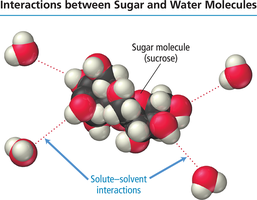
Nonelectrolyte Example: Sugar Dissolution
Sugar dissolves in water as intact molecules, forming a nonelectrolyte solution. The interactions are between the sugar molecules and water, but no ions are produced.
Dissociation and Ionization
Dissociation of Ionic Compounds
When ionic compounds dissolve, their ions separate and disperse in the solution. Polyatomic ions remain intact during dissociation.
Example:
Example:
Ionization of Acids
Strong acids ionize completely in water, while weak acids ionize only partially.
Strong Acid Example:
Weak Acid Example:
Solubility of Ionic Compounds and Precipitation Reactions
Solubility Rules and Precipitation
Solubility rules, based on empirical observations, help predict whether a compound will dissolve in water. A compound is soluble if it dissolves, and insoluble if it does not. Precipitation reactions occur when mixing two solutions produces an insoluble product, called a precipitate.
Predicting Precipitation Reactions
Identify ions in each reactant.
Determine possible products by exchanging ions.
Use solubility rules to determine if products are soluble.
If a product is insoluble, it precipitates; otherwise, write "no reaction."
Balance the equation.
Representing Aqueous Reactions
Molecular, Ionic, and Net Ionic Equations
Molecular Equation: Shows reactants and products as compounds.
Ionic Equation: Shows all strong electrolytes as ions.
Net Ionic Equation: Shows only the species that change during the reaction; spectator ions are omitted.
Steps for Writing Net Ionic Equations
Write a balanced molecular equation.
Dissociate all strong electrolytes.
Cross out unchanged species (spectator ions).
Write the net ionic equation with remaining species.
Acid–Base and Gas-Evolution Reactions
Acid–Base Reactions
Acid–base reactions, also called neutralization reactions, occur when an acid reacts with a base to produce water and a salt. According to Arrhenius, acids produce H+ ions and bases produce OH− ions in solution.
Net Ionic Equation:
Gas-Evolution Reactions
Gas-evolution reactions produce a gas either directly or by decomposition of an ion exchange product. Many are also acid–base reactions.
Example:
Oxidation–Reduction (Redox) Reactions
Definition and Examples
Redox reactions involve the transfer of electrons between reactants. Oxidation is the loss of electrons, and reduction is the gain of electrons. These reactions are fundamental in processes such as combustion and metal-nonmetal reactions.
Example: (rusting)
Example:
Oxidation Numbers
Oxidation numbers are assigned to elements to track electron transfer. The sum of oxidation numbers in a neutral compound is zero; in a polyatomic ion, it equals the ion's charge.
Rules:
Free elements: 0
Monatomic ions: equal to charge
Group I metals: +1
Group II metals: +2
Oxygen: −2 (except peroxides: −1)
Hydrogen: +1 (with nonmetals), −1 (with metals)
Fluorine: −1
Identifying Redox Reactions
Oxidation is an increase in oxidation state; reduction is a decrease. The reactant causing reduction is the reducing agent, and the reactant causing oxidation is the oxidizing agent.
Combustion Reactions
Combustion reactions involve a substance reacting with oxygen to form oxygen-containing compounds and release heat.
Example:
Activity Series of Metals
The activity series ranks metals by their tendency to lose electrons (undergo oxidation). Metals at the top are most reactive and likely to oxidize.
Additional info: The activity series is used to predict whether a redox reaction will occur spontaneously.
