 Back
BackSolutions and Aqueous Reactions: Concentration, Solubility, and Electrolytes
Study Guide - Smart Notes
 Tailored notes based on your materials, expanded with key definitions, examples, and context.
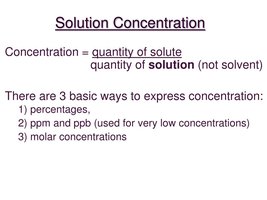
Solution Concentration
Definition and Expression of Concentration
Solution concentration quantifies the amount of solute present in a given quantity of solution. It is a fundamental concept in chemistry, as it allows chemists to describe how much of a substance is dissolved in a solvent.
Concentration = quantity of solute / quantity of solution (not solvent)
Three basic ways to express concentration:
Percentages (e.g., mass/mass %, mass/volume %, volume/volume %)
ppm (parts per million) and ppb (parts per billion) for very low concentrations
Molar concentrations (moles of solute per liter of solution)
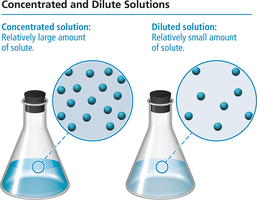
Concentrated vs. Dilute Solutions
Solutions can be described as concentrated or dilute, depending on the relative amount of solute present.
Concentrated solution: Contains a relatively large amount of solute compared to solvent.
Dilute solution: Contains a relatively small amount of solute compared to solvent.
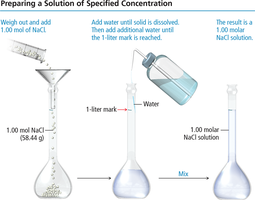
Molarity (M)
Molarity is the most common unit of concentration in chemistry. It is defined as the number of moles of solute per liter of solution.
Formula:
To prepare a solution of specified molarity, weigh out the required moles of solute, dissolve in some solvent, and dilute to the final volume.
Using Molarity in Calculations
Molarity can be used as a conversion factor between moles of solute and volume of solution.
To find moles from volume:
To find volume from moles:


Laboratory Preparation of Solutions
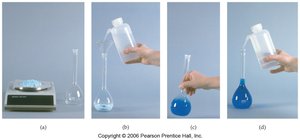
Preparing solutions of known concentration is a common laboratory procedure. The process involves weighing the solute, dissolving it in a portion of solvent, and diluting to the desired final volume.
Use volumetric flasks for precise volume measurements.
Mix thoroughly to ensure homogeneity.
Solution Stoichiometry
Stoichiometric Calculations with Solutions
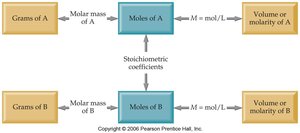
In aqueous reactions, the volume and concentration of reactants can be used to determine the amount of product formed or reactant required. This involves using molarity as a conversion factor and applying stoichiometric relationships from balanced chemical equations.
General plan: Volume A → Amount A (mol) → Amount B (mol) → Volume B
Use balanced equations to relate moles of different substances.

Types of Aqueous Solutions and Solubility
Solute-Solvent Interactions
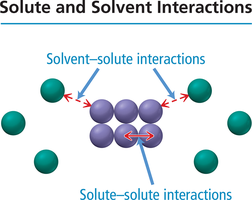
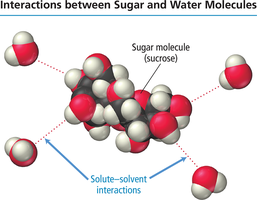
When a solute dissolves in a solvent, intermolecular forces between solute and solvent particles play a crucial role. If the attraction between solute and solvent is strong enough, the solute will dissolve.
Solute-solute interactions: Hold solute particles together.
Solvent-solvent interactions: Hold solvent molecules together.
Solute-solvent interactions: Must be strong enough to overcome solute-solute and solvent-solvent attractions for dissolution to occur.
Polarity of Water
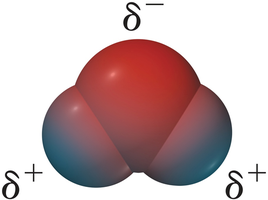
Water is a polar molecule, with a partial negative charge on the oxygen atom and partial positive charges on the hydrogen atoms. This polarity allows water to interact strongly with ions and polar molecules.
Dissolution of Ionic Compounds
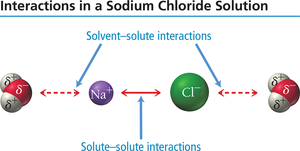
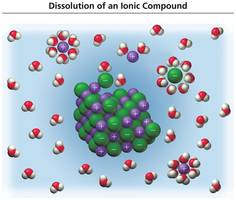
When ionic compounds such as sodium chloride dissolve in water, the ions are separated and surrounded by water molecules. This process is called dissociation, and the resulting solution can conduct electricity.
Each ion is stabilized by interactions with water molecules (hydration).
The solution contains free-moving ions, making it an electrolyte.
Dissolution of Molecular Compounds
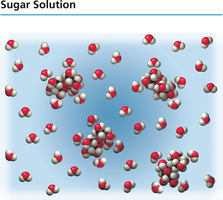
Molecular compounds like sugar dissolve in water without forming ions. The molecules are surrounded by water, but the solution does not conduct electricity.
These are called nonelectrolytes.
Electrolyte and Nonelectrolyte Solutions
Definition and Conductivity
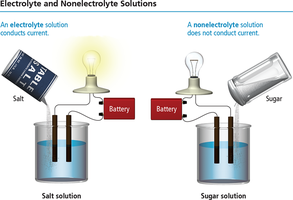
Electrolytes are substances that dissolve in water to produce a solution that conducts electricity, due to the presence of ions. Nonelectrolytes dissolve to form solutions that do not conduct electricity, as they do not produce ions.
Strong electrolytes: Completely dissociate into ions (e.g., NaCl, strong acids).
Weak electrolytes: Partially dissociate into ions (e.g., weak acids).
Nonelectrolytes: Do not dissociate into ions (e.g., sugar).
Summary Table: Types of Solutions and Conductivity
Type of Substance | Behavior in Water | Conductivity |
|---|---|---|
Ionic Compound (e.g., NaCl) | Completely dissociates into ions | Conducts electricity (strong electrolyte) |
Strong Acid (e.g., HCl) | Completely ionizes | Conducts electricity (strong electrolyte) |
Weak Acid (e.g., acetic acid) | Partially ionizes | Weakly conducts electricity (weak electrolyte) |
Molecular Compound (e.g., sugar) | Dissolves as molecules, no ions | Does not conduct electricity (nonelectrolyte) |
