 Back
BackSolutions and Aqueous Reactions: Concentration, Stoichiometry, and Types of Reactions
Study Guide - Smart Notes
 Tailored notes based on your materials, expanded with key definitions, examples, and context.
Introduction to Solutions and Aqueous Reactions
This chapter explores the nature of solutions, how to quantify their concentrations, and the types of chemical reactions that occur in aqueous environments. Understanding these concepts is essential for predicting reaction outcomes and performing laboratory calculations.
Solution Concentration
Definitions and Basic Concepts
Solution: A homogeneous mixture of two or more substances.
Solute: The minority component, dissolved in the solvent.
Solvent: The majority component, the medium in which the solute dissolves.
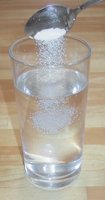
When table salt (NaCl) is mixed with water, it dissolves to form a homogeneous solution. The salt can be recovered by evaporating the water, demonstrating that the solute remains present in the solution.
Quantitative Description: Molarity
Molarity (M): The number of moles of solute per liter of solution.
Formula:
Solutions can be described as dilute (small amount of solute) or concentrated (large amount of solute).
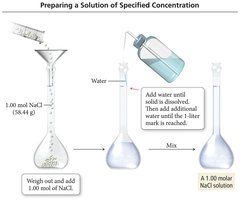
To prepare a solution of a specific molarity, dissolve the calculated amount of solute in less than the final volume of solvent, then dilute to the mark in a volumetric flask.
Using Molarity in Calculations
Molarity serves as a conversion factor between moles of solute and volume of solution.
Example: A 0.500 M NaCl solution contains 0.500 mol NaCl per liter of solution.


Solution Dilution
To dilute a solution, add more solvent without changing the amount of solute.
The relationship is:
Where and are the initial concentration and volume, and and are the final concentration and volume.
Solution Stoichiometry
Concept and Application
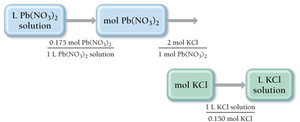
Stoichiometry in solutions involves using balanced chemical equations and molarity to relate volumes and amounts of reactants and products.
Balanced equations provide mole ratios.
Molarity allows conversion between volume and moles.

Types of Aqueous Solutions and Solubility
Solubility and Interactions
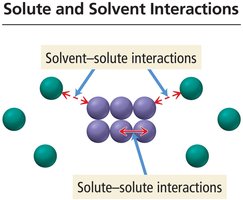
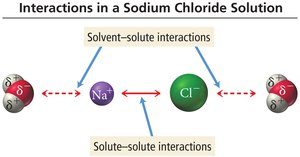
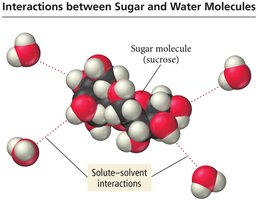
Solubility depends on the interactions between solute and solvent particles. If solute-solvent attractions are strong enough, the solute dissolves.
Dissolving Ionic Compounds
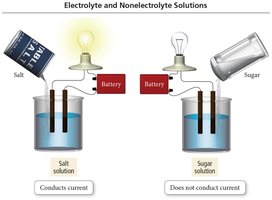
Ionic compounds dissociate into ions when dissolved in water, allowing the solution to conduct electricity (electrolyte).
Dissolving Molecular Compounds
Molecular compounds (like sugar) dissolve without forming ions, so their solutions do not conduct electricity (nonelectrolyte).
Electrolytes vs. Nonelectrolytes
Electrolytes: Substances whose aqueous solutions conduct electricity (e.g., NaCl).
Nonelectrolytes: Substances whose solutions do not conduct electricity (e.g., sugar).
Strong and Weak Electrolytes
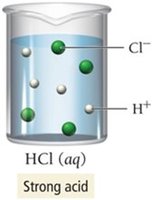
Strong electrolytes: Completely dissociate into ions (e.g., HCl, NaCl).
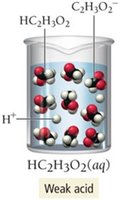
Weak electrolytes: Partially dissociate (e.g., acetic acid).
Nonelectrolytes: Do not form ions (e.g., sucrose).
Precipitation Reactions
Definition and Process
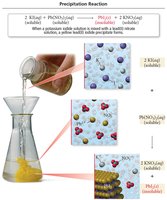
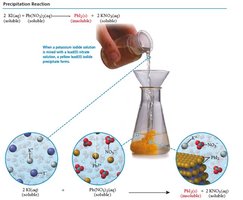
Precipitation reactions occur when two aqueous solutions combine to form an insoluble solid (precipitate).
Solubility Rules
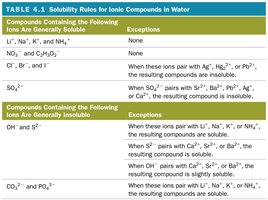
Solubility rules help predict whether a precipitate will form. Compounds containing certain ions are generally soluble or insoluble, with exceptions.
Compounds Generally Soluble | Exceptions |
|---|---|
Li+, Na+, K+, NH4+ | None |
NO3-, C2H3O2- | None |
Cl-, Br-, I- | Ag+, Hg22+, Pb2+ |
SO42- | Sr2+, Ba2+, Pb2+, Ca2+ |
Acid-Base Reactions
Neutralization Reactions
Acid-base reactions involve the reaction of an acid (produces H+ in water) and a base (produces OH- in water) to form water and a salt.
General equation:
Ionization of Acids
Strong acids (e.g., HCl) ionize completely in water.
Weak acids (e.g., acetic acid) ionize partially.
Hydronium ion (H3O+) is often used to represent the proton in solution.
Polyprotic Acids
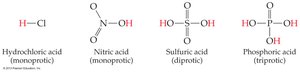
Monoprotic acids: Supply one H+ per molecule (e.g., HCl).
Diprotic acids: Supply two H+ (e.g., H2SO4).
Triprotic acids: Supply three H+ (e.g., H3PO4).
Naming Acids
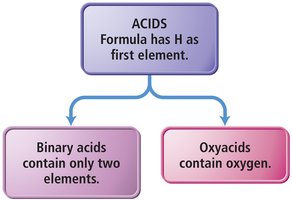
Binary acids: "hydro-" + base name of nonmetal + "-ic acid" (e.g., HCl = hydrochloric acid).
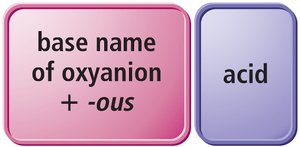
Oxyacids: Based on the polyatomic ion; "-ate" becomes "-ic acid," "-ite" becomes "-ous acid" (e.g., H2SO4 = sulfuric acid, H2SO3 = sulfurous acid).
Acid-Base Titration
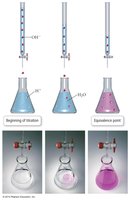
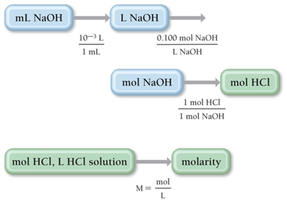
Titration is a technique to determine the concentration of an unknown acid or base by reacting it with a solution of known concentration. The equivalence point is reached when moles of H3O+ equal moles of OH-.
Gas-Evolution Reactions
Types and Examples
Gas-evolution reactions produce a gas either directly or through the decomposition of an intermediate product.
Example (direct):
Example (intermediate):
Oxidation-Reduction (Redox) Reactions
Definitions and Electron Transfer
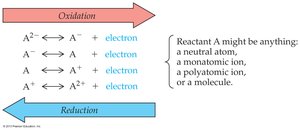
Oxidation: Loss of electrons (increase in oxidation state).
Reduction: Gain of electrons (decrease in oxidation state).
Redox reactions involve the transfer of electrons between species.
Assigning Oxidation States
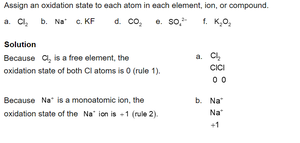
Free elements: Oxidation state = 0.
Monatomic ions: Oxidation state = ion charge.
Sum of oxidation states in a compound = 0; in a polyatomic ion = ion charge.
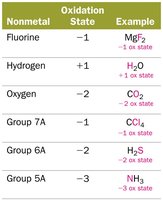
Group 1 metals: +1; Group 2 metals: +2; Nonmetals follow a priority table.
Representing Aqueous Reactions: Molecular, Ionic, and Net Ionic Equations
Types of Equations
Molecular equation: Shows all reactants and products as compounds.
Complete ionic equation: Shows all strong electrolytes as ions.
Net ionic equation: Shows only the species that undergo change, omitting spectator ions.
Example (neutralization):
Molecular:
Net ionic:
Example (redox):
Molecular:
Net ionic:
Classification of Chemical Reactions
Decomposition: A compound breaks into simpler substances (e.g., ).
Combination: Elements or compounds combine to form one compound (e.g., ).
Replacement (Single Displacement): An element replaces another in a compound (e.g., ).
