 Back
BackSolutions and Chemical Kinetics: Exam 2 Study Guide
Study Guide - Smart Notes
 Tailored notes based on your materials, expanded with key definitions, examples, and context.
Solutions
Solubility and "Like Dissolves Like" Principle
The solubility of a substance in a solvent depends on the nature of both the solute and the solvent. The "like dissolves like" principle states that polar solutes dissolve best in polar solvents, while nonpolar solutes dissolve best in nonpolar solvents. Polar and nonpolar substances generally do not mix well due to differences in intermolecular forces.
Polar molecules have uneven charge distribution and interact via dipole–dipole or ion–dipole forces.
Nonpolar molecules interact mainly via dispersion forces.
To predict solubility, identify molecular polarity and the dominant intermolecular forces.
Example: Sodium chloride (NaCl, ionic and polar) dissolves well in water (polar), but not in hexane (nonpolar).
Units of Concentration
Concentration describes the amount of solute in a given quantity of solvent or solution. Several units are used in chemistry, each with specific applications and calculation methods.
Molarity (M):
Molality (m):
Mole fraction (\chi):
Mass percent:
Parts per million (ppm):
Parts per billion (ppb):
These units are used to express concentration in different contexts, such as environmental chemistry (ppm, ppb) or laboratory solutions (molarity, molality).
Unit | Definition | Units |
|---|---|---|
Molarity (M) | amount solute (in mol) / volume solution (in L) | mol/L |
Molality (m) | amount solute (in mol) / mass solvent (in kg) | mol/kg |
Mole fraction (χ) | amount solute (in mol) / total amount of solute and solvent (in mol) | None |
Mass percent (mol %) | amount solute (in mol) / total amount of solute and solvent (in mol) × 100% | % |
Parts by mass | mass solute / mass solution × multiplication factor | — |
Percent by mass (%) | multiplication factor = 100 | % |
Parts per million by mass (ppm) | multiplication factor = 106 | ppm |
Parts per billion by mass (ppb) | multiplication factor = 109 | ppb |
Parts by volume (%/ppm/ppb) | volume solute / volume solution × multiplication factor* | %/ppm/ppb |
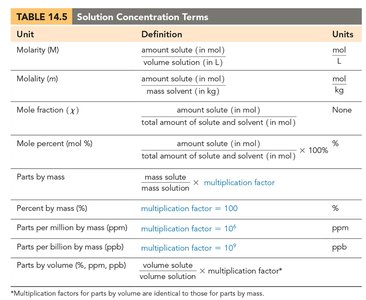
Additional info: Multiplication factors for parts by volume are identical to those for parts by mass.
Ideal Solutions and Raoult’s Law
An ideal solution forms when solute–solvent interactions are similar in strength to solute–solute and solvent–solvent interactions. Raoult’s law describes the vapor pressure of an ideal solution:
Raoult’s Law:
Positive deviation: Occurs when solute–solvent interactions are weaker than those in pure substances, resulting in higher vapor pressure.
Negative deviation: Occurs when solute–solvent interactions are stronger, resulting in lower vapor pressure.
Example: Acetone and hexane show positive deviation; water and ethanol show negative deviation.
Solubility of Gases and Solids
The solubility of gases and solids depends on pressure and temperature:
Gases: Solubility increases with pressure (Henry’s law) and decreases with temperature.
Solids: Solubility is generally unaffected by pressure but increases with temperature (with exceptions).
Henry’s Law:
Example: Carbonated beverages retain more CO2 at higher pressure and lower temperature.
Solubility Curves and Solution Types
Solubility curves show how the solubility of a solid in a liquid changes with temperature. Solubility is often expressed as grams or moles of solute per 100 g of solvent.
Unsaturated solution: Contains less solute than the maximum possible at a given temperature.
Saturated solution: Contains the maximum amount of solute at a given temperature.
Supersaturated solution: Contains more solute than is stable at a given temperature.
Solubility increases with temperature for most solids; exceptions exist.
Example: If a solution contains 40 g of solute at 25°C and the solubility at that temperature is 35 g/100 g solvent, the solution is supersaturated.
Colligative Properties
Colligative properties depend on the number of solute particles, not their identity. These include vapor pressure lowering, boiling point elevation, freezing point depression, and osmotic pressure.
Vapor pressure lowering:
Boiling point elevation:
Freezing point depression:
Osmotic pressure:
Van ’t Hoff factor (i): Accounts for the number of particles produced by a solute in solution (e.g., NaCl produces 2 particles).
Electrolytes produce more particles than nonelectrolytes, affecting colligative properties.
Example: A 1 M NaCl solution will have a greater boiling point elevation than a 1 M glucose solution due to a higher Van ’t Hoff factor.
Chemical Kinetics
Reaction Rates
Chemical kinetics studies the speed of chemical reactions. The rate can be average, instantaneous, or initial, and is calculated from concentration–time data.
Average rate: Change in concentration over a time interval.
Instantaneous rate: Rate at a specific moment, found from the slope of a concentration–time curve.
Initial rate: Rate at the start of the reaction.
Example: If [A] decreases from 0.10 M to 0.08 M in 10 s, average rate = M/s.
Relating Rates of Reactants and Products
The rate of disappearance of reactants and appearance of products is related by the stoichiometry of the balanced equation.
General form:
Rate:
Example: For , rate of disappearance of A is twice the rate of appearance of B.
Reaction Order and Rate Laws
Reaction order describes how the rate depends on reactant concentrations. Zero-, first-, and second-order reactions have distinct characteristics and graphical representations.
Zero-order: Rate is independent of concentration.
First-order: Rate is proportional to concentration.
Second-order: Rate is proportional to the square of concentration or to two reactants. or
Units of k differ: zero-order (M/s), first-order (1/s), second-order (1/M·s).
Example: Plotting [A] vs. time for a first-order reaction yields an exponential decay; ln[A] vs. time is linear.
Integrated Rate Laws and Half-Life
Integrated rate laws allow calculation of concentrations at any time and determination of half-lives.
Zero-order:
First-order:
Second-order:
Half-life (first-order):
Example: For a first-order reaction with s-1, s.
Collision Theory
Collision theory explains how reactions occur at the molecular level. Particles must collide with proper orientation and sufficient energy.
Rate constant (k): Depends on collision frequency (Z), orientation factor (p), and exponential factor.
Arrhenius equation:
Higher temperature and lower activation energy increase reaction rate.
Example: Reactions with complex molecules have lower orientation factors and slower rates.
Arrhenius Equation and Temperature Effects
The Arrhenius equation relates the rate constant to temperature and activation energy. It is used to calculate activation energy, rate constants, or temperature for a given rate.
Arrhenius equation:
Use absolute temperature (Kelvin) and energy units (J/mol).
Example: If and are known at and ,
Reaction Mechanisms, Intermediates, and Catalysts
Reaction mechanisms describe the stepwise process of a reaction. Intermediates are formed and consumed during the reaction, while catalysts participate but are regenerated.
Validating a mechanism: 1) Steps add up to overall reaction; 2) Rate law matches slowest step; 3) Rate law matches experiment.
Intermediates: Produced in one step, consumed in another, not in overall equation.
Catalysts: Added at start, regenerated at end, not in overall equation.
Example: In the reaction , may be an intermediate.
Additional info: For mechanisms where the slow step is not the first, express intermediates in terms of reactant concentrations using preceding steps.
