 Back
BackSolutions and Colligative Properties: Structure, Concentration, and Effects
Study Guide - Smart Notes
 Tailored notes based on your materials, expanded with key definitions, examples, and context.
Solutions and Colligative Properties
Nature of Solutions
Solutions are homogeneous mixtures composed of a solvent (the substance present in the greatest amount) and one or more solutes (substances dissolved in the solvent). The physical state of the solution is typically determined by the solvent. When water is the solvent, the solution is termed aqueous.
Solubility refers to the ability of a solute to dissolve in a solvent.
If a solute does not dissolve, it is termed insoluble.
The solubility of a substance depends on the tendency toward mixing and the types of intermolecular forces present.
Types of Solutions and Solubility
The extent to which substances dissolve depends on their chemical nature and the intermolecular forces involved. "Like dissolves like" is a guiding principle: polar solvents dissolve polar solutes, and nonpolar solvents dissolve nonpolar solutes.
Miscible liquids are mutually soluble in all proportions (e.g., ethanol and water).
Immiscible liquids do not mix (e.g., oil and water).
Solubility varies with temperature and, for gases, with pressure.
Intermolecular Forces in Solutions
Intermolecular forces play a crucial role in the formation and properties of solutions. These forces include dispersion, dipole-dipole, hydrogen bonding, and ion-dipole interactions.
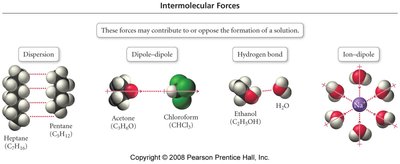
Dispersion forces occur between all molecules, especially nonpolar ones.
Dipole-dipole forces occur between polar molecules.
Hydrogen bonds are a special, strong type of dipole-dipole interaction involving H bonded to N, O, or F.
Ion-dipole forces occur between ionic compounds and polar solvents (e.g., Na+ in water).
Solution Formation and Interactions
When a solution forms, three types of interactions must be considered: solute-solute, solvent-solvent, and solute-solvent. The energy changes associated with breaking and forming these interactions determine whether a solution will form spontaneously.
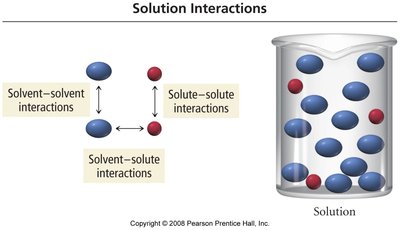
Mixing is favored by entropy (nature's tendency toward disorder).
The enthalpy change of solution formation is given by:
Concentration Units
Molarity (M)
Molarity is the most common unit of concentration in chemistry, defined as moles of solute per liter of solution.
Formula:
Molality (m)
Molality is defined as moles of solute per kilogram of solvent. Unlike molarity, it does not change with temperature because it is based on mass, not volume.
Formula:
Mass Percent and Volume Percent
These units express the concentration as a percentage of the total mass or volume.
Mass percent:
Volume percent:
Mole Fraction (X)
The mole fraction is the ratio of the moles of one component to the total moles in the solution. The sum of all mole fractions in a solution is always 1.
Formula:
Colligative Properties
Definition and Types
Colligative properties are properties of solutions that depend only on the number of solute particles, not their identity. These include vapor pressure lowering, boiling point elevation, freezing point depression, and osmotic pressure.
Vapor Pressure Depression
Boiling Point Elevation
Freezing Point Depression
Osmotic Pressure
Freezing Point Depression
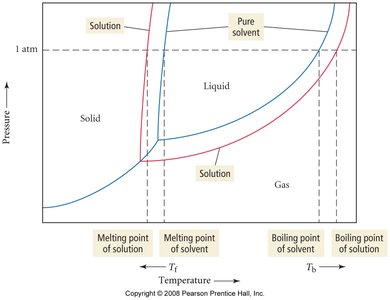
The freezing point of a solution is lower than that of the pure solvent. The change in freezing point is proportional to the molality of the solute and a constant (Kf) specific to the solvent.
Formula:
Kf units: C/m
Boiling Point Elevation
The boiling point of a solution is higher than that of the pure solvent. The change in boiling point is proportional to the molality of the solute and a constant (Kb) specific to the solvent.
Formula:
Kb units: C/m
Osmosis and Osmotic Pressure
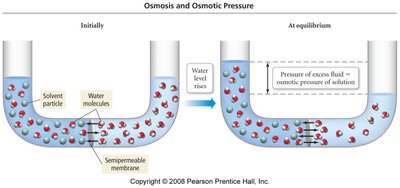
Osmosis is the movement of solvent through a semipermeable membrane from a region of lower solute concentration to higher solute concentration. The pressure required to stop this flow is the osmotic pressure (Π), which is directly proportional to the molarity of the solute particles.
Formula:
Where R = 0.08206 (atm·L)/(mol·K), T is temperature in Kelvin
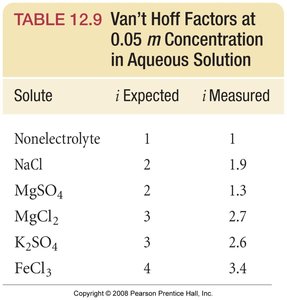
Van't Hoff Factor (i)
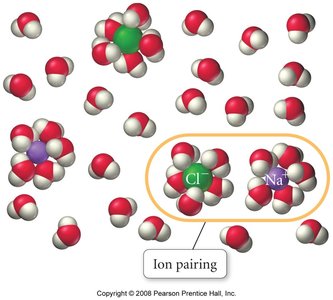
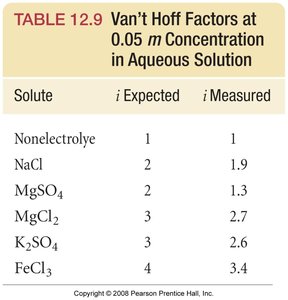
The van't Hoff factor (i) accounts for the number of particles a solute produces in solution. For ionic compounds, i is greater than 1 due to dissociation, but actual values may be lower due to ion pairing.
Formula:
Vapor Pressure Lowering and Raoult's Law
The vapor pressure of a solvent above a solution is lower than that of the pure solvent. Raoult's Law quantifies this effect for ideal solutions.
Formula:
For volatile solutes:
Effect of Dissociation on Colligative Properties
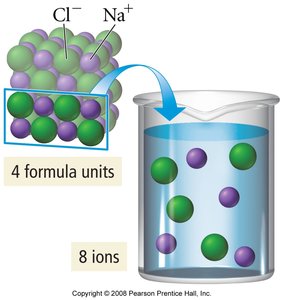
Ionic compounds dissociate into multiple particles, amplifying colligative effects. For example, NaCl dissociates into Na+ and Cl−, doubling the number of particles compared to a nonelectrolyte.
Solubility Limits and Curves
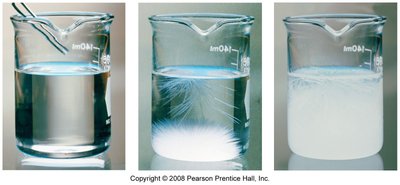
Saturated, Unsaturated, and Supersaturated Solutions
A saturated solution contains the maximum amount of solute that can dissolve at a given temperature. An unsaturated solution contains less than this amount, while a supersaturated solution contains more and is unstable.
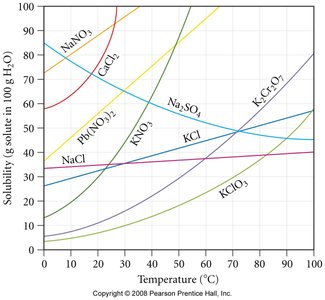
Solubility Curves
Solubility curves show how the solubility of various substances changes with temperature. Most solids become more soluble with increasing temperature, while gases typically become less soluble.
Henry's Law
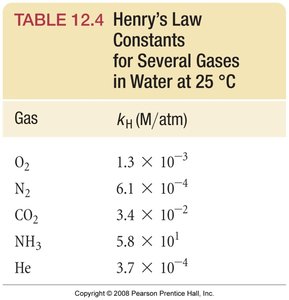
The solubility of a gas in a liquid is directly proportional to its partial pressure above the solution. Henry's Law is expressed as:
Formula:
Where is Henry's Law constant, specific to each gas-solvent pair.
Summary Table: Key Colligative Property Constants
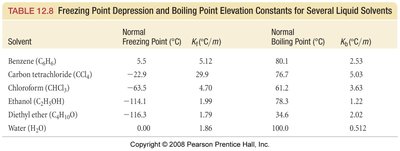
Solvent | Normal Freezing Point (°C) | Kf (°C/m) | Normal Boiling Point (°C) | Kb (°C/m) |
|---|---|---|---|---|
Benzene (C6H6) | 5.5 | 5.12 | 80.1 | 2.53 |
Carbon tetrachloride (CCl4) | -22.9 | 29.9 | 76.7 | 5.03 |
Chloroform (CHCl3) | -63.5 | 4.70 | 61.2 | 3.63 |
Ethanol (C2H5OH) | -114.1 | 1.99 | 78.3 | 1.22 |
Diethyl ether (C4H10O) | -116.3 | 1.79 | 34.6 | 2.02 |
Water (H2O) | 0.0 | 1.86 | 100.0 | 0.512 |
Summary Table: Van't Hoff Factors for Common Solutes
Solute | i Expected | i Measured |
|---|---|---|
Nonelectrolyte | 1 | 1 |
NaCl | 2 | 1.9 |
MgSO4 | 2 | 1.3 |
MgCl2 | 3 | 2.7 |
K2SO4 | 3 | 2.6 |
FeCl3 | 4 | 3.4 |
Summary Table: Henry's Law Constants for Gases in Water at 25°C
Gas | kH (M/atm) |
|---|---|
O2 | 1.3 × 10⁻³ |
N2 | 6.1 × 10⁻⁴ |
CO2 | 3.4 × 10⁻² |
NH3 | 5.8 × 101 |
He | 3.7 × 10⁻⁴ |
Additional info: The above notes integrate and expand upon the provided slides, including definitions, formulas, and tables for clarity and completeness. All images included are directly relevant to the adjacent explanations and reinforce key concepts in solution chemistry and colligative properties.
