 Back
BackSolutions and Their Composition: Concentration, Dilution, and Percent Calculations
Study Guide - Smart Notes
 Tailored notes based on your materials, expanded with key definitions, examples, and context.
Solutions and Their Composition
Molarity and Major Concentration Units
Understanding the concentration of solutions is fundamental in general chemistry. Molarity (M) is the most common concentration unit, defined as the number of moles of solute per liter of solution.
Molarity (M):
Usage: Molarity is used as a conversion factor between the amount of solute and the volume of solution.
Example: If you have 0.5 mol NaCl dissolved in 1.0 L of solution, the molarity is .
Calculating moles from molarity:
Calculating mass from moles:
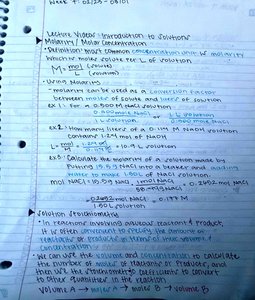
Solution Stoichiometry
Stoichiometry in solutions involves using molarity to relate reactants and products in chemical reactions. This is essential for predicting the outcome of reactions and for laboratory calculations.
Steps:
Write the balanced equation.
Convert volumes to moles using molarity.
Use mole ratios from the equation to relate reactants and products.
Convert moles back to volume or mass as needed.
Example: To calculate the volume of a solution needed to react with another, use the molarity and the stoichiometric coefficients from the balanced equation.
Precipitation Reactions and Solution Calculations
Precipitation Reactions
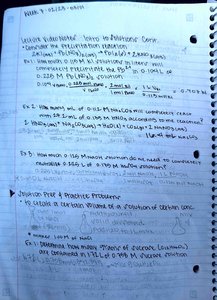
Precipitation reactions occur when two solutions are mixed and an insoluble product (precipitate) forms. Calculating the amount of precipitate requires using molarity and stoichiometry.
Example: Mixing 0.100 M AgNO3 with 0.100 M NaCl produces AgCl as a precipitate. Calculate the moles of AgCl formed using the molarity and volume of each reactant.
Limiting Reactant: The reactant that produces the least amount of product determines the maximum amount of precipitate.
Solution Dilution and Concentration Calculations
Dilution Equation
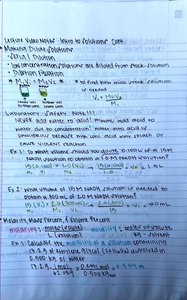
Dilution is the process of reducing the concentration of a solution by adding more solvent. The relationship between the initial and final concentrations and volumes is given by the dilution equation:
Where:
= initial molarity
= initial volume
= final molarity
= final volume
Example: To prepare 250 mL of 0.10 M NaCl from a 1.0 M stock solution, use the equation to find the volume of stock solution needed.
Laboratory Preparation of Solutions
To prepare solutions of a desired concentration, chemists often dilute a more concentrated stock solution. The dilution equation helps determine the volumes required.
Example: If you need 100 mL of 0.5 M HCl from a 2.0 M stock, calculate the volume of stock solution to use.
Percent Concentration Calculations
Mass Percent and Volume Percent
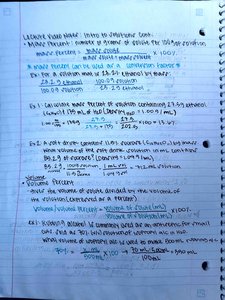
Percent concentration expresses the amount of solute in a solution as a percentage of the total solution mass or volume.
Mass Percent (%):
Volume Percent (%):
Example: If 25 g NaCl is dissolved in 100 g water, the mass percent is .
Parts Per Million (PPM) and Parts Per Billion (PPB)
PPM and PPB Calculations
These units are used for very dilute solutions, especially in environmental chemistry.
PPM:
PPB:
Percent by volume:
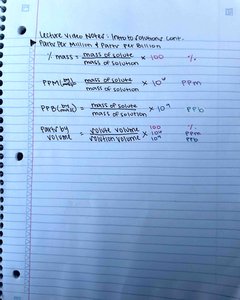
Summary Table: Concentration Units
Unit | Formula | Typical Use |
|---|---|---|
Molarity (M) | General solution concentration | |
Mass Percent (%) | Household and industrial solutions | |
Volume Percent (%) | Liquid mixtures | |
PPM | Trace environmental concentrations | |
PPB | Ultra-trace environmental concentrations |
Additional info:
These notes cover topics from Chapter 6 (Compounds, Solutions, and Their Composition) and Chapter 11 (Solutions and Colligative Properties) in general chemistry.
All calculations and examples are standard for introductory college chemistry courses.
