 Back
BackSolutions and Their Physical Properties: General Chemistry Study Notes
Study Guide - Smart Notes
 Tailored notes based on your materials, expanded with key definitions, examples, and context.
Solutions and Their Physical Properties
Types of Solutions: Some Terminology
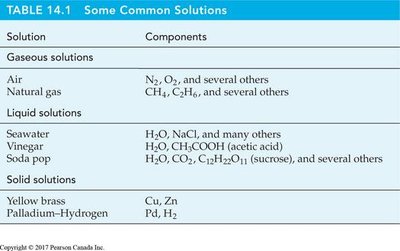
Solutions are homogeneous mixtures composed of two or more substances. The solvent is the component present in the largest amount and determines the physical state of the solution, while solutes are the substances dissolved in the solvent.
Gaseous solutions: Air (N2, O2, etc.), natural gas (CH4, C2H6, etc.)
Liquid solutions: Seawater (H2O, NaCl, etc.), vinegar (H2O, CH3COOH), soda pop (H2O, CO2, C12H22O11)
Solid solutions: Yellow brass (Cu, Zn), palladium-hydrogen (Pd, H2)
Solution Concentration
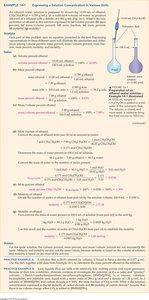
Concentration expresses the amount of solute present in a given quantity of solvent or solution. Common units include:
Percent concentration:
Mass percent (m/m):
Volume percent (v/v):
Mass/volume percent (m/v):
Parts per million (ppm), billion (ppb), trillion (ppt): Used for very dilute solutions.
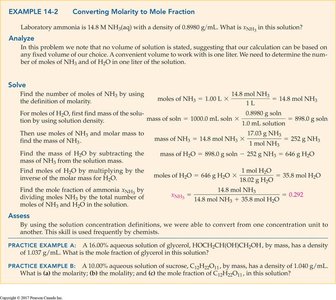
Mole fraction (χ):
Molarity (M):
Molality (m):
Intermolecular Forces and the Solution Process
Enthalpy of Solution
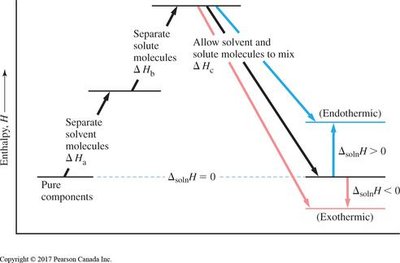
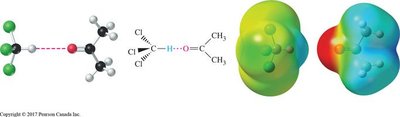
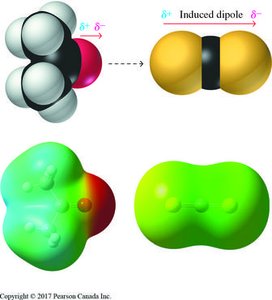
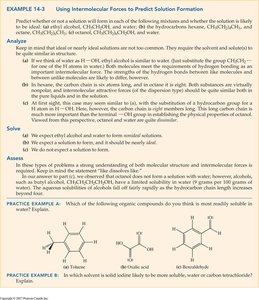
The process of dissolving involves breaking intermolecular forces in both solute and solvent, and forming new interactions. The overall enthalpy change () can be endothermic, exothermic, or zero (ideal solution).
Ideal solution: Intermolecular forces between all components are similar; .
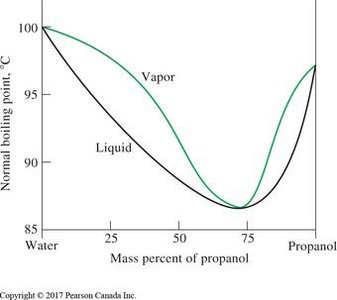
Nonideal solution: If adhesive forces (between different molecules) are stronger than cohesive forces (between like molecules), (exothermic).
Formation of Ionic Solutions
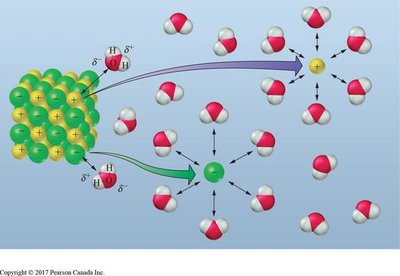
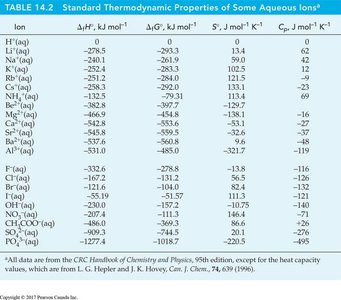
Ionic compounds dissolve in polar solvents like water due to ion-dipole interactions. The enthalpy of solution is the sum of lattice energy (endothermic) and hydration energies (exothermic).
Lattice energy: Energy required to separate ions in a solid.
Hydration energy: Energy released when ions interact with water molecules.
Overall:
Solution Formation and Equilibrium
Saturated, Unsaturated, and Supersaturated Solutions
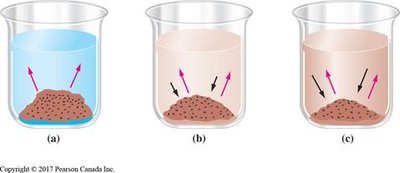
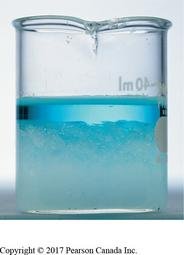
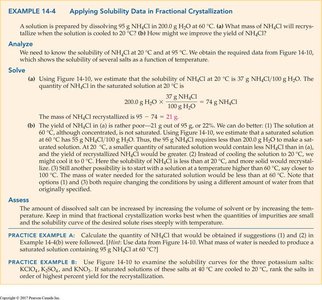
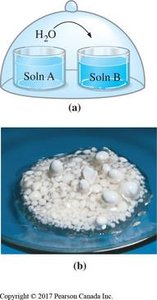
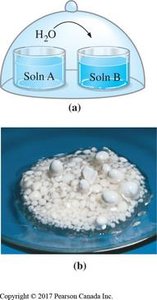
A saturated solution contains the maximum amount of solute at a given temperature. Unsaturated solutions can dissolve more solute, while supersaturated solutions contain more solute than is stable and can precipitate excess solute.
Solubilities of Gases
Temperature and Pressure Effects
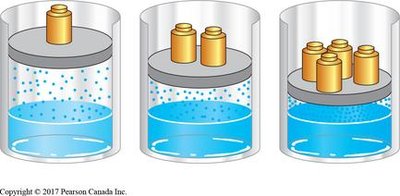
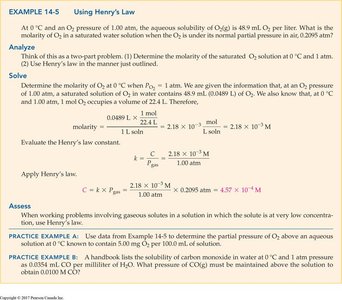
Gas solubility in water decreases with increasing temperature but increases with pressure. Henry's Law quantifies the effect of pressure:
Henry's Law:
Vapor Pressures of Solutions
Raoult's Law
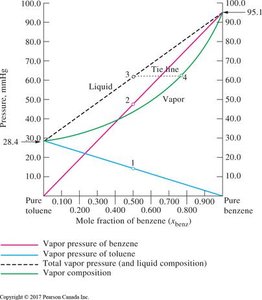
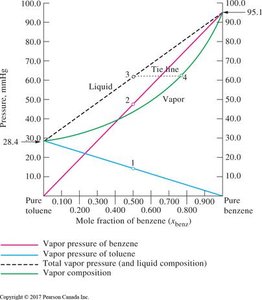
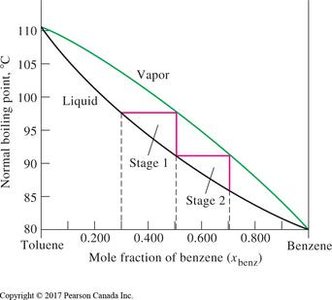
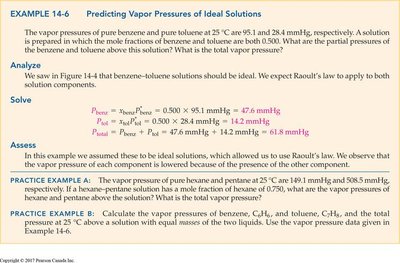
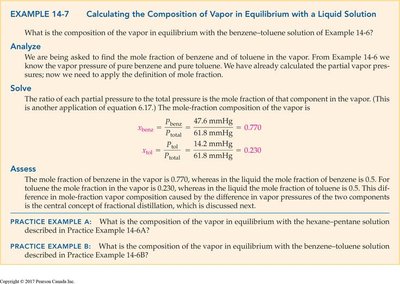
The vapor pressure of a solvent is lowered by the presence of a nonvolatile solute. Raoult's Law describes this effect:
Where is the vapor pressure of component A, is its mole fraction, and is the vapor pressure of pure A.
Osmotic Pressure
Osmosis and Osmotic Pressure
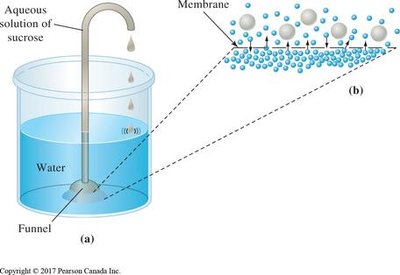
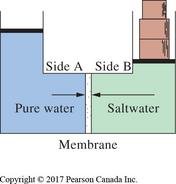
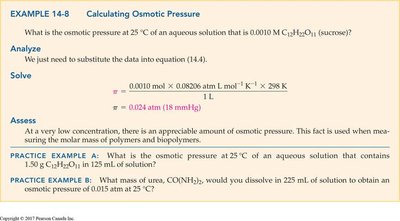
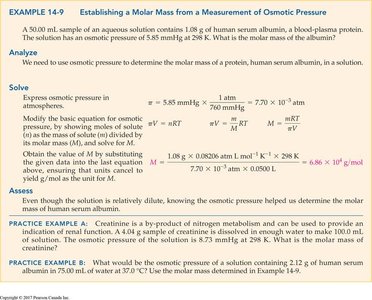
Osmosis is the movement of solvent through a semipermeable membrane from a region of lower solute concentration to higher concentration. The osmotic pressure () is given by:
or
Where is molarity, is the gas constant, and is temperature in Kelvin.
Biological Aspects
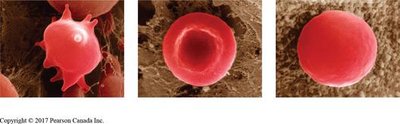
Cells in hypertonic, isotonic, or hypotonic solutions experience water flow that can cause crenation (shrinking) or rupture (lysis).
Hypertonic: Water flows out, cell shrinks.
Isotonic: No net water flow.
Hypotonic: Water flows in, cell swells and may burst.
Phase Changes of Nonelectrolyte Solutions
Colligative Properties: Freezing-Point Depression and Boiling-Point Elevation
The presence of a solute lowers the vapor pressure of a solvent, resulting in boiling point elevation and freezing point depression:
Where and are the freezing and boiling point constants, and is molality.
Solutions of Electrolytes
Van't Hoff Factor and Colligative Properties
Electrolytes dissociate into ions, increasing the number of solute particles and affecting colligative properties. The van't Hoff factor () accounts for this effect:
Colloidal Mixtures
Properties of Colloids
Colloids are mixtures with particle sizes between 1 and 1000 nm. They can remain suspended indefinitely and exhibit unique properties such as the Tyndall effect (scattering of light).
Examples: Milk, fog, gels
Increasing ionic strength can cause coagulation or precipitation of colloidal particles.
