 Back
BackSolutions and Their Properties: A Comprehensive Study Guide
Study Guide - Smart Notes
 Tailored notes based on your materials, expanded with key definitions, examples, and context.
Solutions: Introduction and Basic Concepts
Definition and Components of Solutions
Solutions are homogeneous mixtures composed of two or more substances. The substance present in the largest amount is called the solvent, while the other substances are called solutes. Solutions can exist in various phases, including gas, liquid, and solid.
Solvent: The component present in the greatest amount (by moles).
Solute: The component(s) present in lesser amounts.
Homogeneous mixture: Uniform composition throughout.
Heterogeneous mixture: Non-uniform composition; different phases are visible.
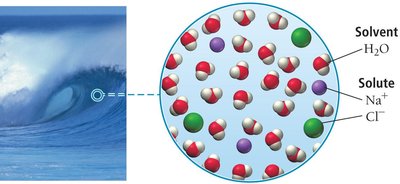
Example: Seawater is a solution where water is the solvent and salts (such as NaCl and MgCl2) are the solutes.
Common Types of Solutions
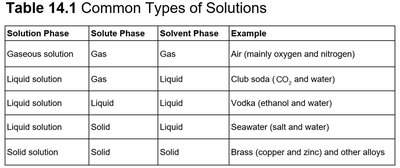
Solutions can be classified based on the physical states of their solute and solvent. The following table summarizes common types of solutions:
Solution Phase | Solute Phase | Solvent Phase | Example |
|---|---|---|---|
Gas | Gas | Gas | Air (mainly oxygen and nitrogen) |
Liquid | Gas | Liquid | Club soda (CO2 and water) |
Liquid | Liquid | Liquid | Vodka (ethanol and water) |
Liquid | Solid | Liquid | Seawater (salt and water) |
Solid | Solid | Solid | Brass (copper and zinc) and other alloys |
Formation of Solutions
Spontaneous Mixing and Entropy
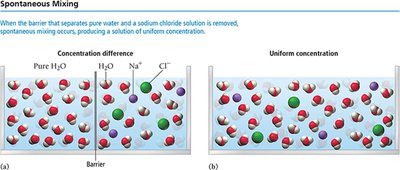
When solutions with different solute concentrations come into contact, they spontaneously mix to form a uniform distribution of solute. This process is driven by entropy, the tendency of energy to disperse and spread out over as large a volume as possible.
Entropy: A measure of energy dispersal in a system; mixing increases entropy.
Gases always mix spontaneously due to entropy, but liquids require favorable intermolecular interactions as well.
Intermolecular Forces in Solution Formation
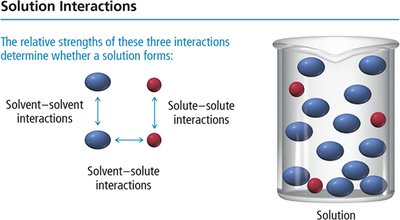
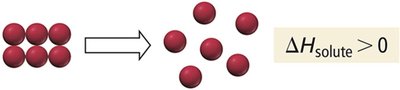
The formation of a solution depends on the balance of intermolecular forces between solute and solvent particles. Three types of interactions must be considered:
Solute-solute interactions: Must be overcome (endothermic process).
Solvent-solvent interactions: Must be overcome (endothermic process).
Solvent-solute interactions: Must be favorable for mixing (exothermic process).
The overall enthalpy change for solution formation is given by:
If the energy released in forming solvent-solute interactions is greater than the energy required to break solute-solute and solvent-solvent interactions, the process is exothermic. Otherwise, it is endothermic.
Solubility and Miscibility
Solubility is the maximum amount of solute that can dissolve in a given amount of solvent at a specific temperature and pressure. Two liquids that are mutually soluble are called miscible; if not, they are immiscible.
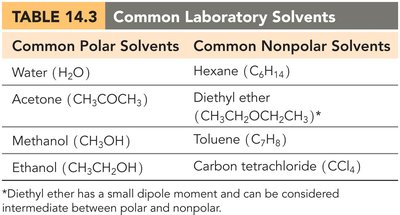
"Like dissolves like": Polar solutes dissolve in polar solvents; nonpolar solutes dissolve in nonpolar solvents.
Solubility depends on temperature, pressure (for gases), and the nature of intermolecular forces.
Common Polar Solvents | Common Nonpolar Solvents |
|---|---|
Water (H2O) | Hexane (C6H14) |
Acetone (CH3COCH3) | Diethyl ether (CH3CH2OCH2CH3) |
Methanol (CH3OH) | Toluene (C7H8) |
Ethanol (CH3CH2OH) | Carbon tetrachloride (CCl4) |
Solution Equilibrium and Saturation
Saturated, Unsaturated, and Supersaturated Solutions
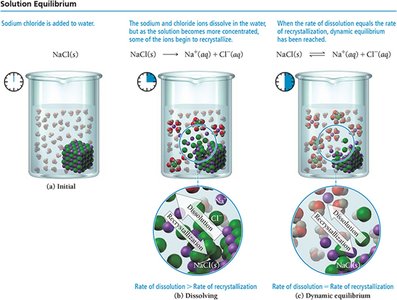
When a solute dissolves in a solvent, an equilibrium is established between dissolution and recrystallization. The solution can be:
Saturated: Contains the maximum amount of solute at equilibrium; excess solute remains undissolved.
Unsaturated: Contains less solute than the equilibrium amount; more solute can dissolve.
Supersaturated: Contains more solute than the equilibrium amount; unstable and can precipitate solute if disturbed.
Temperature and Pressure Effects on Solubility
The solubility of solids generally increases with temperature (if dissolution is endothermic), while the solubility of gases decreases with increasing temperature. For gases, solubility increases with increasing pressure.
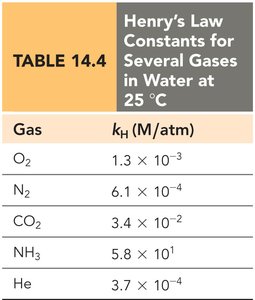
Henry's Law: The solubility of a gas in a liquid is directly proportional to the partial pressure of the gas above the solution.
Where is the solubility, is Henry's Law constant, and is the partial pressure of the gas.
Concentration Units
Molarity (M), Molality (m), and Other Units
Concentration expresses the amount of solute in a given amount of solution or solvent. Common units include:
Molarity (M): Moles of solute per liter of solution.
Molality (m): Moles of solute per kilogram of solvent.
Percent by mass: (mass of solute / mass of solution) × 100%
Parts per million (ppm): (mass of solute / mass of solution) × 106
Parts per billion (ppb): (mass of solute / mass of solution) × 109
Mole fraction (X): Moles of component / total moles in solution (unitless)
Mole percent: Mole fraction × 100%
Example: To prepare a 1 m solution of NaCl, dissolve 1 mole (58.44 g) of NaCl in 1 kg of water.
Colligative Properties
Definition and Types
Colligative properties depend on the number of solute particles in solution, not their identity. These properties include:
Vapor pressure lowering
Boiling point elevation
Freezing point depression
Osmotic pressure
Vapor Pressure Lowering and Raoult's Law
Adding a nonvolatile solute to a solvent lowers the solvent's vapor pressure. Raoult's Law quantifies this effect:
Where is the vapor pressure of the solution, is the mole fraction of the solvent, and is the vapor pressure of the pure solvent.
Boiling Point Elevation and Freezing Point Depression
Adding solute increases the boiling point and decreases the freezing point of a solvent. The changes are given by:
(Boiling point elevation)
(Freezing point depression)
Where is the van't Hoff factor (number of particles the solute dissociates into), and are the boiling and freezing point constants, and is the molality.
Osmotic Pressure
Osmotic pressure () is the pressure required to stop the flow of solvent into a solution through a semipermeable membrane. It is given by:
Where is the molarity, is the gas constant, and is the temperature in Kelvin.
Mixtures and Colloids
Types of Mixtures
Mixtures can be classified as solutions, colloids, or suspensions:
Solutions: Homogeneous, do not separate on standing.
Colloids: Heterogeneous, do not separate on standing, show Tyndall effect.
Suspensions: Heterogeneous, separate on standing.
Summary
Solutions are homogeneous mixtures driven by intermolecular forces and entropy.
Solubility depends on the similarity of intermolecular forces, temperature, and pressure (for gases).
Concentration can be expressed in various units, including molarity, molality, percent, ppm, and mole fraction.
Colligative properties depend on the number of dissolved particles and include vapor pressure lowering, boiling point elevation, freezing point depression, and osmotic pressure.
Electrolytes dissociate in solution, increasing the number of particles and the magnitude of colligative effects.
