 Back
BackSolutions and Their Properties: Structure, Formation, and Concentration
Study Guide - Smart Notes
 Tailored notes based on your materials, expanded with key definitions, examples, and context.
Solutions and Their Properties
Introduction to Solutions
Solutions are homogeneous mixtures composed of two or more substances with uniform composition. The study of solutions is fundamental in chemistry, as many chemical reactions and processes occur in solution. Understanding the properties, formation, and concentration of solutions is essential for predicting and controlling chemical behavior.
Types of Solutions
Common Types of Solutions
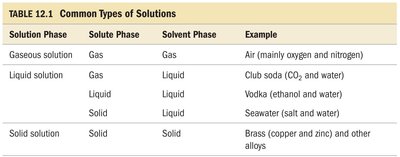
Solutions can exist in various phases depending on the physical states of the solute and solvent. The following table summarizes the main types:
Solution Phase | Solute Phase | Solvent Phase | Example |
|---|---|---|---|
Gaseous solution | Gas | Gas | Air (mainly oxygen and nitrogen) |
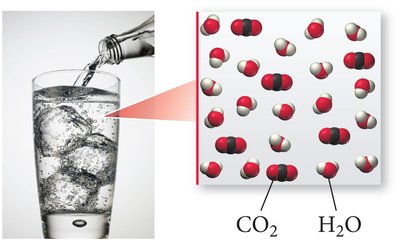
Liquid solution | Gas | Liquid | Club soda (CO2 and water) |
Liquid solution | Liquid | Liquid | Vodka (ethanol and water) |
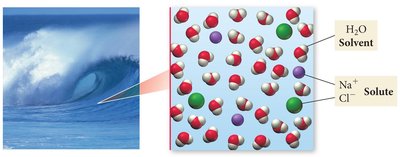
Liquid solution | Solid | Liquid | Seawater (salt and water) |
Solid solution | Solid | Solid | Brass (copper and zinc) and other alloys |
Examples of Solutions
Seawater: A homogeneous mixture of salts (mainly NaCl) dissolved in water.
Club soda: Carbon dioxide gas dissolved in water.
Brass: A solid solution of copper and zinc.
Solution Formation and Mixing
Spontaneous Mixing and Homogeneity
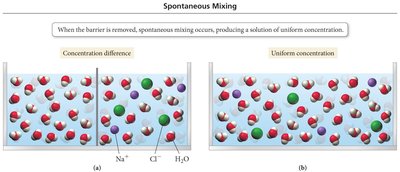
When solutions with different solute concentrations come into contact, they spontaneously mix to form a uniform distribution of solute throughout the solution. This process is driven by the natural tendency toward increased entropy (disorder) in the system.
Osmosis and Biological Relevance
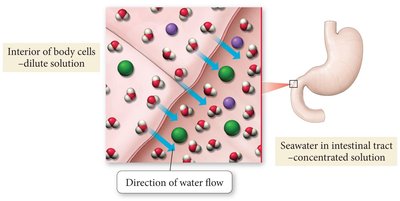
Osmosis is the movement of solvent (usually water) through a semipermeable membrane from a region of lower solute concentration to a region of higher solute concentration. This process is crucial in biological systems, such as the movement of water in and out of cells. For example, drinking seawater causes dehydration because the high salt concentration outside cells draws water out of the cells, leading to cell shrinkage and dehydration.
Solution Concentration Units
Describing Solution Concentration
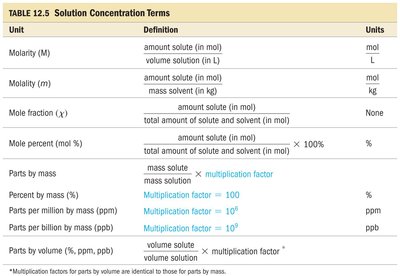
The concentration of a solution describes the amount of solute present in a given amount of solution or solvent. Several units are commonly used:
Unit | Definition | Units |
|---|---|---|
Molarity (M) | amount solute (mol) / volume solution (L) | mol/L |
Molality (m) | amount solute (mol) / mass solvent (kg) | mol/kg |
Mole fraction (χ) | amount solute (mol) / total amount (mol) | None |
Percent by mass (%) | mass solute / mass solution × 100 | % |
Parts per million (ppm) | mass solute / mass solution × 106 | ppm |
Parts per billion (ppb) | mass solute / mass solution × 109 | ppb |
Molarity (M)
Molarity is defined as the number of moles of solute per liter of solution. It is the most common unit for expressing solution concentration in chemistry laboratories.
Formula:

Parts Per Million (PPM)
PPM is used for very dilute solutions and expresses the amount of solute per one million parts of solution.
Formula:
For aqueous solutions, 1 mg/L ≈ 1 ppm.


Preparation of Standard Solutions
Steps in Preparing a Standard Solution
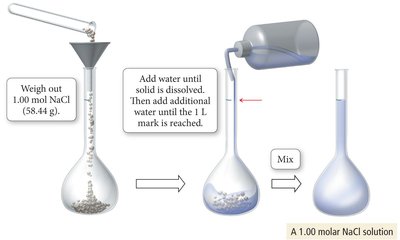
A standard solution has a precisely known concentration. The preparation involves:
Weighing the exact amount of solute.
Dissolving the solute in a small volume of solvent.
Transferring the solution to a volumetric flask and diluting to the desired final volume.
Energetics and Intermolecular Forces in Solution Formation
Intermolecular Forces
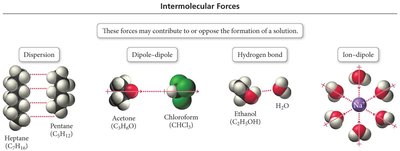
The formation of solutions depends on the types and strengths of intermolecular forces (IMFs) between solute and solvent particles. The main types of IMFs include dispersion forces, dipole-dipole interactions, hydrogen bonding, and ion-dipole interactions.
Energetics of Solution Formation
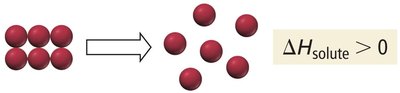
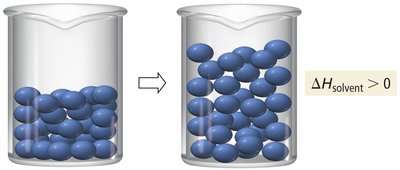
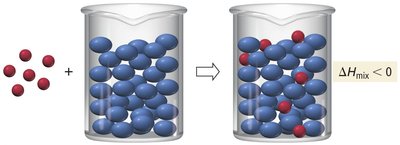
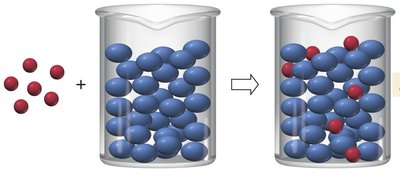
Solution formation involves three main steps:
Separating solute particles (endothermic, )
Separating solvent particles (endothermic, )
Mixing solute and solvent particles (exothermic, )
The overall enthalpy change is:
Relative Interactions and Solution Formation
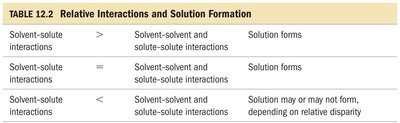
The likelihood of solution formation depends on the relative strengths of solute-solute, solvent-solvent, and solute-solvent interactions:
Solvent-solute interactions | Relative to | Result |
|---|---|---|
> | Solvent-solvent and solute-solute interactions | Solution forms |
= | Solvent-solvent and solute-solute interactions | Solution forms |
< | Solvent-solvent and solute-solute interactions | Solution may or may not form, depending on disparity |
Solubility and Saturation
Solubility Limits
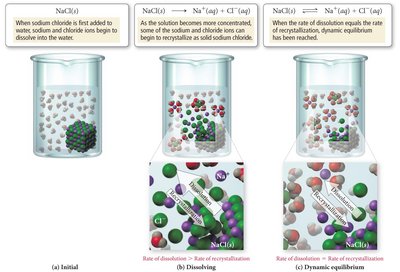
Solubility is the maximum amount of solute that can dissolve in a given amount of solvent at a specific temperature and pressure. Solutions can be:
Saturated: Contains the maximum amount of dissolved solute; additional solute will not dissolve.
Unsaturated: Contains less solute than the saturation point; more solute can dissolve.
Supersaturated: Contains more solute than the saturation point; unstable and solute may precipitate out.
Summary Table: Solution Concentration Terms
Unit | Definition | Units |
|---|---|---|
Molarity (M) | amount solute (mol) / volume solution (L) | mol/L |
Molality (m) | amount solute (mol) / mass solvent (kg) | mol/kg |
Mole fraction (χ) | amount solute (mol) / total amount (mol) | None |
Percent by mass (%) | mass solute / mass solution × 100 | % |
Parts per million (ppm) | mass solute / mass solution × 106 | ppm |
Parts per billion (ppb) | mass solute / mass solution × 109 | ppb |
Additional info: This guide covers the essential aspects of solution chemistry, including types, formation, energetics, and concentration units, with relevant examples and visual aids for enhanced understanding.
