 Back
Solutions, Electrolytes, Acids, Bases, and Reactions: General Chemistry Study Notes
Study Guide - Smart Notes
 Tailored notes based on your materials, expanded with key definitions, examples, and context.
Solutions and Their Properties
Parts of a Solution
A solution is a homogeneous mixture composed of two or more substances. The solute is the substance being dissolved, while the solvent is the substance doing the dissolving. In most cases, water acts as the solvent. When a solute dissolves, solvent particles surround individual solute particles, resulting in a uniform mixture.
Solute: Substance that is dissolved (e.g., sugar in water).
Solvent: Substance that dissolves the solute (e.g., water in sugar-water solution).
Solution: Homogeneous mixture of solute and solvent.
Example: In lemonade, sugar is the solute, water is the solvent, and the mixture is the solution.
Making Solutions and Calculations
Preparing solutions of a specific concentration often requires calculations involving molarity, mass, and volume. Molarity (M) is defined as moles of solute per liter of solution.
Molarity formula:
Example Calculation: To prepare a 0.650 M solution of NaF using 24.8 g of NaF:
Find moles:
Find volume:
Mass/Volume Percent:
Volume Percent:
Electrolytes and Types of Solutes
Electrolytes
Electrolytes are substances that conduct electricity when dissolved in water due to the presence of ions. There are three types of solutes based on their ability to conduct electricity:
Strong Electrolytes: Completely dissociate into ions (e.g., ionic compounds like CaCl2).
Weak Electrolytes: Partially dissociate into ions (e.g., weak acids like HF).
Non-Electrolytes: Do not produce ions (e.g., covalent compounds like glucose).
Types of Liquid Mixtures and Solutions in Biological Context
Types of Solutions in Relation to Cells
Solutions can be classified based on their solute concentration relative to that inside a cell:
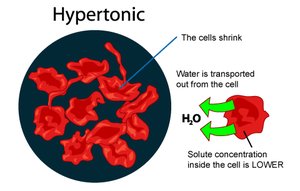
Hypertonic Solution: Higher solute concentration than the cell; water leaves the cell, causing crenation (shrinking).
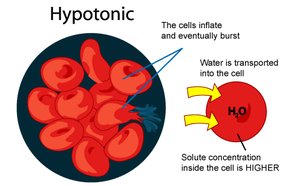
Hypotonic Solution: Lower solute concentration than the cell; water enters the cell, causing lysis (bursting).
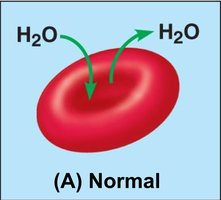
Isotonic Solution: Equal solute concentration; no net water movement.
Solubility and Its Factors
Solubility
Solubility is the maximum amount of solute that can dissolve in a given amount of solvent at a specific temperature. The phrase "like dissolves like" means polar solutes dissolve in polar solvents, and non-polar solutes dissolve in non-polar solvents.
Saturated Solution: Contains the maximum amount of dissolved solute.
Unsaturated Solution: Contains less than the maximum amount of dissolved solute.
Temperature Effects on Solubility
Solid Solutes: Solubility increases with temperature.
Gas Solutes: Solubility decreases with temperature.
Example: More sugar dissolves in hot water; carbonated drinks lose gas faster when warm.
Acids, Bases, and pH
Acids and Bases
Acids generate H+ ions in solution, are often sour, and can be corrosive. Bases generate OH- ions, are bitter, slippery, and can also be caustic. Both come in strong and weak forms.
Strong Acids: Completely ionize in solution (e.g., HBr, HCl, HNO3).
Weak Acids: Partially ionize (e.g., HF).
Strong Bases: Ionic hydroxides that completely dissociate (e.g., NaOH, KOH).
Weak Bases: Partially react with water to produce OH- (e.g., F-).
Conjugate Acid-Base Pairs
A conjugate acid-base pair consists of two species that differ by one proton (H+). The conjugate base of a weak acid is a weak base, and vice versa.
pH Scale
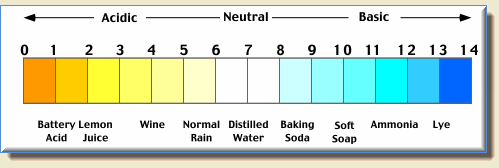
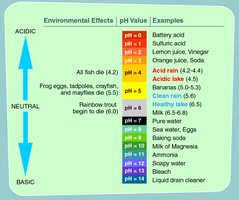
The pH scale measures the acidity or basicity of a solution. It is a logarithmic scale:
pH < 7: Acidic
pH = 7: Neutral
pH > 7: Basic
Each unit change represents a tenfold change in H+ concentration.
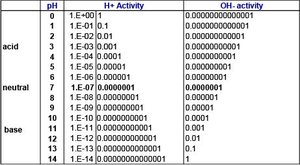
pH | H+ Activity | OH- Activity |
|---|---|---|
0 | 1 | 0.00000000000001 |
7 | 0.0000001 | 0.0000001 |
14 | 0.00000000000001 | 1 |
Additional info: Table shows the inverse relationship between H+ and OH- as pH changes. | ||
Buffers
Buffer Solutions
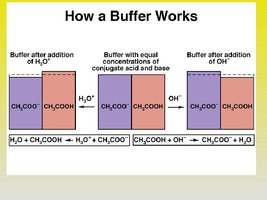
Buffers are solutions containing a weak acid and its conjugate base. They resist changes in pH when small amounts of acid or base are added, which is crucial for maintaining stable pH in biological systems.
Example: Human blood maintains a pH of 7.35–7.45 using buffers.
Acid-Base Reactions
Neutralization Reactions
A neutralization reaction occurs when an acid reacts with a base to produce a salt and water.
General equation:
Example:
Acids with Carbonates and Metals
Acid + Carbonate/Bicarbonate: Produces carbon dioxide, water, and a salt.
Example:
Acid + Metal: Produces a salt and hydrogen gas.
Example:
Summary Table: Common Acid-Base Reactions
Compound | Chemical Formula | Chemical Reaction |
|---|---|---|
Aluminum hydroxide | Al(OH)3 | Al(OH)3 + 3 HCl → AlCl3 + 3 H2O |
Calcium carbonate | CaCO3 | CaCO3 + 2 HCl → CaCl2 + H2O + CO2 |
Magnesium carbonate | MgCO3 | MgCO3 + 2 HCl → MgCl2 + H2O + CO2 |
Magnesium hydroxide | Mg(OH)2 | Mg(OH)2 + 2 HCl → MgCl2 + 2 H2O |
Sodium bicarbonate | NaHCO3 | NaHCO3 + HCl → NaCl + H2O + CO2 |
