 Back
BackSolutions: Properties, Formation, and Concentration
Study Guide - Smart Notes
 Tailored notes based on your materials, expanded with key definitions, examples, and context.
Solutions
Definition and Examples
Solutions are homogeneous mixtures of two or more substances, where the components are distributed uniformly at the molecular or ionic level. The solvent is the majority component, and the solute is the minority component. Common examples include seawater, air, and club soda.
Solvent: The substance present in the largest amount (e.g., water in seawater).
Solute: The substance dissolved in the solvent (e.g., sodium chloride in seawater).
Solutions can be solid, liquid, or gas phases, and can involve combinations such as gas in liquid, solid in liquid, etc.
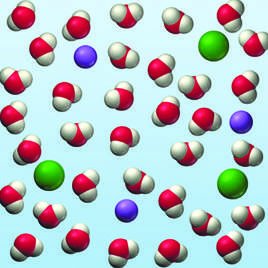
Additional info: In some mixtures, such as water and ethanol in equal amounts, the distinction between solute and solvent is not meaningful.
Why Solutions Form
Solutions form due to the natural tendency toward spontaneous mixing and entropy (energy dispersal). Unless energetically unfavorable, substances tend to mix to form uniform solutions.
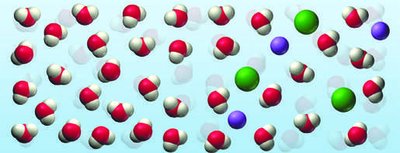
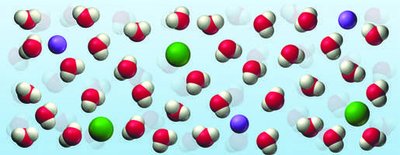
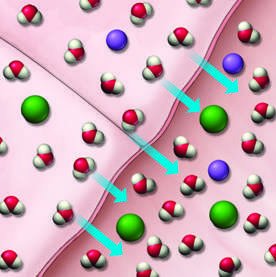
When a barrier between pure water and a sodium chloride solution is removed, the two mix spontaneously, resulting in a uniform concentration.
Osmosis and Biological Relevance
Seawater is a concentrated solution that draws water out of body cells due to osmosis, leading to dehydration if consumed. This is because water moves from areas of lower solute concentration (inside cells) to higher solute concentration (seawater in the intestine).
Types of Solutions and Solubility
Types of Solutions
Solutions can be classified by the phases of their solute and solvent:
Solution Phase | Solute Phase | Solvent Phase | Example |
|---|---|---|---|
Gaseous | Gas | Gas | Air (O2 and N2) |
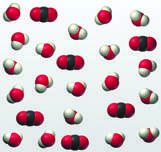
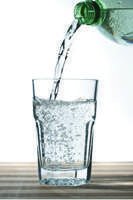
Liquid | Gas | Liquid | Club soda (CO2 in water) |
Liquid | Liquid | Liquid | Vodka (ethanol and water) |
Liquid | Solid | Liquid | Seawater (salt in water) |
Solid | Solid | Solid | Brass (copper and zinc) |
Solubility
Solubility is the amount of solute that will dissolve in a given amount of solvent at a specific temperature. It depends on the tendency toward mixing (entropy) and the types of intermolecular forces present.
Water dissolves ionic and polar substances well, but not nonpolar substances like grease.
"Like dissolves like": Polar solvents dissolve polar/ionic solutes; nonpolar solvents dissolve nonpolar solutes.
Energetics of Solution Formation
Enthalpy Changes in Solution Formation
The formation of a solution involves three steps, each with an associated enthalpy change:
Separating solute particles (endothermic, $\Delta H_{solute} > 0$)
Separating solvent particles (endothermic, $\Delta H_{solvent} > 0$)
Mixing solute and solvent particles (exothermic, $\Delta H_{mix} < 0$)
The overall enthalpy change is:
$\Delta H_{soln} = \Delta H_{solute} + \Delta H_{solvent} + \Delta H_{mix}$
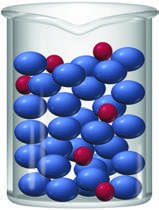
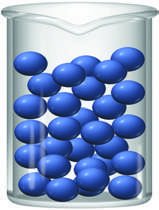
Additional info: If the sum of the endothermic steps is less than the exothermic step, the process is exothermic; if greater, it is endothermic.
Heat of Hydration
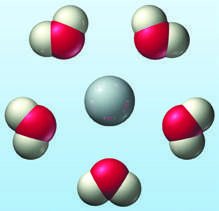
For ionic compounds in water, the combined enthalpy of solvent separation and mixing is called the heat of hydration ($\Delta H_{hydration}$), which is always negative due to strong ion-dipole interactions.
Solution Equilibrium and Factors Affecting Solubility
Dynamic Equilibrium
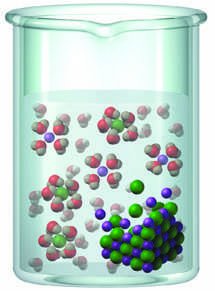
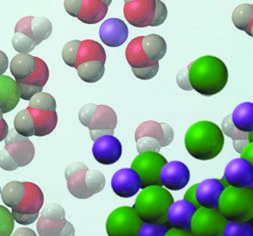
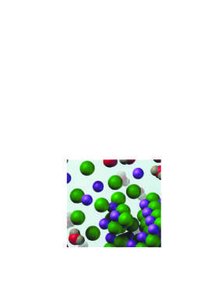
When a solute dissolves in a solvent, it eventually reaches dynamic equilibrium, where the rate of dissolution equals the rate of recrystallization. At this point, the solution is saturated. If more solute is added, it will not dissolve. If less than the equilibrium amount is present, the solution is unsaturated. Supersaturated solutions contain more than the equilibrium amount and are unstable.
Temperature and Solubility
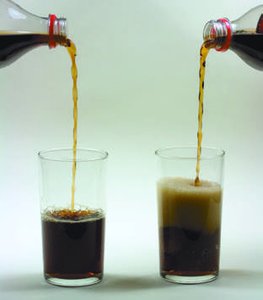
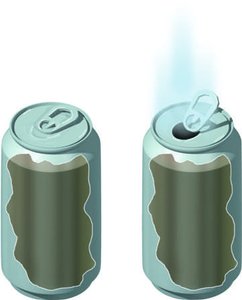
The solubility of most solids in water increases with temperature, while the solubility of gases decreases with temperature. Pressure also affects gas solubility: higher pressure increases gas solubility in liquids (Henry's Law).
$S_{gas} = k_H P_{gas}$
where $S_{gas}$ is the solubility, $k_H$ is Henry's law constant, and $P_{gas}$ is the partial pressure of the gas.
Expressing Solution Concentration
Common Units
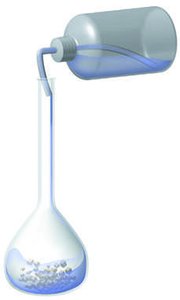
Molarity (M): $\text{M} = \frac{\text{mol solute}}{\text{L solution}}$
Molality (m): $\text{m} = \frac{\text{mol solute}}{\text{kg solvent}}$
Percent by mass: $\% = \frac{\text{mass solute}}{\text{mass solution}} \times 100$
Parts per million (ppm): $\text{ppm} = \frac{\text{mass solute}}{\text{mass solution}} \times 10^6$
Mole fraction (x): $x_{solute} = \frac{n_{solute}}{n_{solute} + n_{solvent}}$
Colligative Properties
Vapor Pressure Lowering
The addition of a nonvolatile solute to a solvent lowers the vapor pressure of the solution compared to the pure solvent. This is described by Raoult's Law:
$P_{solution} = x_{solvent} P^\circ_{solvent}$
The decrease in vapor pressure is proportional to the mole fraction of the solute:
$\Delta P = x_{solute} P^\circ_{solvent}$
Freezing Point Depression and Boiling Point Elevation
Adding a solute lowers the freezing point and raises the boiling point of a solvent. The changes are given by:
$\Delta T_f = m K_f$
$\Delta T_b = m K_b$
where $m$ is molality, $K_f$ is the freezing point depression constant, and $K_b$ is the boiling point elevation constant.
Osmosis and Osmotic Pressure
Osmosis is the flow of solvent from a region of lower solute concentration to higher solute concentration through a semipermeable membrane. The pressure required to stop this flow is the osmotic pressure ($\Pi$):
$\Pi = MRT$
where $M$ is molarity, $R$ is the gas constant, and $T$ is temperature in Kelvin.
Colligative Properties of Electrolyte Solutions
For electrolytes, the number of particles in solution is greater due to dissociation. The van't Hoff factor ($i$) accounts for this:
$i = \frac{\text{moles of particles in solution}}{\text{moles of formula units dissolved}}$
Colligative property equations are modified as:
$\Delta T_f = i m K_f$
$\Delta T_b = i m K_b$
$\Pi = i M R T$
Colloids
Definition and Properties
A colloid is a mixture where the dispersed particles are intermediate in size between those in solutions and suspensions (1 nm to 1000 nm). Colloids scatter light (Tyndall effect) and remain dispersed due to Brownian motion and electrostatic repulsion.
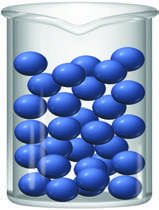
Micelles and Soap
Soap forms micelles in water, with nonpolar tails inward and ionic heads outward, allowing the colloid to remain stable and interact with water.
Summary Table: Types of Solutions
Type | Solute | Solvent | Example |
|---|---|---|---|
Gas in Gas | O2 | N2 | Air |
Gas in Liquid | CO2 | H2O | Club soda |
Solid in Liquid | NaCl | H2O | Seawater |
Solid in Solid | Zn | Cu | Brass |
