 Back
Backchem exam 4 (ch12)-Solutions: Properties, Types, and Concentrations
Study Guide - Smart Notes
 Tailored notes based on your materials, expanded with key definitions, examples, and context.
Solutions
Definition and Components
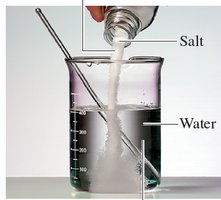
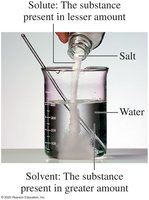
Solutions are homogeneous mixtures composed of two or more substances. The substance present in the smaller amount is called the solute, while the substance present in the greater amount is the solvent. The solute is uniformly dispersed throughout the solvent, resulting in a single phase.
Solute: The substance dissolved in the solvent (e.g., salt in water).
Solvent: The substance that dissolves the solute (e.g., water in a saltwater solution).
Solutions can be solid, liquid, or gas.
Properties of Solutes in Solutions
Solutes are not visible and cannot be separated by filtration.
Solutes can be separated by evaporation.
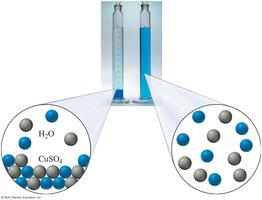
Solutes may impart color to a solution (e.g., copper(II) sulfate in water).
Types of Solutes and Solvents
Solutes and solvents can be gases, liquids, or solids, leading to various types of solutions (e.g., air, saltwater, brass).
Solute–Solvent Interactions
Polarity and Solubility
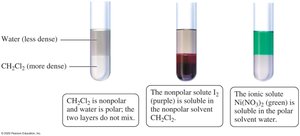
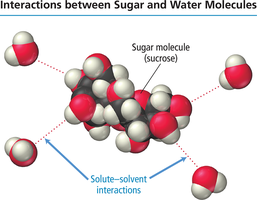
The formation of a solution depends on the attractive forces between solute and solvent particles. The rule "like dissolves like" means that polar solutes dissolve in polar solvents, and nonpolar solutes dissolve in nonpolar solvents.
Polar solvents (like water) dissolve ionic and polar solutes.
Nonpolar solvents (like CH2Cl2) dissolve nonpolar solutes.
Formation of Solutions
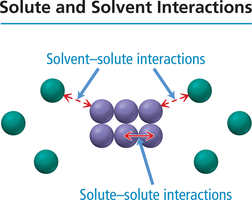
When a solute dissolves, the attractive forces between solute and solvent must be strong enough to overcome the forces holding the solute particles together and those holding the solvent molecules together.
Dissolution of Ionic Compounds
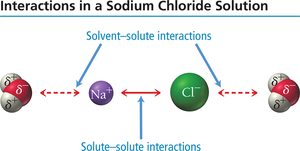
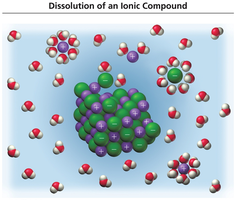
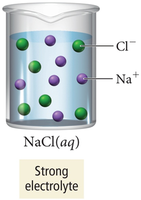
For ionic compounds like NaCl, the attraction between the ions and water molecules (hydration) must overcome the ionic lattice energy. Each ion becomes surrounded by water molecules, resulting in a solution of free-moving ions.
Electrolytes and Nonelectrolytes
Definitions and Properties
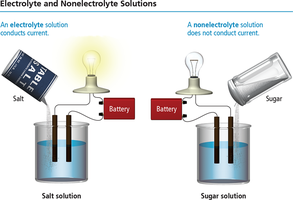
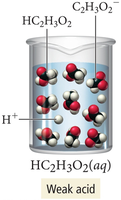
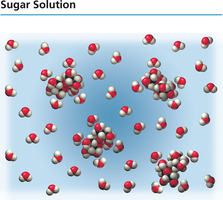
Substances that dissolve in water to form ions and conduct electricity are called electrolytes. Those that dissolve as molecules and do not conduct electricity are nonelectrolytes.
Strong electrolytes: Completely dissociate into ions (e.g., NaCl).
Weak electrolytes: Partially dissociate, producing some ions and mostly molecules (e.g., acetic acid).
Nonelectrolytes: Do not produce ions (e.g., sugar).
Examples and Equations
Strong electrolyte:
Weak electrolyte:
Nonelectrolyte:
Solubility
Definition and Factors Affecting Solubility
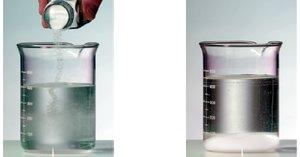
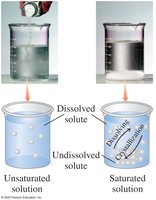
Solubility is the maximum amount of solute that can dissolve in a specific amount of solvent at a given temperature. Solutions can be unsaturated (more solute can dissolve) or saturated (no more solute dissolves; excess remains undissolved).
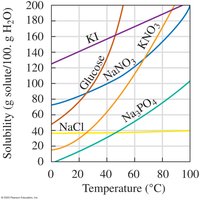
Solubility is usually expressed as grams of solute per 100 grams of solvent.
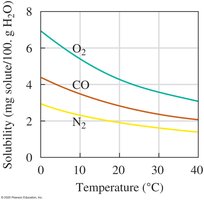
Temperature affects solubility: for most solids, solubility increases with temperature; for gases, it decreases.

Soluble and Insoluble Ionic Compounds
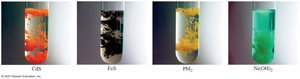
Ionic compounds that dissolve in water are called soluble salts; those that do not are insoluble salts.
Solution Concentrations
Concentration Expressions
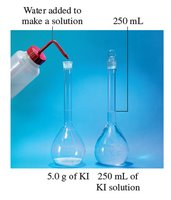
The concentration of a solution is the amount of solute dissolved in a specific amount of solution. Common units include mass percent, volume percent, mass/volume percent, and molarity.
Mass percent (m/m):
Volume percent (v/v):
Mass/volume percent (m/v):
Molarity (M):

Sample Calculations
To calculate mass percent:
To calculate molarity:
Dilution of Solutions
Concept and Calculation
Dilution is the process of adding solvent to a solution to decrease its concentration. The amount of solute remains constant before and after dilution. The relationship is given by:
, where is concentration and is volume.
Example: To prepare 1000 mL of 35.0% (m/v) dextrose from 50.0% (m/v) stock, use .
Summary Table: Classification of Solutes in Aqueous Solutions
Type | Behavior in Water | Electrical Conductivity | Example |
|---|---|---|---|
Strong Electrolyte | Completely dissociates into ions | Conducts well | NaCl |
Weak Electrolyte | Partially dissociates | Conducts weakly | Acetic acid |
Nonelectrolyte | No ions formed | Does not conduct | Sucrose |
Key Equations
Mass percent:
Volume percent:
Mass/volume percent:
Molarity:
Dilution:
